If You're Curious About These Questions...
You should listen to this audiobook
- Did you know that many behaviors we once thought were uniquely human—from using complex tools to having sex for pleasure—are actually widespread across the animal kingdom?
- Have you ever wondered what the single, most defining characteristic is that truly separates us from every other creature on Earth?
- Are you curious about how the latest breakthroughs in genetics and archaeology are completely rewriting the history of what it means to be a human being?
Listen to The Book of Humans — Free Audiobook
Loading player...
Key Takeaways from The Book of Humans
- Discover why human specialness is surprisingly marginal, and how the behaviors we share with animals all but eclipse the traits that separate us.
- Understand the evolutionary paradox of tool use, and learn how our distinctly large brains and nimble fingers allowed human technology to surpass all other species.
- Learn how remarkable animals like dolphins and crows utilize cultural transmission to socially teach complex, non-genetic survival skills to their young.
- Find out how the human invention of agriculture fundamentally altered our DNA, triggering a timely genetic mutation that allowed us to digest milk into adulthood.
- Realize that humans are surprisingly late to the agricultural game by exploring how leaf-cutter ants have been successfully farming fungus for 60 million years.
Learning Tools
Reinforce what you learned from The Book of Humans
Mind Map
The Book of Humans
The Human Paradox+
Tool Use+
Skill Transmission+
Agriculture+
Sexuality+
DNA & Evolution+
Speech & Language+
Behavioral Modernity+
Quiz — Test Your Understanding
Question 1 of 8
Why are human tools significantly more advanced than those used by other animals?
Question 2 of 8
What does the behavior of crows recognizing human faces and bottlenose dolphins using sea sponges illustrate?
Question 3 of 8
According to the text, how did the advent of agriculture directly impact human biology?
Question 4 of 8
Which of the following is cited as evidence that humans are not the world's only farmers?
Question 5 of 8
How do many scientists typically react to the prevalence of non-reproductive sex acts in the animal kingdom?
Question 6 of 8
How does the text describe the random DNA mutations that drive biological evolution?
Question 7 of 8
What is described as the essential prerequisite to 'behavioral modernity' in humans?
Question 8 of 8
What does the discovery of 64,000-year-old cave paintings in northern Spain suggest?
The Book of Humans — Full Chapter Overview
- 1Recommendation
- 2Animals use tools, yet human tools are far more advanced.
- 3Only a few animals gain skills via biological and cultural transmission.
- 4Agriculture built the foundation of modern human society, yet humans still aren’t the world’s only farmers.
- 5Humans have separated sex from reproduction, and we aren’t the only ones.
- 6DNA is the primary driver of biological evolution.
- 7Human speech and language distinguish us from all other animals.
- 8Human behavioral modernity is defined by imagination, abstract thought, and the remarkable ability to create art.
The Book of Humans Summary & Overview
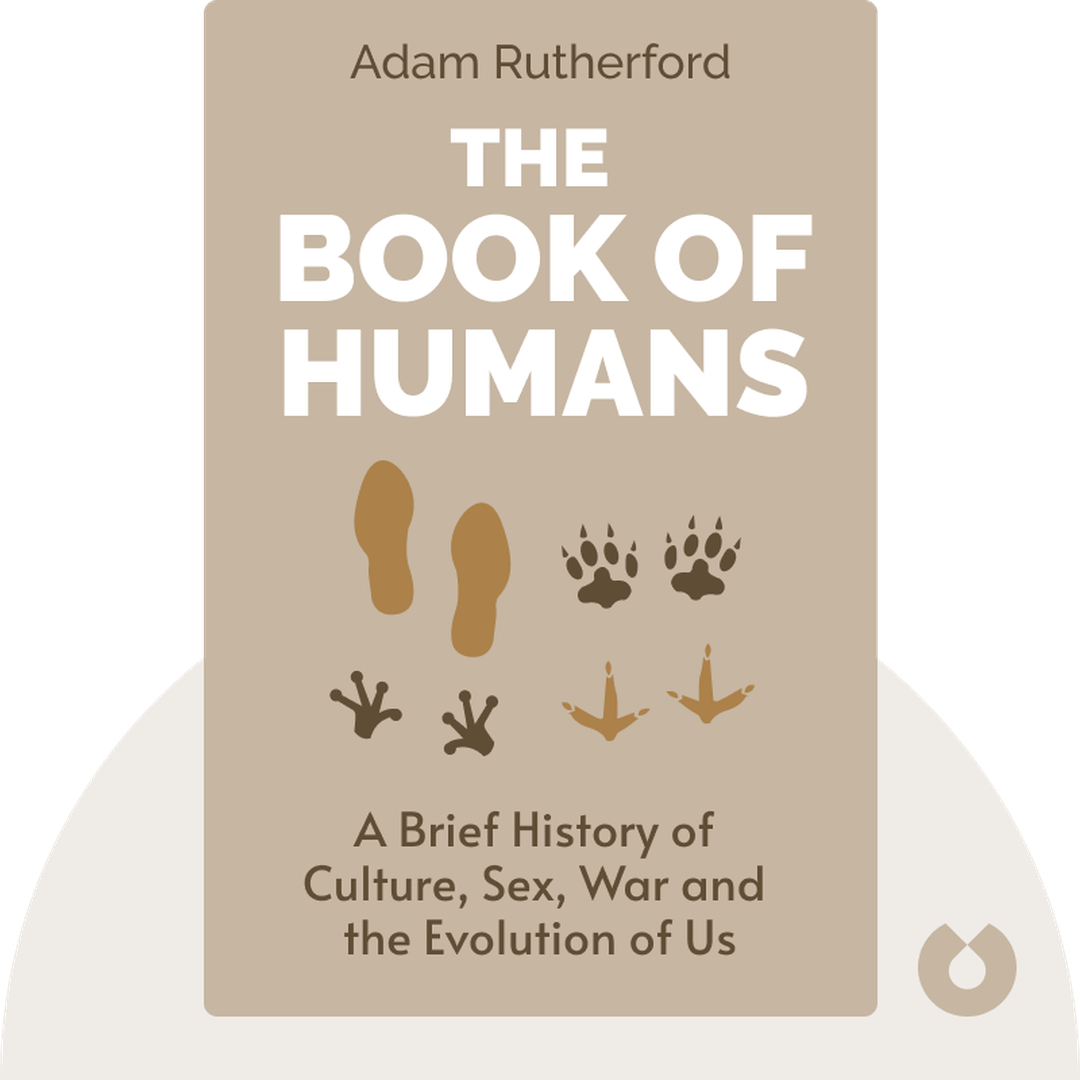
The Book of Humans (2018) is an accessible tour of evolutionary history. It illuminates both the many qualities we share with animals and the many others that set us apart. Incorporating the latest scientific discoveries from genetics and archaeology, it provides a thrilling compendium of the rich variety of life on Earth.
Who Should Listen to The Book of Humans?
- People seeking a primer on evolutionary biology
- Darwin enthusiasts
- Animal lovers
Books Similar to The Book of Humans
Readers who enjoyed this also liked these titles.