If You're Curious About These Questions...
You should listen to this audiobook
- Have you ever wondered how a physically weak, hairless ape managed to outlast stronger human species and eventually dominate the entire planet?
- Did you know that the secret to our global cooperation lies in a unique human ability to believe in things that don't actually exist?
- Are you curious about whether the transition from hunting to farming was actually history’s biggest mistake?
Listen to Sapiens — Cinematic Audio Edition
Loading player...
Key Takeaways from Sapiens
- Understand how the evolutionary need for long-term childhood care hardwired our ancient brains to prioritize social connections and relationships for survival.
- Discover why our unique ability to create and believe in collective fictions—such as money, nations, and human rights—united our species and granted us supremacy over the planet.
- Learn how modern behavioral struggles, like the inability to resist overeating high-calorie foods, are actually survival mechanisms inherited directly from our hunter-gatherer DNA.
- Recognize the hidden costs of the Agricultural Revolution and how humanity's pursuit of luxury and an easier life accidentally trapped us in a cycle of endless work and stress.
- Realize that systemic inequalities and discrimination are not based on biological facts, but are instead enduring societal myths perpetuated by arbitrary historical events.
Learning Tools
Reinforce what you learned from Sapiens
Mind Map
Sapiens
Early Humans & Cognitive Revolution+
The Agricultural Revolution+
The Unification of Humankind+
The Scientific Revolution & Capitalism+
Modernity and Human Experience+
The Future of Sapiens+
Quiz — Test Your Understanding
Question 1 of 10
According to the text, what was the relationship between early Homo sapiens and other human species?
Question 2 of 10
What does Yuval Noah Harari argue is the primary reason Homo sapiens are able to cooperate flexibly in large numbers?
Question 3 of 10
How did the Agricultural Revolution affect the daily lives of early Homo sapiens?
Question 4 of 10
Why did Homo sapiens originally invent money and writing around 3,000 BC?
Question 5 of 10
What role did religion play in the expansion and maintenance of early empires?
Question 6 of 10
During the Scientific Revolution, why did European kings and emperors heavily fund scientists and explorers?
Question 7 of 10
According to the text, what is currently the most powerful global cultural norm, largely inherited from European imperialism?
Question 8 of 10
How does the text describe the level of violence in our modern, globalized world compared to the past?
Question 9 of 10
What do psychologists' subjective well-being questionnaires reveal about human happiness throughout history?
Question 10 of 10
What does the text suggest is the likely future for Homo sapiens?
Sapiens — Full Chapter Overview
- 1Recommendation
- 2Though not the first humans, Homo sapiens supplanted every other human species worldwide in the end.
- 3The Cognitive Revolution gave Homo sapiens mental and linguistic abilities that enabled them to dominate the entire world.
- 4A capacity for complex language gave Homo sapiens key advantages, helping them expand widely and prosper.
- 5In the Agricultural Revolution, humans shifted from foraging to farming, triggering explosive growth in population overall.
- 6To make trade work across large communities, humans created money and writing systems.
- 7The rise of empires and religion steered humanity toward a path of global unification.
- 8The Scientific Revolution modernized humanity, opening paths to new technologies, imperialism, and accelerated economic growth.
- 9Our global society, anchored by faith in capitalism’s power, remains a lasting legacy of far-reaching European imperialism today.
- 10Humanity has never been more peaceful than in these globalized times.
- 11History is not inherently good or bad, and its twists largely matter little to our individual happiness overall.
- 12In time, Homo sapiens will surpass biological limits, ultimately transforming itself into a wholly new species entirely.
Sapiens Summary & Overview
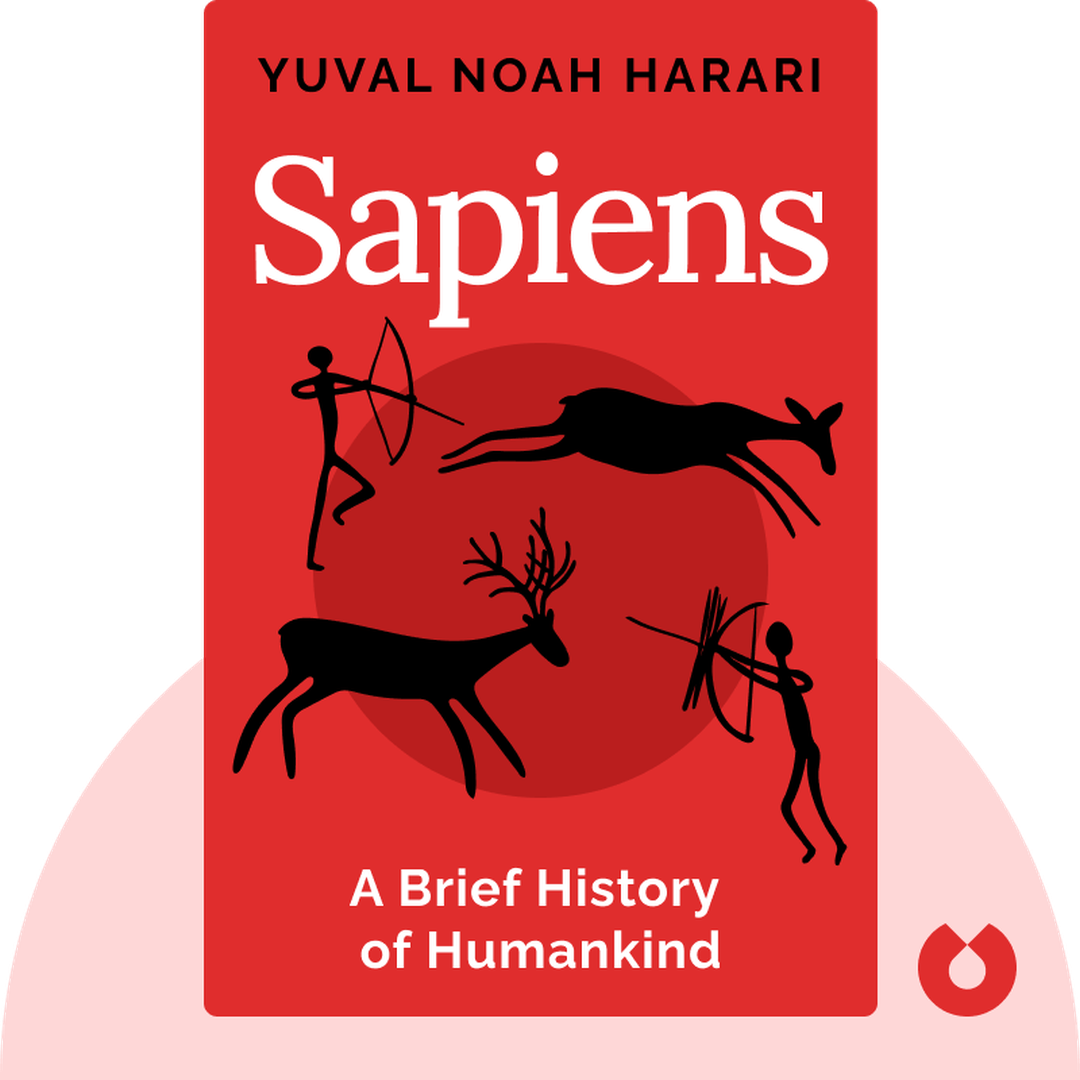
Sapiens (2015) traces the evolution of our species – from the rise of our most ancient ancestors to our current place in the modern, technological age. How have we, a species of hairless, tailless ape, managed to completely dominate the entire planet? These blinks show you the developments and trends that have allowed Homo sapiens to rise to the top.
Who Should Listen to Sapiens?
- People curious about why our species – Homo sapiens – came to rule the world
- Those who want to know how humans ended up living in a capitalist world community
- Anyone curious to discover the beginnings of human society and culture
Books Similar to Sapiens
Readers who enjoyed this also liked these titles.