If You're Curious About These Questions...
You should listen to this audiobook
- Have you ever wondered why using logic during an argument often makes the other person even more irrational?
- What if you could stay perfectly calm and in control while the person you’re talking to is in 'crazy mode'?
- What’s the secret to getting through to someone who seems completely unreachable, whether it's a defiant teenager or a difficult colleague?
Listen to Talking to Crazy — Free Audiobook
Loading player...
Key Takeaways from Talking to Crazy
- Understand how acknowledging your own moments of irrationality enables you to empathize with others and keep your cool when they lash out.
- Discover why arguing with an irrational person never works, and learn to identify their specific emotional triggers to guide them back to reality.
- Master the strategy of stepping into an irrational person's headspace by accepting their distorted reality first, rather than instantly fighting them with logic.
- Learn to defuse power struggles by temporarily yielding control or preemptively voicing the other person's complaints, while still setting clear personal boundaries.
- Find out how to bypass a person's outer 'crazy wrapper' and connect with their inner sanity by redirecting their focus to mundane topics until they calm down.
Learning Tools
Reinforce what you learned from Talking to Crazy
Mind Map
Talking to Crazy
Understanding 'Crazy'+
Core De-escalation Tactics+
Managing Power Struggles+
Connecting with Inner Sanity+
Handling Specific Behaviors+
Relationships & Family+
Clinical Mental Illness+
Quiz — Test Your Understanding
Question 1 of 10
What is the critical first step in reducing irrational or 'crazy' behavior in yourself and dealing with it in others?
Question 2 of 10
According to the book, what is the most effective initial response when someone goes into 'crazy mode'?
Question 3 of 10
Why do people often snap into crazy, irrational behavior during a conflict?
Question 4 of 10
How does the author suggest you connect with the 'sane person on the inside' when someone is screaming at you?
Question 5 of 10
When dealing with manipulative behavior, such as a person trying to drive a wedge between two friends, what is a recommended strategy?
Question 6 of 10
What counterintuitive strategy does the book recommend for dealing with a know-it-all or narcissistic person?
Question 7 of 10
What does it mean to become your partner’s 'sponsor' in a relationship?
Question 8 of 10
If your partner completely shuts down and refuses to communicate, what technique should you use to jump-start the conversation?
Question 9 of 10
According to the text, what is the limit of using these empathy and communication techniques?
Question 10 of 10
When a person is in 'crazy mode,' why does the author suggest looking at their left eye?
Talking to Crazy — Full Chapter Overview
- 1Recommendation
- 2Acknowledge that everyone, yourself included, can sometimes behave or simply be a little crazy.
- 3When someone goes into crazy mode, try to identify the trigger and truly empathize with them.
- 4Never get into a power struggle with a crazy person; instead, do empathize and set boundaries.
- 5Don’t yell at the crazy on the outside; instead, try to calmly connect with the sane person within.
- 6Manipulators are frequently driven by disappointment or anger, so help them to process it.
- 7Catch narcissistic and sarcastic people off-guard with surprising behavior or witty remarks.
- 8Respect and work with your partner, even when you’re breaking up. Do it for the kids!
- 9When a loved one shuts down and refuses to communicate, try voicing your partner’s thoughts instead.
- 10Someone with a genuine mental illness truly needs professional help; you cannot handle this alone.
Talking to Crazy Summary & Overview
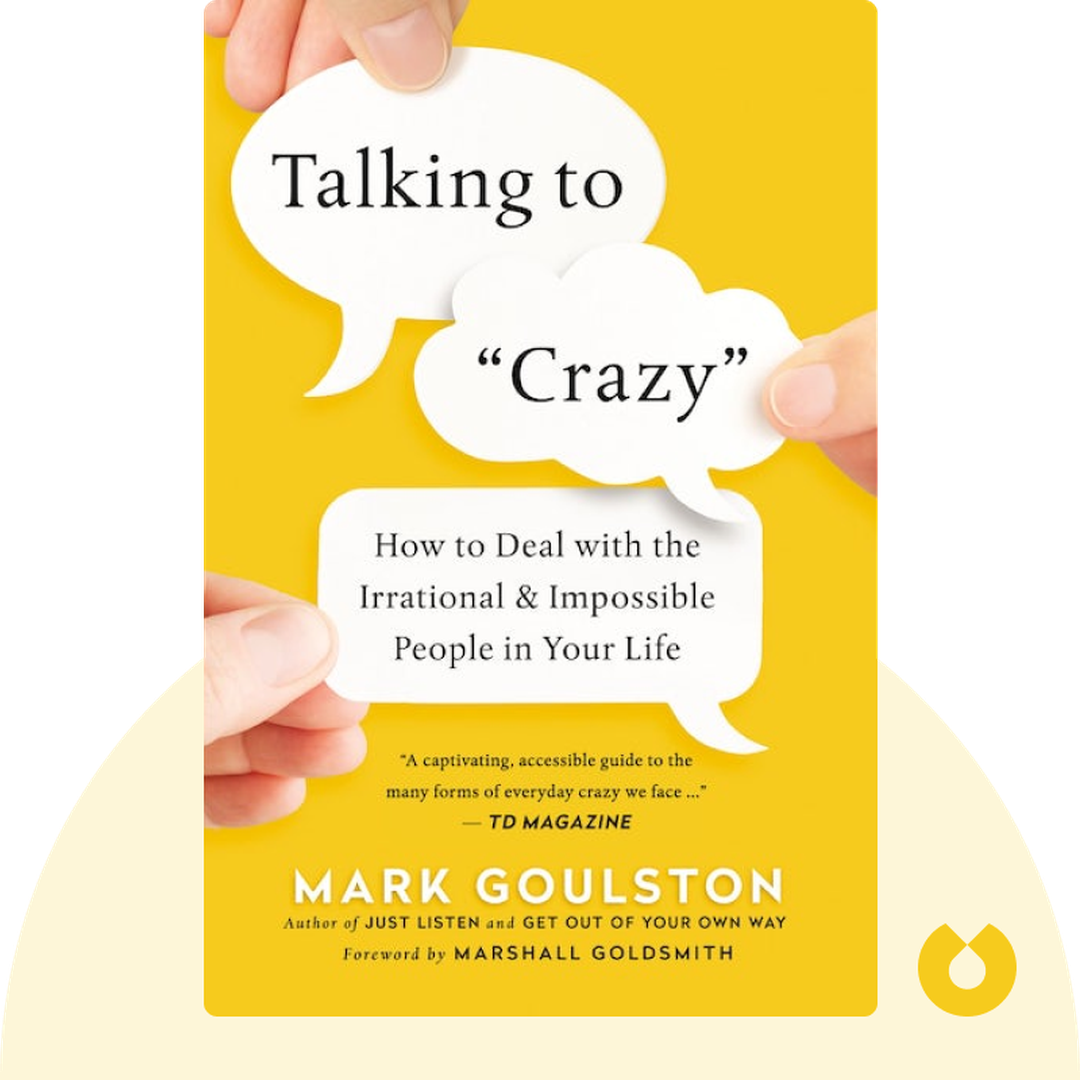
Talking to Crazy (2015) acknowledges that each person has the potential to be a little crazy, giving into irrational behavior when the mood strikes. These blinks offer sound advice on how to empathize and communicate with a person in “crazy mode” so you can keep yourself from going off the deep end, too.
Who Should Listen to Talking to Crazy?
- People with anger management issues
- Anyone struggling with constructive communication in a relationship
- Parents and teachers dealing with young adults
Books Similar to Talking to Crazy
Readers who enjoyed this also liked these titles.