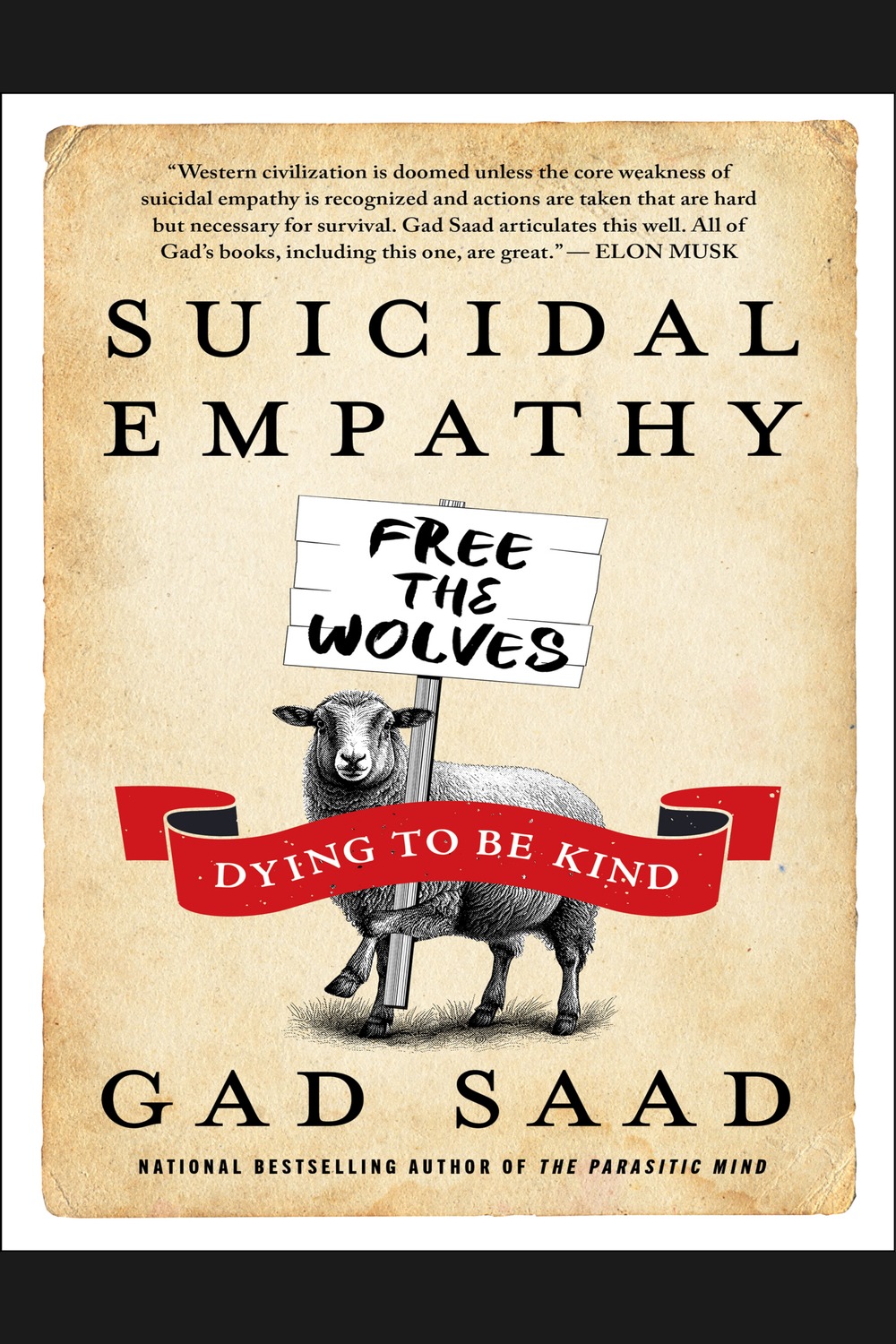
Suicidal Empathy: Dying to Be Kind
If You're Curious About These Questions...
You should listen to this audiobook
- Have you ever wondered why there’s an "inverted-U" curve for empathy—and how having too much of it might actually invite manipulation or even threaten a society's survival?
- What if the desire to protect people’s feelings is actually blinding us to the truth? Are you curious about the hidden costs of "epistemological empathy" and how it might be reshaping our schools and media?
- Did you know that "trade-off neglect" can turn well-intentioned policies into social disasters? What if you could use a simple "empathy audit" to reveal who really bears the cost when we prioritize emotional reassurance over measurable results?
Listen to Suicidal Empathy: Dying to Be Kind — Cinematic Audio Edition
Key Takeaways from Suicidal Empathy: Dying to Be Kind
- Recognize that empathy operates on an inverted-U curve, where excessive, unbounded compassion ignores consequences and invites manipulation instead of providing genuine help.
- Evaluate compassionate decisions by their complete pattern of real-world consequences rather than the good intentions or the moral status they grant the giver.
- Preserve personal agency by resisting the urge to blame every human failure on external environments, a practice that erases individual accountability.
- Protect objective truth from 'epistemological empathy,' a dangerous trend where institutions suppress scientific evidence and factual reality simply to avoid offending marginalized groups.
- Apply a 'cultural theory of mind' when evaluating cross-cultural policies, recognizing that kindness offered by one culture may be interpreted as weakness by another.
Learning Tools
Reinforce what you learned from Suicidal Empathy: Dying to Be Kind
Mind Map
Quiz — Test Your Understanding
Suicidal Empathy: Dying to Be Kind — Full Chapter Overview
- 1Recommendation
- 2When a Virtue Loses Its Aim
- 3The Map Beneath Compassion
- 4Truth on Trial
- 5The Stranger at the Gate
- 6The Victim Disappears
- 7The Price Hidden Behind Consensus
- 8Merit at the Altar
- 9The State That Cares Too Much
- 10Compassion With a Compass
Suicidal Empathy: Dying to Be Kind Summary & Overview
Suicidal Empathy presents Gad Saad’s argument that a valuable human emotion can become socially harmful when it is excessive, indiscriminate, or directed toward the wrong target. Drawing on evolutionary psychology, behavioral science, political commentary, historical episodes, and contemporary controversies, Saad distinguishes what he calls adaptive empathy from compassion that neglects consequences, personal agency, reciprocity, and risk.
The book applies this framework to free inquiry, immigration and assimilation, criminal justice, pandemic policy, climate activism, transgender policy, diversity initiatives, taxation, welfare systems, and military readiness. Its examples and rhetoric are frequently partisan, polemical, and disputed, so the central analytical lesson is best approached critically: good intentions do not remove the need to examine evidence, opportunity costs, competing rights, and long-term outcomes. Saad closes with practical safeguards, including resisting emotionally gratifying reactions, tracing downstream effects, recognizing statistical patterns without erasing individuals, demanding reciprocity, and directing compassion toward both visible and overlooked victims.
Who Should Listen to Suicidal Empathy: Dying to Be Kind?
- Listeners interested in evolutionary psychology, empathy, altruism, and moral decision-making.
- Readers examining conservative critiques of progressive institutions and public policy.
- Anyone willing to evaluate a provocative argument while separating its core framework from its partisan examples.
Books Similar to Suicidal Empathy: Dying to Be Kind
Readers who enjoyed this also liked these titles.