If You're Curious About These Questions...
You should listen to this audiobook
- Have you ever wondered why the world's most complex problems—from managing a global team to losing weight—are often best solved with just a handful of simple rules?
- What’s the secret to Tina Fey’s creative success, and how can applying a few basic "rules of thumb" help you overcome your own professional hurdles?
- What if you could reclaim your focus and master everything from a better night’s sleep to employee engagement without ever relying on another exhausting checklist?
Listen to Simple Rules — Free Audiobook
Loading player...
Key Takeaways from Simple Rules
- Discover why adopting a small set of simple rules allows you to react flexibly and focus on what truly matters, easily outperforming overly complex systems.
- Learn how to navigate an overwhelmingly intricate world by using simple rules to filter out trivial details and make fast, effective decisions.
- Understand why establishing non-prescriptive boundaries actually fosters creativity and leaves room for choice, making long-term goals easier to stick to.
- Find out how to successfully coordinate collective behavior and manage group interactions by turning simple rules into easily adopted norms.
- Master three specific types of decision-making frameworks—boundary, prioritizing, and stopping rules—to quickly evaluate options and rank your best choices.
Learning Tools
Reinforce what you learned from Simple Rules
Mind Map
Simple Rules
Why We Need Simple Rules+
Rules for Better Decisions+
Rules for Better Performance+
How to Create Your Own Rules+
Evolving and Adapting Rules+
Quiz — Test Your Understanding
Question 1 of 9
Why do the authors argue that having a small set of 'Simple Rules' is more effective than elaborate rule systems?
Question 2 of 9
How do Simple Rules help individuals navigate overwhelmingly complex situations, such as medical triage in an army hospital?
Question 3 of 9
According to the text, what is a surprising benefit of the concrete but non-prescriptive nature of Simple Rules?
Question 4 of 9
How does Zipcar successfully manage the behavior of its users without using long, complex contracts?
Question 5 of 9
Which type of Simple Rule is best suited for making a straightforward 'yes-or-no' decision, such as a burglar deciding whether to target a house?
Question 6 of 9
In improvisational comedy, actors use the rule 'Yes, and...' to instantly respond to scene partners. What kind of Simple Rule does this represent?
Question 7 of 9
When creating your own Simple Rules, what is recommended if you lack personal experience in a specific area?
Question 8 of 9
What is the critical second step in creating your own personal Simple Rules, immediately after figuring out the critical action?
Question 9 of 9
Why did the streaming service Netflix break the traditional TV rule of 'having a stable cast of characters that appear in every episode'?
Simple Rules — Full Chapter Overview
- 1Recommendation
- 2The world is overwhelmingly complex, yet Simple Rules can help us cope.
- 3Simple Rules are easy to follow and leave you room to choose.
- 4Simple Rules help coordinate our collective behavior.
- 5Three types of Simple Rules help us make better decisions.
- 6Three additional Simple Rules improve our performance.
- 7Experience and negotiation enable us to create our own Simple Rules.
- 8Create your own Simple Rules in three steps.
- 9Simple Rules won’t last forever.
Simple Rules Summary & Overview
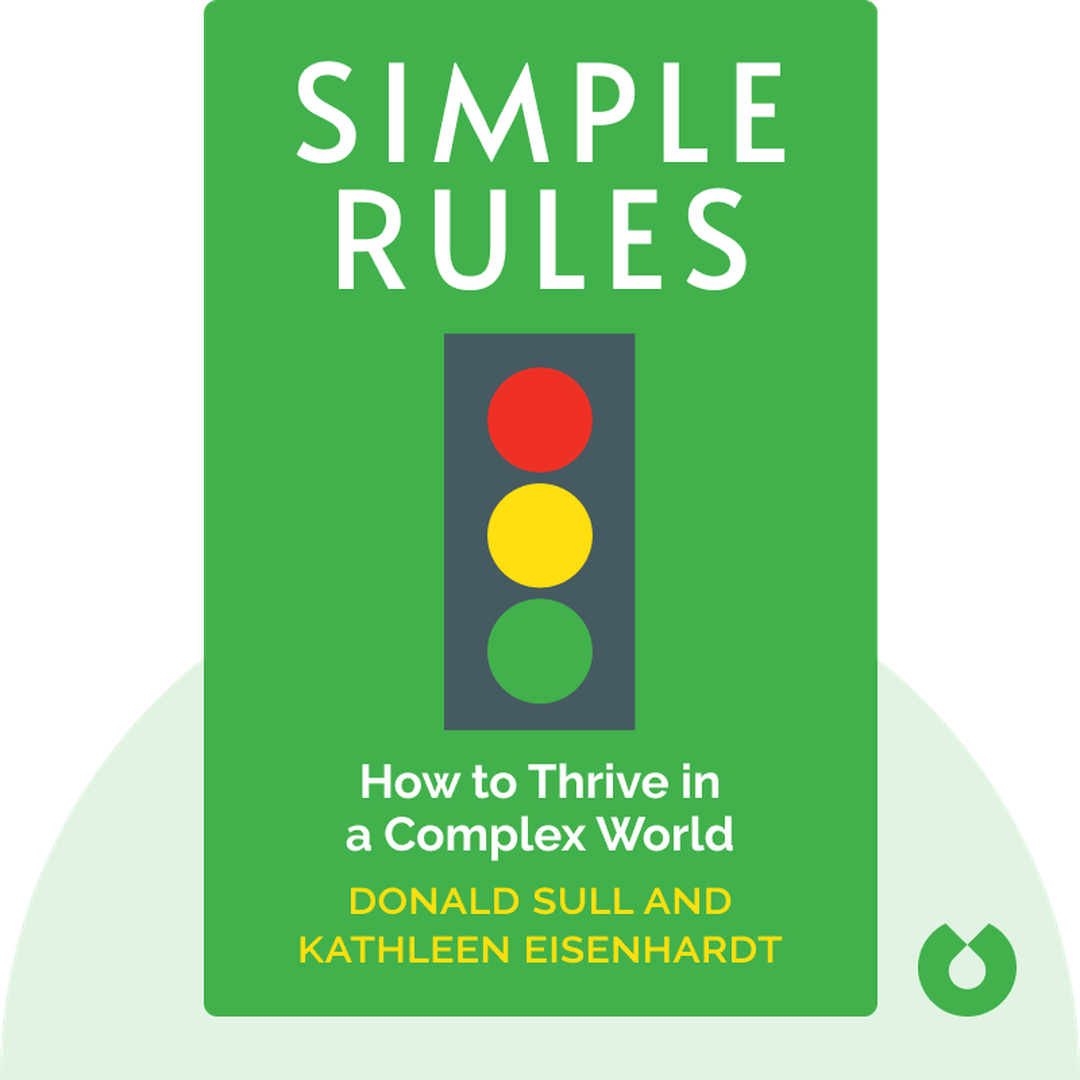
Simple Rules (2015) contains the ultimate rules of thumb that’ll guide you to your goals in your professional life, and your personal life too. The tips provided in these blinks will help you rediscover simplicity in an increasingly complex modern world, without committing you to a crazy checklist that takes over your life.
Who Should Listen to Simple Rules?
- Managers struggling to keep employees engaged in their programs
- Readers who want to overcome insomnia, lose weight or learn from Tina Fey
- Anyone who wants to tame today’s overwhelming complexity
Books Similar to Simple Rules
Readers who enjoyed this also liked these titles.