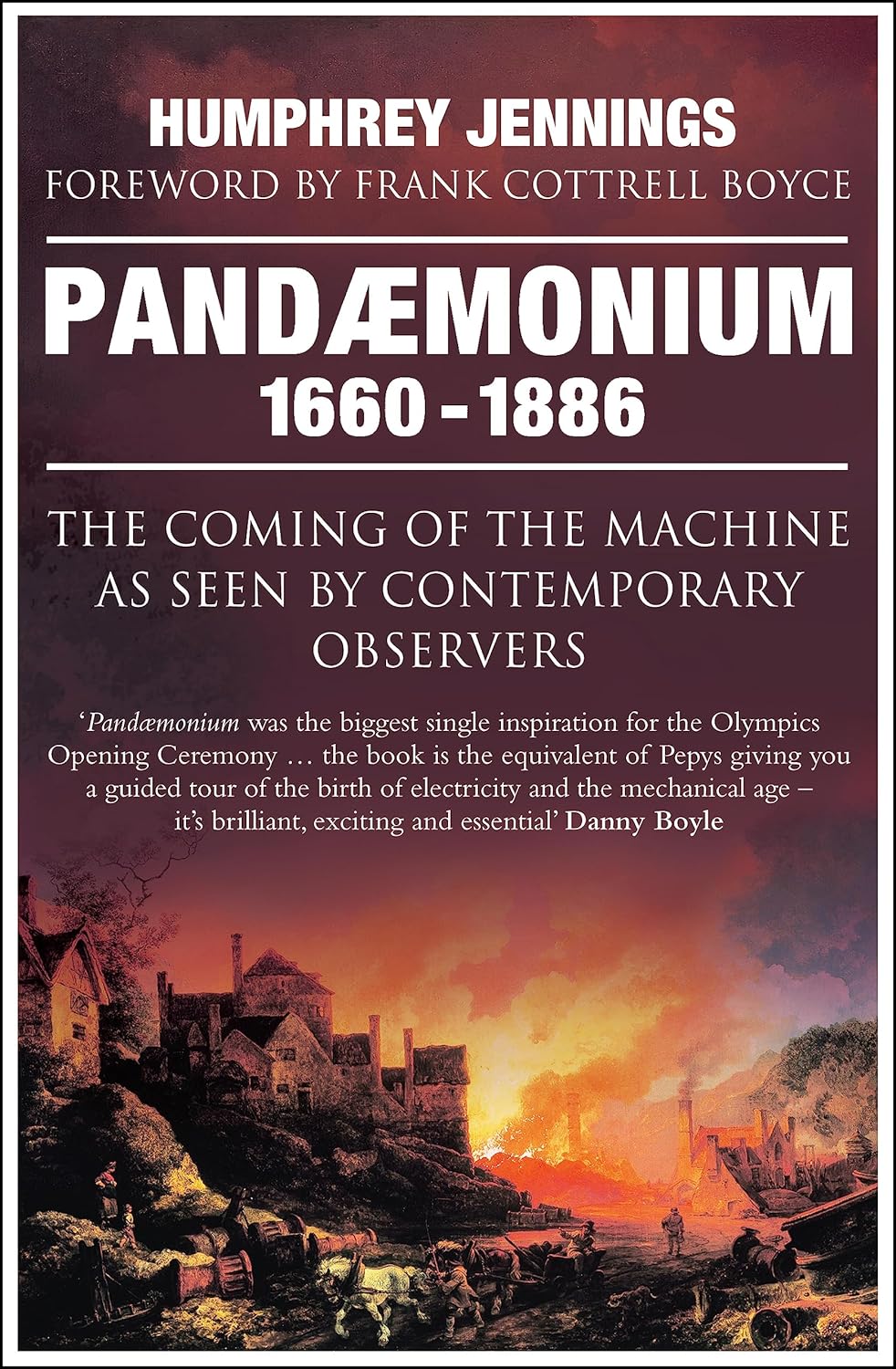
Pandæmonium 1660–1886: The Coming of the Machine as Seen by Contemporary Observers audiobook cover - A storm of voices—poets, engineers, preachers, factory men, philosophers—speaks across two centuries as Britain’s green world is broken open, fired, mechanised, and transformed into a new kind of human reality.

Pandæmonium 1660–1886: The Coming of the Machine as Seen by Contemporary Observers

A storm of voices—poets, engineers, preachers, factory men, philosophers—speaks across two centuries as Britain’s green world is broken open, fired, mechanised, and transformed into a new kind of human reality.

Humphrey Jennings

4.3 / 5(4 ratings)

If You're Curious About These Questions...

You should listen to this audiobook

Listen to Pandæmonium 1660–1886: The Coming of the Machine as Seen by Contemporary Observers — Free Audiobook

Loading player...

Key Takeaways from Pandæmonium 1660–1886: The Coming of the Machine as Seen by Contemporary Observers

Learning Tools

Reinforce what you learned from Pandæmonium 1660–1886: The Coming of the Machine as Seen by Contemporary Observers

Mind Map

Oceanofpdf.Com Pandaemonium 1660 1886 Humphrey Jennings
The Method: An Imaginative History+
1660–1790: Observation to Exploitation+
1791–1834: Revolution, Protest, and Speed+
1835–1851: Factory Automatons & The Exhibition+
1852–1871: High Vistas, Darwin, and the Plague-Wind+
1872–1886: Confusion & Cognitive Overload+

Quiz — Test Your Understanding

Question 1 of 11
What is the central underlying tension or drama that Humphrey Jennings explores throughout 'Pandaemonium'?
  • A. The conflict between agricultural laborers and factory owners
  • B. The tension between the violently transformed "Means of Production" and the surviving "Means of Vision"
  • C. The political struggle between the Royal Society and the British Monarchy
  • D. The economic competition between British and European manufacturers
Question 2 of 11
How does Jennings construct his "imaginative history" of the Industrial Revolution?
  • A. By writing a chronological narrative from the perspective of a single factory worker
  • B. By arguing a central economic thesis in his own voice
  • C. By using a montage of contemporary quotations, or "Images," to make conflicts suddenly visible
  • D. By analyzing statistical data and parliamentary reports on factory production
Question 3 of 11
In the period of 1660–1729, how is John Evelyn's account of London's smoke pall conceptually positioned in the book?
  • A. As an early, iconic vision of pollution arriving alongside the exhilaration of scientific discovery
  • B. As a purely religious allegory for the sins of the expanding British Empire
  • C. As a political protest against the burning of agricultural lands
  • D. As a celebration of the profitable coal industry that would fuel the empire
Question 4 of 11
Which structure from the 1730–1790 period does Jennings highlight as a prototype for the coming age, where labor is gathered, timed, powered, and multiplied?
  • A. The Coalbrookdale iron bridge
  • B. The Derby silk-mill
  • C. Bentham's panopticon
  • D. Wedgwood's teapot factory
Question 5 of 11
How does Jennings frame Mary Shelley's 'Frankenstein' within the context of the Industrial Revolution?
  • A. As a distraction that the working class used to escape the harsh realities of factory life
  • B. As an argument for the necessity of scientific progress despite human costs
  • C. As an Image of the machine-age imagination generating its own monsters, representing power without responsibility
  • D. As a literal representation of the physical deformities caused by working in cotton mills
Question 6 of 11
What 1830s technological arrival is described as not just an engineering milestone, but a "psychic event" that reorganized the environment by timetable and track?
  • A. The telegraph network
  • B. The steam-powered printing press
  • C. The railway
  • D. The Bessemer converter
Question 7 of 11
How are the views of Andrew Ure and Thomas Carlyle contrasted regarding the mid-century factory system?
  • A. Ure saw factories as spiritually uplifting, while Carlyle saw them as financially ruinous.
  • B. Ure idealized the factory as a self-regulating "iron man," while Carlyle saw it as a monstrous discord that drained life into mechanism.
  • C. Ure advocated for workers' rights, while Carlyle defended the absolute authority of factory owners.
  • D. Ure believed factories were a passing fad, while Carlyle believed they were the eternal future of Britain.
Question 8 of 11
What dual nature of the 1851 Great Exhibition does the book capture through its curated Images?
  • A. The conflict between British and French industrial designs
  • B. The tension between agricultural laborers and factory workers protesting outside the glass palace
  • C. The juxtaposition of magical, glittering celebration against the suffocating feeling of being trapped inside modernity
  • D. The debate between scientists and religious leaders over the exhibition of evolutionary artifacts
Question 9 of 11
How does Darwin’s theory of evolution fit into Jennings’ narrative of the 1850s and 60s?
  • A. It represents a return to animism and spiritual interpretations of the natural world.
  • B. It acts as a distraction from the worsening conditions of "Coketown" and urban poverty.
  • C. It shows the world being conceptually mechanized through material causes and statistical thinking, mirroring physical mechanization.
  • D. It provides a moral justification for the aggressive expansion of the British Empire.
Question 10 of 11
What late-Victorian concept does John Ruskin introduce to express the feeling that industry had poisoned both the environment and the human spirit?
  • A. The lower Pthah
  • B. The plague-wind
  • C. The hellish cloud
  • D. The mental choking
Question 11 of 11
In the final section (1872–1886), what does Herbert Spencer's phrase "mental choking" refer to?
  • A. The physical suffocation caused by dense coal smoke in London
  • B. The psychological consequences of mass society, including cognitive overload and anxiety
  • C. The suppression of radical political ideas by government censors
  • D. The loss of traditional agricultural skills among the younger generation

Pandæmonium 1660–1886: The Coming of the Machine as Seen by Contemporary Observers — Full Chapter Overview

Pandæmonium 1660–1886: The Coming of the Machine as Seen by Contemporary Observers Summary & Overview

Pandæmonium is Humphrey Jennings’ “imaginative history” of the Industrial Revolution, built not from a single authorial argument but from a moving sequence of contemporaneous quotations he calls “Images.” Arranged chronologically from 1660 to 1886, the extracts form a continuous, film-like narrative of a nation passing from early scientific curiosity and experimental observation into exploitation, upheaval, and finally a late-Victorian sense of dizzying complexity and moral uncertainty.

Across diaries, sermons, scientific notes, letters, parliamentary records, journalism, autobiography, and literature, Jennings’ collage captures the revolution as lived experience: smoke and furnaces, enclosure and displacement, awe at invention, terror at machinery, class conflict and reform, the clash between animism and materialism, and the struggle to keep imagination alive in an increasingly automated world.

Who Should Listen to Pandæmonium 1660–1886: The Coming of the Machine as Seen by Contemporary Observers?

  • Readers who want a vivid, primary-source-driven journey through the Industrial Revolution beyond standard political/economic history.
  • Artists, writers, filmmakers, and designers interested in collage methods, montage thinking, and “image-sequence” storytelling.
  • Students and general readers curious about how science, religion, labour, class, and imagination collided as modern Britain took shape.

About the Author: Humphrey Jennings

Humphrey Jennings (1907–1950) was an English filmmaker, artist, and writer, educated at Cambridge and best known for his landmark wartime documentaries including Listen to Britain and Fires Were Started. He co-founded Mass Observation (1936) and worked with surrealist circles in 1930s London. Pandæmonium, assembled from his lifelong collecting of textual “images,” was published posthumously in edited form.

🎧
Listen in the AppOffline playback & background play
Get App