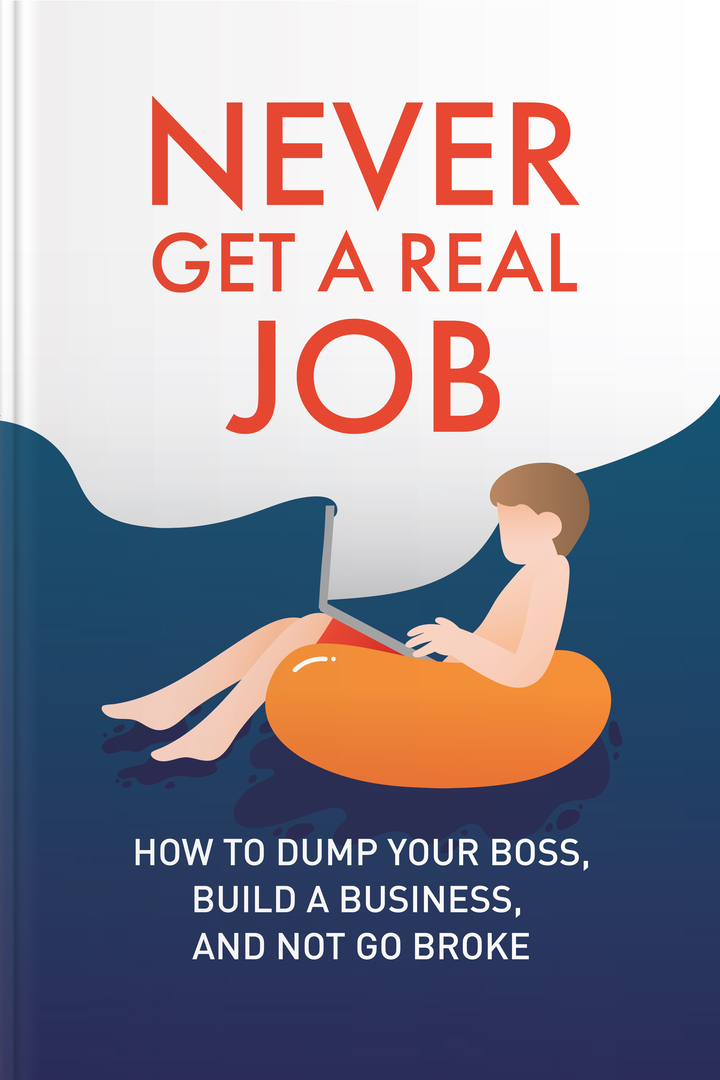
Never Get a Real Job audiobook cover - This warm, practical guide walks through why “real jobs” can feel like a shaky promise, and how steady, realistic steps—clear goals, smart partnerships, simple branding, and consistent execution—can help build a business path that feels more alive and truly your own.

Never Get a Real Job

This warm, practical guide walks through why “real jobs” can feel like a shaky promise, and how steady, realistic steps—clear goals, smart partnerships, simple branding, and consistent execution—can help build a business path that feels more alive and truly your own.

Scott Gerber

4.0 / 5(3 ratings)

If You're Curious About These Questions...

You should listen to this audiobook

Listen to Never Get a Real Job — Free Audiobook

Loading player...

Key Takeaways from Never Get a Real Job

Learning Tools

Reinforce what you learned from Never Get a Real Job

Mind Map

Never Get a “Real” Job
Mindset & Preparation+
Bootstrapping & Validation+
Lean Planning+
Partnerships & Networking+
Lifestyle & Operations+
Branding & Marketing+

Quiz — Test Your Understanding

Question 1 of 10
How does the author suggest entrepreneurs should plan for the future when making business decisions?
  • A. By creating a perfect, unchangeable plan to ensure success.
  • B. By planning for rock bottom and preparing for the worst-case scenarios.
  • C. By focusing only on the best possible outcomes to stay motivated.
  • D. By relying entirely on traditional, time-tested business models.
Question 2 of 10
Before turning a personal hobby into a business, which of the following is a critical question you must ask yourself?
  • A. Can I secure a large bank loan to fund this hobby?
  • B. Will my friends and family financially support this idea?
  • C. Are there enough people interested in this to create a viable market?
  • D. Can I immediately hire a team of experts to manage the workload?
Question 3 of 10
What is the primary purpose of the 'One-Paragraph Start-Up Plan'?
  • A. To secure venture capital funding with a highly concise pitch.
  • B. To test business hypotheses through actionable steps that evolve over time.
  • C. To eliminate the need for any financial tracking or budgeting.
  • D. To serve as a static, formal document for legal business registration.
Question 4 of 10
What is a 'Guess and Checklist' in the context of the One-Paragraph Start-Up Plan?
  • A. A list of potential competitors and their estimated revenue.
  • B. A financial forecasting tool used to guess first-year profits.
  • C. A set of five actionable steps generated from each sentence of your plan.
  • D. A checklist of legal requirements needed to register the business.
Question 5 of 10
If a potential business partner has a great product idea but lacks business acumen, what alternative does the author suggest instead of a standard partnership?
  • A. Hiring them as an unpaid intern until they learn the ropes.
  • B. Sending them to business school before launching the start-up.
  • C. Entering into a licensing deal or a joint venture.
  • D. Giving them a majority equity stake so they stay motivated.
Question 6 of 10
How does the author recommend developing a 'power routine' for maximum productivity?
  • A. By working seven days a week for a month to track when different types of successes occur.
  • B. By strictly adhering to a traditional 9-to-5 schedule to maintain work-life balance.
  • C. By delegating all internal operations to focus solely on revenue generation.
  • D. By reading biographies of successful CEOs and copying their daily habits.
Question 7 of 10
When building a website for a new start-up, which qualities should you prioritize according to the book?
  • A. Complex, custom-coded features to stand out from competitors.
  • B. High-end, cutting-edge graphic design that requires a professional consultant.
  • C. Flashy animations that showcase your technical skills to visitors.
  • D. Simplicity, quick loading times, and easy navigation.
Question 8 of 10
What cost-effective strategy does the author recommend instead of hiring expensive business coaches?
  • A. Reading free business books at the local public library.
  • B. Taking potential mentors and network contacts out to lunch.
  • C. Joining paid online mastermind groups for start-up founders.
  • D. Bartering your start-up's services in exchange for professional consulting.
Question 9 of 10
According to the book, what should be the ultimate goal of all marketing activity?
  • A. To build a massive social media following on platforms like Facebook.
  • B. To generate industry buzz and general brand awareness.
  • C. To encourage immediate action that generates revenue.
  • D. To create a beautiful, award-winning advertising campaign.
Question 10 of 10
Despite the intense hustle required to start a business, what does the author advise entrepreneurs to prioritize for long-term success?
  • A. Networking at every available industry event.
  • B. Their own health, by scheduling downtime and exercising.
  • C. Securing a backup corporate job just in case.
  • D. Rapidly expanding their team to reduce their personal workload.

Never Get a Real Job — Full Chapter Overview

Never Get a Real Job Summary & Overview

Many people grow up with a familiar script: study hard, get good grades, land a stable job, and life will work out. This narration gently challenges that promise, exploring how much of life is shaped by forces outside personal control—and why corporate work can sometimes leave capable people feeling powerless, underpaid, and replaceable.

Across these chapters, the focus turns toward entrepreneurship, not as an easy escape, but as a demanding, learnable path. Through practical reflections on failure, decision-making, money habits, outdated planning, partnerships, and marketing, the listener is invited to build a realistic foundation—one step at a time—toward work that feels meaningful and self-directed.

Who Should Listen to Never Get a Real Job?

  • People who feel disillusioned by the traditional “go to school, get a job” path and want a more self-directed career.
  • Early-stage entrepreneurs who want encouragement and grounded reminders about execution, budgeting, partnering wisely, and marketing clearly.
  • Anyone craving a calm, reality-based push to clarify priorities and build a business with steady, practical steps.

About the Author: Scott Gerber

The summary references entrepreneur Scott Gerber and lessons drawn from his early business experiences, including mistakes made while building a multimedia agency. The narration uses those examples to highlight practical principles around research, decision-making, partnerships, and marketing.

🎧
Listen in the AppOffline playback & background play
Get App