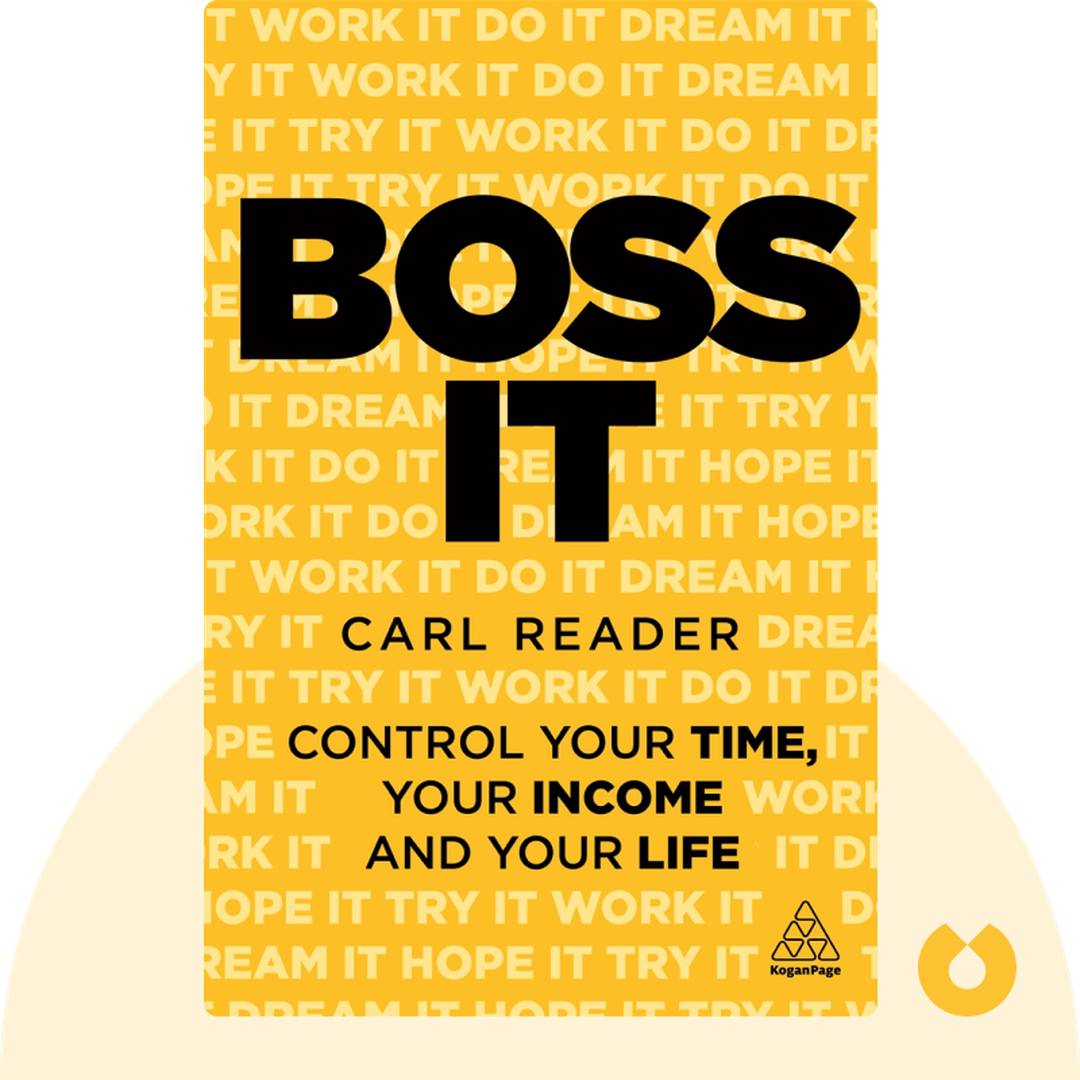
If You're Curious About These Questions...
You should listen to this audiobook
- Have you ever wondered why some people successfully launch their dream business while others never get past the planning stage?
- What's the secret to turning a simple side-hustle into a fully established business without losing your mind—or your savings—in the process?
- Did you know that there is a specific 'Boss It' framework that can bridge the gap between having a great idea and actually making it a reality?
Listen to Boss It — Free Audiobook
Loading player...
Key Takeaways from Boss It
- Discover why you must get absolutely clear on your core motivation before starting a business to survive the harsh reality of long hours and unpredictable paychecks.
- Master the four essential steps of running a successful enterprise—dream, plan, do, and review—to ensure your business thrives in a saturated marketplace.
- Learn how to craft a simple, relatable, and massively ambitious vision for your company that aligns with your values and inspires both customers and employees.
- Find out how to build a dynamic business plan equipped with a SWOT and sensitivity analysis to safeguard your new venture against unexpected market shifts.
- Understand the critical difference between good and bad debt, and discover how to strategically use debt or equity funding to turn your business idea into a valuable asset.
Learning Tools
Reinforce what you learned from Boss It
Mind Map
Boss It
Motivation & Foundation+
Planning & Vision+
Financing+
Systems & Operations+
Marketing & Acquisition+
Customer Retention+
Scaling & Culture+
Quiz — Test Your Understanding
Question 1 of 8
According to the book, what is the primary difference between starting a business and becoming self-employed?
Question 2 of 8
What is the purpose of a 'sensitivity analysis' when creating a business plan?
Question 3 of 8
How does the author distinguish between debt funding and equity funding?
Question 4 of 8
What is the difference between a 'process' and a 'system' as described in the text?
Question 5 of 8
Why does the author emphasize retaining existing customers over constantly finding new ones?
Question 6 of 8
How have tech giants like Google and Amazon impacted small business customer service?
Question 7 of 8
What is the book's key advice for avoiding hiring mistakes when scaling a business?
Question 8 of 8
According to the actionable advice section, what role does 'indirect marketing' (like logos and website design) play for a new business?
Boss It — Full Chapter Overview
- 1Recommendation
- 2Clarify why you’re willing to take on the hard work of running your own business.
- 3To achieve big things, you need to dream big first.
- 4Don’t fear “good debt.”
- 5Help your business grow healthily by setting up operational systems carefully.
- 6Understand your customer and how to reach them.
- 7Your key customer is your business’s best ally.
- 8Hire the right people and create the right atmosphere to scale your business.
- 9Final summary
Boss It Summary & Overview
Boss It (2020) is every aspiring entrepreneurs’ starter guide. Filled with both practical guidance and inspiring motivation, this book outlines all you need to know to turn your dream into a fully established business.
Who Should Listen to Boss It?
- Entrepreneurs looking for pointers
- Business dreamers looking for motivation
- Anyone with a business idea they want to make a reality
Books Similar to Boss It
Readers who enjoyed this also liked these titles.