If You're Curious About These Questions...
You should listen to this audiobook
- Did you know that a single monk’s internal spiritual crisis was the spark that permanently fractured Western Christianity and reshaped the entire map of Europe?
- Have you ever wondered how one man’s act of defiance against the world's most powerful institution laid the unexpected groundwork for the modern age?
- Are you curious about what the life of a 16th-century revolutionary can reveal about the intense power of belief and its influence on our modern world?
Listen to Martin Luther — Free Audiobook
Loading player...
Key Takeaways from Martin Luther
- Discover how the radical geopolitical and economic upheavals of the late Middle Ages set the perfect stage for Martin Luther's world-changing actions.
- Learn how a near-death experience with a lightning bolt drove Luther to abandon a secure legal career for the monastery, forever altering the course of European history.
- Understand why Luther bypassed papal teachings and turned directly to the Bible to resolve his terrifying existential fears of a punishing God.
- Find out the true motivation behind the famous 95 theses, which were originally drafted to protest the corrupt, cash-driven sale of indulgences rather than spark a deliberate revolution.
- Explore how criticizing a few seemingly academic religious practices caused the deeply intertwined political, economic, and philosophical systems of sixteenth-century Europe to completely unravel.
Learning Tools
Reinforce what you learned from Martin Luther
Mind Map
Martin Luther
Early Life & Context+
Theological Awakening+
The 95 Theses & Media Strategy+
Defiance of Authority+
Social Revolution & Conflict+
Institutionalizing Protestantism+
Darker Aspects+
Enduring Legacy+
Quiz — Test Your Understanding
Question 1 of 10
Why did Martin Luther initially abandon his legal studies to enter a monastery?
Question 2 of 10
What was Luther's primary intention when he posted his 95 theses in 1517?
Question 3 of 10
What was the central theological argument Luther arrived at in 1518 that became the foundation of the Reformation?
Question 4 of 10
How did Luther successfully build a massive following and become a recognizable adversary to the Pope?
Question 5 of 10
Why was the Holy Roman Emperor Charles V fundamentally opposed to Luther's ideas at the Diet of Worms?
Question 6 of 10
How did Thomas Müntzer's vision of the Reformation differ from Martin Luther's?
Question 7 of 10
What stance did Luther take during the Peasants' War?
Question 8 of 10
Where does the term 'Protestantism' originate?
Question 9 of 10
Why did Luther heavily promote the building of municipal and village schools?
Question 10 of 10
According to the text, what was one of the major, long-term geopolitical consequences of Luther's Reformation?
Martin Luther — Full Chapter Overview
- 1Recommendation
- 2Martin Luther was born at the close of the Middle Ages, during a time of major social upheaval.
- 3Luther joined a reform-minded monastery and learned to criticize the Church in Rome.
- 4As a Bible teacher in Wittenberg, Luther formed the theological basis for the Reformation.
- 5Luther’s posting of his theses sparked a revolution, even if it wasn’t intentional.
- 6The publication of the theses made Luther both celebrated and condemned.
- 7Luther’s skilled media strategy made him the Pope’s most famous opponent.
- 8Luther openly stated his opposition to the Roman Catholic Church at the Diet of Worms.
- 9The Reformation took root and spread through the middle classes.
- 10Thomas Müntzer built a social-revolutionary movement around the principles of Luther’s Reformation.
- 11During the Peasants’ War, Luther sided with the nobility.
- 12Luther’s Reformation created lasting changes in society.
- 13Despite Luther’s progressive views in some areas, he was anti-Semitic.
- 14Luther paved the way for fundamental change in Europe.
- 15Final summary
Martin Luther Summary & Overview
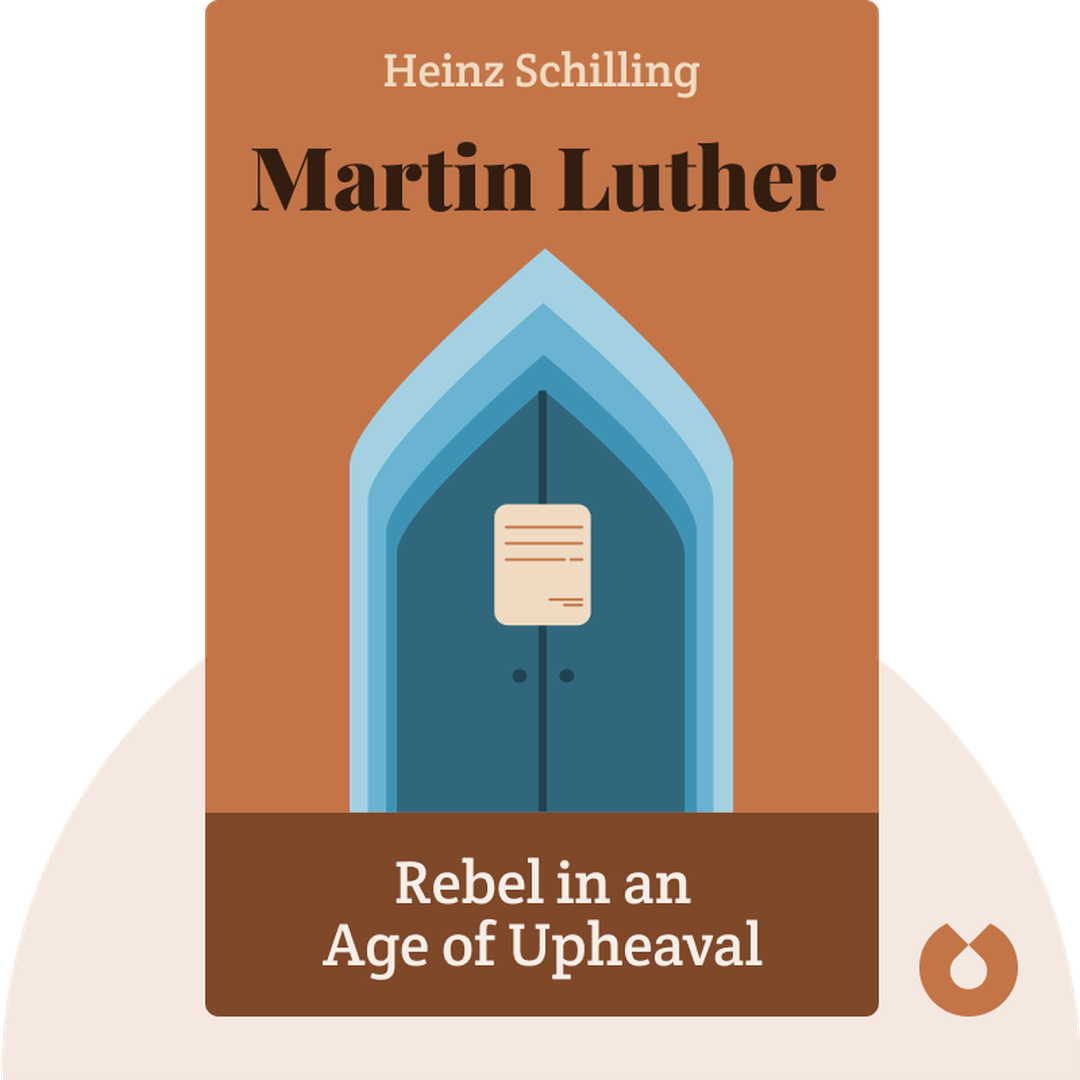
Martin Luther (2017) details the life and times of one of the most important figures in European history. Five hundred years ago, the German priest Martin Luther sparked the Reformation, which would eventually bring the Protestant Church into existence and thereby create a permanent schism between the Protestant and the Roman Catholic Church. This book presents a fresh interpretation of Luther’s life, investigating what his actions – and the Reformation in general – tell us about the modern world.
Who Should Listen to Martin Luther?
- People skeptical as to the power religion can hold over people
- History junkies who want to learn more about how modern Europe emerged
- Anyone curious about one of the most famous historical figures of all time
Books Similar to Martin Luther
Readers who enjoyed this also liked these titles.