If You're Curious About These Questions...
You should listen to this audiobook
- Have you ever wondered why we’re taught to fear disagreement, when it might actually be the most powerful engine for growth in your career and relationships?
- What if you could transform your most bitter arguments into collaborative breakthroughs using just a few simple shifts in perspective?
- Are you curious about the secret strategies expert communicators use to navigate high-stakes conflict and find common ground where others find only frustration?
Listen to I Don't Agree — Free Audiobook
Loading player...
Key Takeaways from I Don't Agree
- Learn how to break the cycle of endless arguments by actively teaching children collaborative problem-solving and modeling healthy conflict resolution.
- Understand why over 90 percent of fights end in a standoff, and discover how active listening can prevent disagreements from feeling like personal attacks.
- Discover how to build highly effective teams by conducting a 'values outing exercise' to identify complementary skills, inspired by the evolutionary adaptation of Darwin's finches.
- Master the art of authentic collaboration by identifying your top personal flaws and practicing a mental ritual to leave your ego at the door before every meeting.
- Find out why pride is actually a vital, self-conscious emotion that helps you gauge social perception and drives positive contributions in the workplace.
Learning Tools
Reinforce what you learned from I Don't Agree
Mind Map
I Don't Agree
Early Conflict Resolution+
Team Collaboration+
Leadership & Diversity+
Communication & Culture+
Bridging Animosity+
Advanced Negotiation+
Quiz — Test Your Understanding
Question 1 of 10
According to the text, what is the most productive way for parents to handle conflicts between their children?
Question 2 of 10
How does the author suggest workplace teams emulate Charles Darwin's finches?
Question 3 of 10
What personal ritual did the author use to overcome his own flaws and improve his collaboration skills?
Question 4 of 10
How does 'authentic pride' differ from the dominating behavior exhibited by leaders like Steve Jobs?
Question 5 of 10
What biological explanation is provided for why women often make highly successful workplace leaders?
Question 6 of 10
Why does Dr. Brett Grellier recommend using a neutral facial expression when first greeting someone in certain contexts?
Question 7 of 10
In a business negotiation between an American and a Japanese executive, what cultural misunderstanding is most likely to occur based on the text?
Question 8 of 10
What is 'status affirmation,' a technique recommended by Corinne Bendersky to bridge the animosity gap?
Question 9 of 10
Which set of tactics is a core part of the 'active listening' skills used by hostage negotiators?
Question 10 of 10
How did the author use the psychology of risk-aversion to help get approval for the Pixar 'Up' hot air balloon stunt?
I Don't Agree — Full Chapter Overview
- 1Recommendation
- 2Start building conflict resolution skills early in life.
- 3Identify your core values and those of your teammates.
- 4Turn collaboration into a daily practice, not just a buzzword.
- 5Take genuine pride in your contributions at work.
- 6Address gender inequality in the workplace.
- 7Notice your body language and how others read it.
- 8Recognize how much of your worldview is culturally shaped, and stay sensitive to differences.
- 9Close the animosity gap by acknowledging your opponent’s perspective.
- 10Build active listening skills to defuse conflict.
- 11Create a strategy for bringing multiple stakeholders on board.
I Don't Agree Summary & Overview
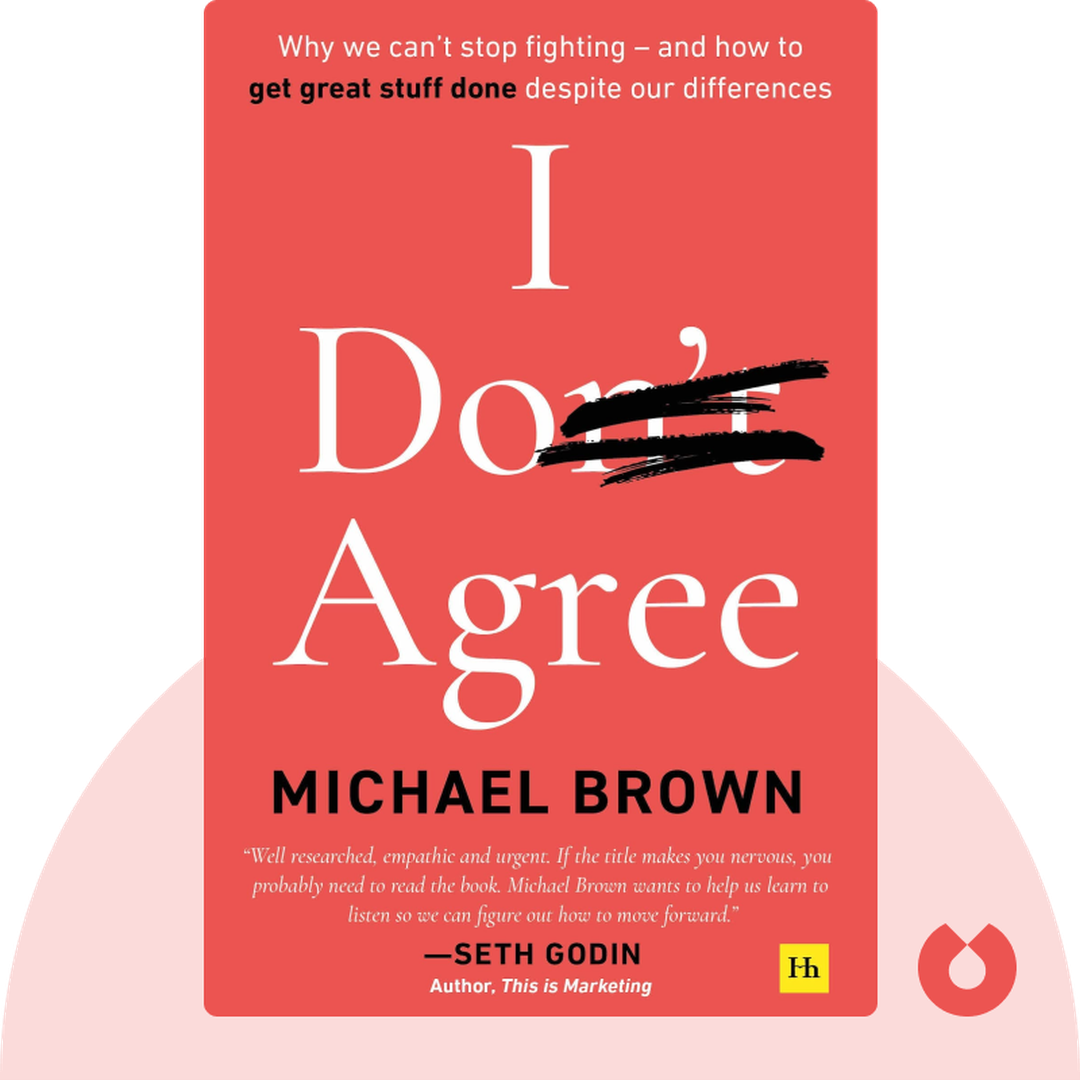
I Don’t Agree (2020) is a practical guide to improving your conflict resolution skills. Disagreement is seen as bad, and even scary. But, actually, conflict can be a powerful engine for growth if you know how to deal with it effectively. I Don’t Agree provides ten practical strategies that will help you become an expert in dealing with conflict in all areas of your life.
Who Should Listen to I Don't Agree?
- Employees seeking to improve their collaborations
- Anyone wanting to resolve a bitter argument
- Parents who want to learn how to teach conflict resolution skills to their kids
Books Similar to I Don't Agree
Readers who enjoyed this also liked these titles.