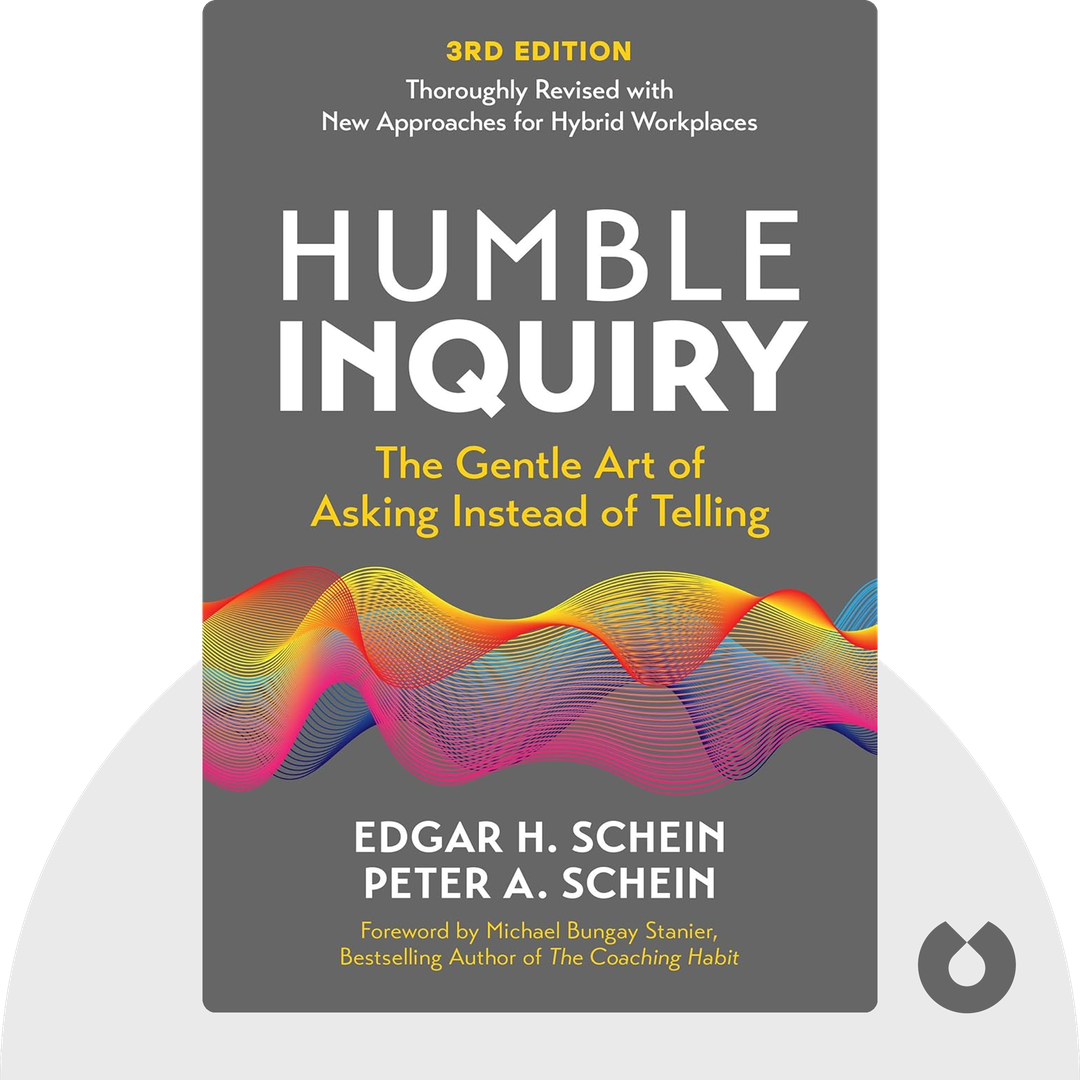
If You're Curious About These Questions...
You should listen to this audiobook
- Have you ever wondered why 'telling' your team what to do might actually be the biggest barrier to your success as a leader?
- What if you could master a specific style of questioning that not only solves complex problems but also builds unbreakable professional relationships?
- Are you curious about the subtle communication shift that can prevent costly workplace errors and transform a toxic office culture?
Listen to Humble Inquiry — Free Audiobook
Loading player...
Key Takeaways from Humble Inquiry
- Discover how shifting your leadership approach from telling to asking can replace employee resentment with active engagement.
- Understand why eliminating fear-based communication barriers between managers and employees is vital to preventing disastrous company failures.
- Learn how to adopt humble inquiry not just as a questioning strategy, but as a core leadership attitude that demonstrates trust and respect.
- Master the technique of diagnostic inquiry to dig deeper into specific topics while maintaining a sincere tone that makes your team feel valued.
- Find out how to carefully use confrontational inquiry to steer conversations and introduce your own ideas without making others feel defensive.
Learning Tools
Reinforce what you learned from Humble Inquiry
Mind Map
Humble Inquiry
Core Philosophy+
Types of Inquiry+
Barriers to Overcome+
Cultivating the Mindset+
Quiz — Test Your Understanding
Question 1 of 7
According to the text, what is the primary reason many business leaders fail to emulate the successful teamwork found in sports?
Question 2 of 7
How did the author successfully resolve the issue of the high departmental phone bill using humble inquiry?
Question 3 of 7
Which type of inquiry should you use if you want to steer a conversation by introducing your own ideas in the form of a question?
Question 4 of 7
If you notice your conversation partner seems uncomfortable and you ask, 'Am I being too personal?', which type of inquiry are you practicing?
Question 5 of 7
In today’s 'task accomplishment culture,' how is a manager asking questions often viewed?
Question 6 of 7
How does perceived social status typically affect our use of humble inquiry?
Question 7 of 7
What lesson is illustrated by the story of the student who yelled at his six-year-old daughter for interrupting his studying?
Humble Inquiry — Full Chapter Overview
- 1Recommendation
- 2You can’t build a successful team if employees can’t freely share what they think.
- 3To build a strong team, ask questions that show trust, inclusion, and respect.
- 4Humble inquiry comes in many forms, depending on how quickly you need an answer.
- 5Use humble inquiry to guide conversations and assess their quality.
- 6Simply “getting things done” blocks good communication and hinders humble inquiry.
- 7Our focus on status and social rank gets in the way of humble inquiry.
- 8The right mind-set improves communication and makes humble inquiry easier.
- 9Final summary
Humble Inquiry Summary & Overview
Humble Inquiry (2013) sets out the basic principles of the art of asking the right questions in the right way. It examines how your approach to inquiry affects your relationships at the office, your ability to get quality work completed and, ultimately, your success as a leader.
Who Should Listen to Humble Inquiry?
- Anyone who wants to improve how they communicate at work
- Anyone who wants to be a great leader
- Anyone who wants to learn how to ask the right questions
Books Similar to Humble Inquiry
Readers who enjoyed this also liked these titles.