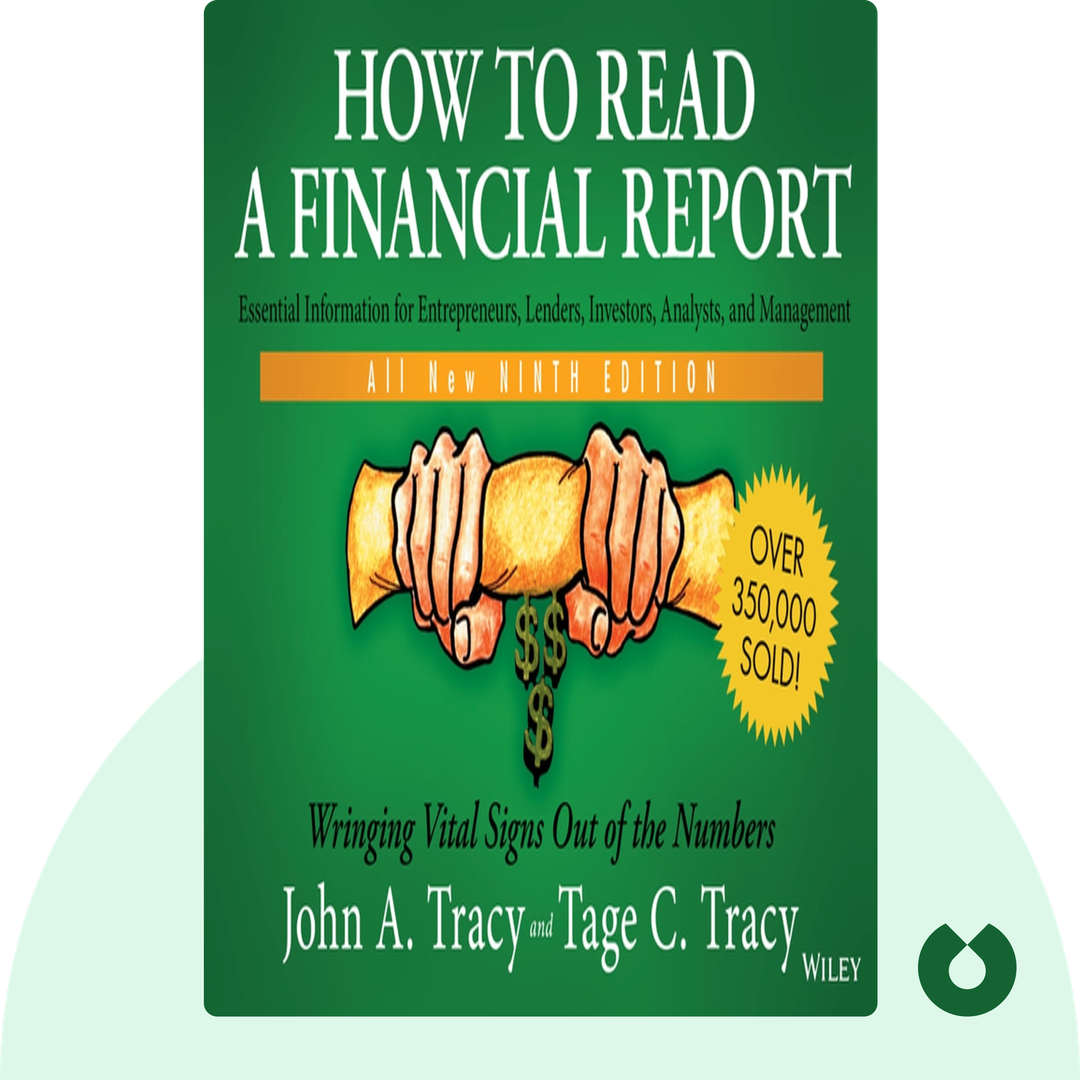
How to Read a Financial Report
Start ListeningDownload Try free on iPhoneScan to start in 5 seconds
Categories:
If You're Curious About These Questions...
You should listen to this audiobook
- Have you ever wondered why a company can report impressive profits on paper but still struggle to pay its bills?
- What if you could decode the 'fine print' in financial notes to uncover the hidden risks that most investors completely overlook?
- Did you know that mastering just a few key financial ratios can give you the power to predict a business's long-term success before you even invest a dime?
Listen to How to Read a Financial Report — Free Audiobook
Loading player...
Key Takeaways from How to Read a Financial Report
- Master the foundational basics of financial reporting to confidently extract valuable business insights without needing a formal finance education.
- Understand how to assess a company’s financial health and short-term liquidity by decoding the assets, liabilities, and equity on its balance sheet.
- Discover the critical difference between revenue and profit by using the income statement to evaluate growth trends and performance over time.
- Track the true lifeblood of a business by analyzing the cash flow statement's three crucial buckets: operating, investing, and financing activities.
- Learn to read between the lines using profitability ratios like gross, operating, and net margins to uncover a company’s true earning capabilities.
Learning Tools
Reinforce what you learned from How to Read a Financial Report
Mind Map
How to Read a Financial Report
The Three Main Statements+
Statement of Cash Flows+
Financial Ratios+
Decoding Footnotes+
The Auditors' Report+
Quiz — Test Your Understanding
Question 1 of 6
According to the text, how does a balance sheet fundamentally differ from an income statement?
Question 2 of 6
Which of the following is NOT one of the three primary categories into which the statement of cash flows divides a company's cash flow?
Question 3 of 6
What is the primary purpose of calculating leverage ratios, such as the debt-to-equity ratio?
Question 4 of 6
According to the text, what is a common challenge when dealing with the footnotes of a financial report?
Question 5 of 6
If an auditor issues an 'adverse opinion' on a company's financial report, what does this indicate?
Question 6 of 6
Why do financial analysts insist on looking at the balance sheet, income statement, and statement of cash flow together?
How to Read a Financial Report — Full Chapter Overview
- 1Recommendation
- 2Financial Statements Basics
- 3Tracking the Money
- 4Reading Between the Lines in a Financial Report
- 5Remember to Review the Footnotes
- 6Securing the Accountant’s Approval
- 7Final summary
How to Read a Financial Report Summary & Overview
How to Read a Financial Report (1980) serves as a comprehensive guide that demystifies the complexities of evaluating a company's fiscal health. It explores balance sheets and income reports, clarifies the fundamentals of financial ratios, and explains any accompanying notes, offering tools for a clear and confident assessment of a business's economic status.
Who Should Listen to How to Read a Financial Report?
- Investors
- Managers
- Non-financial professionals
Books Similar to How to Read a Financial Report
Readers who enjoyed this also liked these titles.