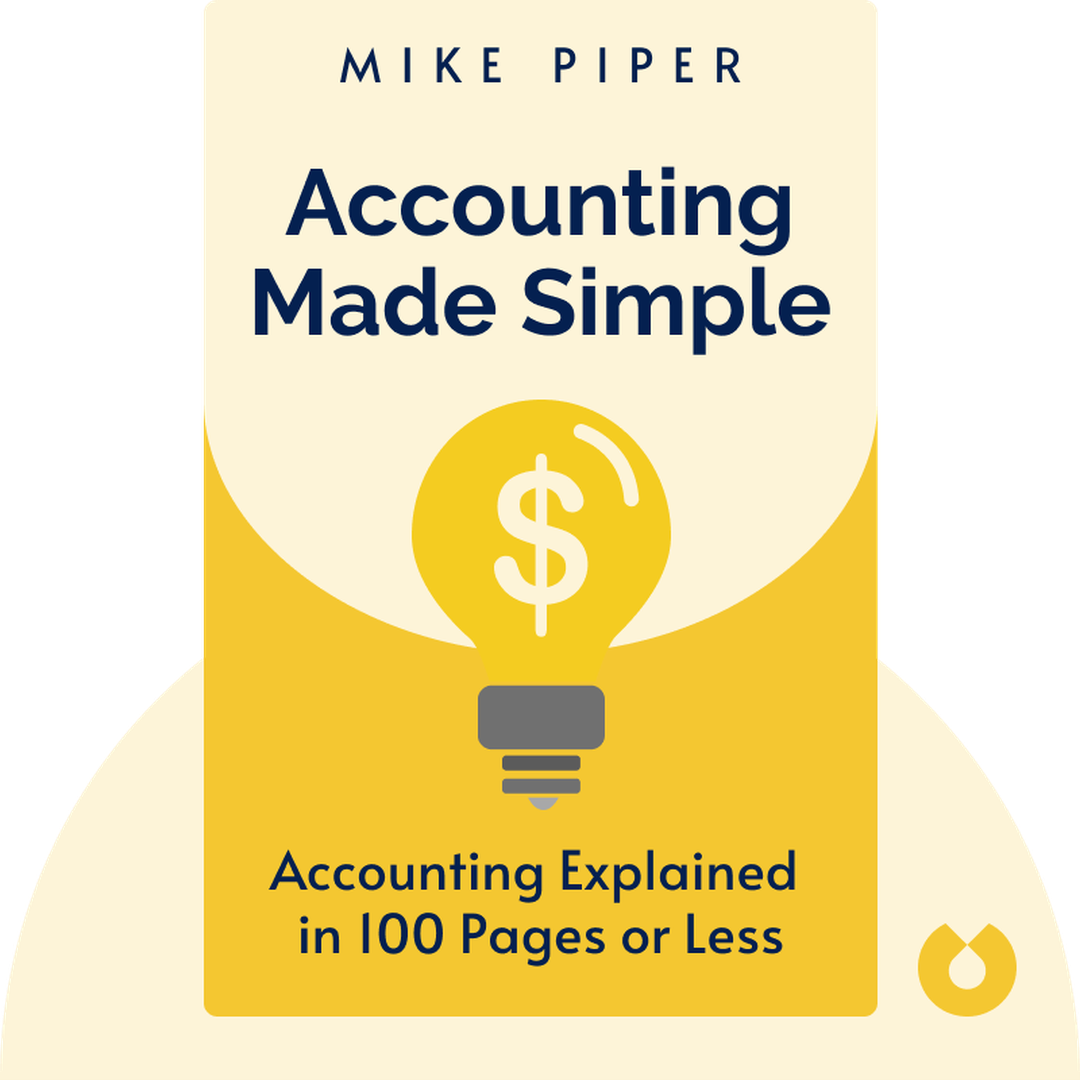
Accounting Made Simple
Start ListeningDownload Try free on iPhoneScan to start in 5 seconds
Categories:
If You're Curious About These Questions...
You should listen to this audiobook
- Have you ever wondered why a business can show a profit on paper but still run out of cash when it matters most?
- What if you could master the 'language of business' and finally understand exactly what your financial statements are trying to tell you?
- Are you curious about the simple, centuries-old system that ensures every single penny in your business is perfectly accounted for?
Listen to Accounting Made Simple — Cinematic Audio Edition
Loading player...
Key Takeaways from Accounting Made Simple
- Understand the fundamental accounting equation—Assets = Liabilities + Owner's Equity—and use it to determine the exact financial position of any business or personal investment.
- Learn how to decode a balance sheet to evaluate a company's financial health at any given moment by organizing its core assets, liabilities, and equity.
- Discover how to track financial performance and calculate net income over time by subtracting the cost of goods sold and operating expenses from your revenue on an income statement.
- Master the cash flow statement to accurately record actual money inflows and outflows, ensuring you avoid pitfalls caused by the time lapse between recorded sales and received payments.
- Find out how to classify your company's cash movements into operating, investing, and financing activities to gain a crystal-clear picture of exactly where your money is going.
Learning Tools
Reinforce what you learned from Accounting Made Simple
Mind Map
Accounting Made Simple
The Accounting Equation+
The Balance Sheet+
The Income Statement+
The Cash Flow Statement+
Financial Ratios+
Double-Entry System & GAAP+
Quiz — Test Your Understanding
Question 1 of 7
Which of the following represents the fundamental accounting equation used to determine a company's financial position?
Question 2 of 7
What is a primary difference between a balance sheet and an income statement?
Question 3 of 7
According to the text, how is a company's gross profit calculated on an income statement?
Question 4 of 7
Which category of the cash flow statement would record the cash spent on purchasing a new factory or selling financial securities like stocks?
Question 5 of 7
Why does the quick ratio provide a 'worst-case scenario' assessment of a company's liquidity compared to the current ratio?
Question 6 of 7
Why is it more useful to calculate profitability ratios, such as the Return on Assets (ROA), rather than just looking at net income?
Question 7 of 7
In the GAAP-approved double-entry accounting system, how are increases in assets and increases in liabilities recorded, respectively?
Accounting Made Simple — Full Chapter Overview
- 1Recommendation
- 2The basic accounting equation shows a company’s financial position through assets, liabilities, and owner’s equity.
- 3The accounting equation is the foundation of your balance sheet.
- 4The income statement measures a company’s financial performance over a set period of time.
- 5The cash flow statement tracks a company’s cash inflows and outflows.
- 6Use financial ratios to assess your firm’s financial health.
- 7Accountants record every transaction with a double-entry system.
- 8Final summary
Accounting Made Simple Summary & Overview
Accounting Made Simple (2013) provides a brief introduction to the fundamentals of accounting, illustrating how to read the most important financial statements and draw a conclusion about the numbers. It also outlines the double-entry ledger system, a hallmark of accounting best practices.
Who Should Listen to Accounting Made Simple?
- Small business owners curious about the fundamentals of accounting
- People who want to be able to read and understand a financial statement
- Anyone who wants to know about the basic aspects of accounting
Books Similar to Accounting Made Simple
Readers who enjoyed this also liked these titles.