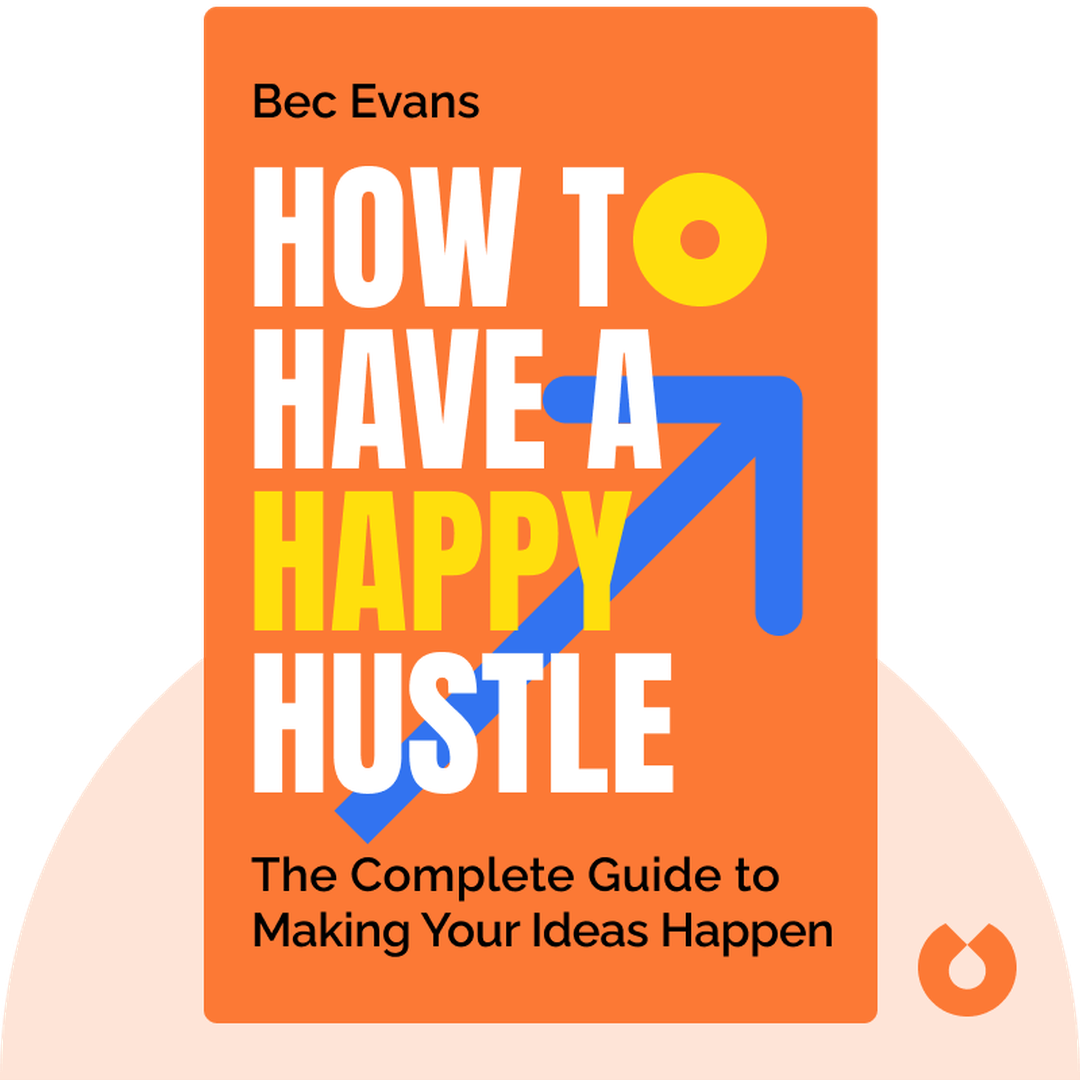
How to Have a Happy Hustle audiobook cover - The Complete Guide to Making Your Ideas Happen

How to Have a Happy Hustle

The Complete Guide to Making Your Ideas Happen

Bec Evans

4.5 / 5(136 ratings)
Categories:

If You're Curious About These Questions...

You should listen to this audiobook

Listen to How to Have a Happy Hustle — Free Audiobook

Loading player...

Key Takeaways from How to Have a Happy Hustle

Learning Tools

Reinforce what you learned from How to Have a Happy Hustle

Mind Map

How to Have a Happy Hustle
Finding Inspiration & Ideas+
Understanding the Audience+
Generating Solutions+
Prototyping & Testing+
Pitching & Feedback+
Mindset & Resilience+
Marketing & Growth+
Gathering Resources+
The Side Hustle Era+

Quiz — Test Your Understanding

Question 1 of 10
According to the text, what is often the best source of inspiration for a new startup idea?
  • A. Waiting for a moment of divine genius to strike
  • B. Analyzing everyday annoyances and problems you encounter
  • C. Copying the business models of wildly successful companies
  • D. Reading academic journals to find highly technical gaps in the market
Question 2 of 10
Why does researcher Paul-Jervis Heath's study on spending habits suggest that direct observation is better than simply asking people questions?
  • A. People often deliberately lie to researchers to protect their privacy.
  • B. People are usually too busy to answer surveys accurately.
  • C. People often fool themselves into reporting their aspirational behavior rather than their actual behavior.
  • D. Observation allows researchers to legally acquire participants' financial data.
Question 3 of 10
What is the primary goal of the 'Crazy Eights' exercise used by Google Ventures?
  • A. To encourage divergent thinking by generating multiple creative solutions under time constraints.
  • B. To build a financial model spanning the first eight months of a startup.
  • C. To divide a startup team into eight specific, highly specialized roles.
  • D. To test a product on eight different demographic groups to find the ideal persona.
Question 4 of 10
According to the book, what is the key difference between a prototype and a Minimum Viable Product (MVP)?
  • A. A prototype is expensive to make, while an MVP is always free.
  • B. A prototype is designed for investors, while an MVP is designed for competitors.
  • C. A prototype can be as simple as a drawing, but an MVP must actually function.
  • D. A prototype requires a patent, whereas an MVP does not.
Question 5 of 10
How does the author recommend processing the feedback you receive after pitching your idea?
  • A. Discard any negative feedback and focus only on the positive to maintain momentum.
  • B. Immediately change your core product to match the first piece of feedback you receive.
  • C. Argue with your audience to defend your vision and prove your expertise.
  • D. Write down direct quotations on Post-it notes, cluster key ideas together, and write down main takeaways.
Question 6 of 10
How did the founders of the online marketplace Teddle demonstrate a 'growth mindset'?
  • A. They refused to quit and poured their remaining funds into aggressive marketing.
  • B. They analyzed their failure, realized users were searching for cleaners, and successfully pivoted to Hassle.com.
  • C. They sold their failing company to Richard Branson to avoid bankruptcy.
  • D. They sued their competitors for stealing their target audience.
Question 7 of 10
Why did George Burgess's initial marketing strategy for his study app, Gojimo, fail to grow his user base?
  • A. He priced the app too high for his target demographic.
  • B. He relied on traditional newspaper media, ignoring that his student audience didn't read newspapers.
  • C. He focused exclusively on Facebook ads instead of television commercials.
  • D. He offered too many rewards for sharing the app, which bankrupted his marketing budget.
Question 8 of 10
Aside from raising money, what is an added benefit of using crowdfunding sites like Kickstarter or GoFundMe?
  • A. It guarantees your product will be featured in national media.
  • B. It automatically protects your intellectual property from being stolen.
  • C. It doubles as market research by gathering valuable feedback on user needs and wants.
  • D. It exempts your new business from having to pay corporate taxes.
Question 9 of 10
According to the author's exclusive blink, what is the psychological benefit of starting a side hustle small?
  • A. It bypasses the fear centers of the brain and reduces the risk of failure.
  • B. It tricks investors into thinking the company is already profitable.
  • C. It allows you to avoid writing a formal business plan.
  • D. It ensures that you can keep your side hustle a secret from your current employer.
Question 10 of 10
What actionable advice does the author give to people who claim they have 'no time' to develop a side hustle?
  • A. Quit your day job immediately so you are forced to succeed.
  • B. Take a month-long retreat to focus solely on the business idea.
  • C. Hire virtual assistants to do the creative thinking for you.
  • D. Steal little pockets of time, such as getting up an hour early or using a lunch break to think.

How to Have a Happy Hustle — Full Chapter Overview

How to Have a Happy Hustle Summary & Overview

How to Have a Happy Hustle (2019) is an empowering guide to making ideas happen. Puncturing the mystique surrounding successful startups, Bec Evans reveals how anyone can grow an idea into a business by starting small, thinking creatively and getting feedback from their target market. Most importantly, by focusing on the process of testing and building an idea, connecting with people, and learning from mistakes a happy hustle redefines success to include personal growth, fulfilment as well as financial gain.

How to Have a Happy Hustle won the Startup Inspiration category at the Business Book Awards 2020.

Who Should Listen to How to Have a Happy Hustle?

  • Women who’d love to get into tech but have been put off by the macho culture
  • Aspiring startup founders who lack the confidence, time and money to get started
  • Innovative thinkers itching to introduce their ideas to the world
  • Busy professionals keen to build their entrepreneurial skill set

About the Author: Bec Evans

Bec Evans is a former head of innovation whose side hustle became a startup. As well as running Prolifiko, she's a writer, speaker and coach. She helps busy people find the time for creative side projects and coaches budding entrepreneurs to make their ideas a reality.

🎧
Listen in the AppOffline playback & background play
Get App