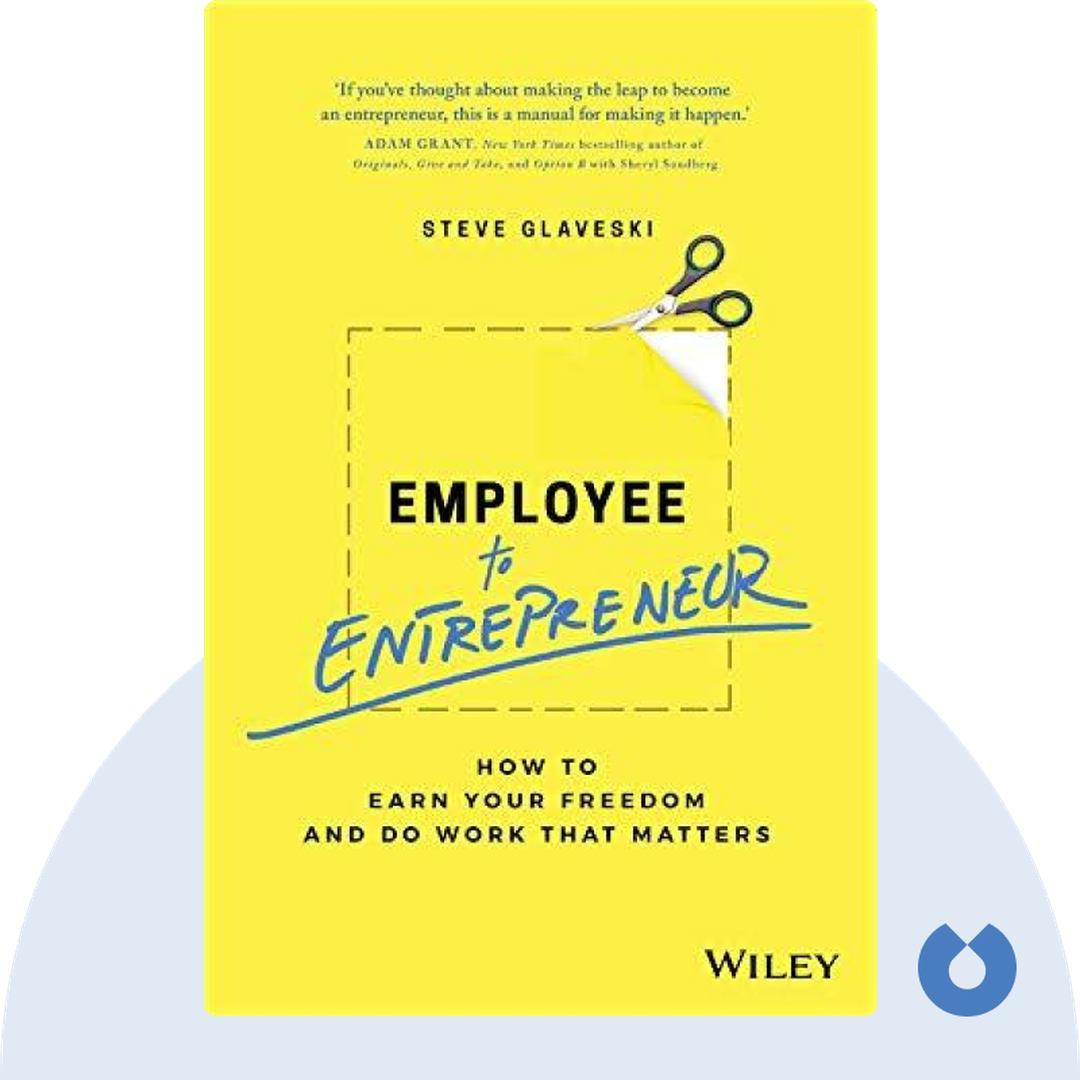
Employee to Entrepreneur
Start ListeningDownload Try free on iPhoneScan to start in 5 seconds
Categories:
If You're Curious About These Questions...
You should listen to this audiobook
- Did you know that the very habits that make you a 'perfect employee' might be the biggest obstacles standing in the way of your entrepreneurial success?
- What if you could rigorously test your business ideas and ensure they'll work before you ever risk quitting your day job?
- Are you curious about the specific mindset shift required to stop trading time for money and start building a life of true purpose and freedom?
Listen to Employee to Entrepreneur — Free Audiobook
Loading player...
Key Takeaways from Employee to Entrepreneur
- Discover why transitioning from a predictable corporate paycheck to successful entrepreneurship requires a fundamental mindset shift to keep pace with exponential technological change.
- Learn how to cultivate a growth mindset that reframes failure and temporary discomfort as essential feedback for your personal and professional development.
- Find out why inviting constructive negative criticism, much like a successful hedge fund's 'challenge networks,' can expose the hidden obstacles holding you back.
- Understand why relying on monetary incentives can actually harm your drive, and why intrinsic motivation is the only way to survive the entrepreneurial 'trough of despair'.
- Evaluate your true motives before abandoning your corporate career to determine if you actually need to start a full-time enterprise, or if a freelance side hustle will fulfill your goals.
Learning Tools
Reinforce what you learned from Employee to Entrepreneur
Mind Map
Employee to Entrepreneur
The Changing World of Work+
The Entrepreneurial Mindset+
Finding Your Purpose+
Idea Generation+
Validating Your Idea+
Time Management & Focus+
Quiz — Test Your Understanding
Question 1 of 8
Why does hedge fund Bridgewater Associates hold regular meetings known as 'challenge networks'?
Question 2 of 8
What did psychologist Edward Deci’s 1970s experiment reveal about motivation?
Question 3 of 8
According to the author, what is the primary purpose of the 'five Fs' method?
Question 4 of 8
How does 'first principles thinking' contribute to successful entrepreneurship?
Question 5 of 8
What is a 'make-or-break assumption' in the context of launching a new business?
Question 6 of 8
How does the author suggest entrepreneurs handle administrative tasks that generate low financial value?
Question 7 of 8
What actionable advice does the author give for dealing with negative emotions like anger or frustration?
Question 8 of 8
How does the book use Moore’s law to explain the modern business landscape?
Employee to Entrepreneur — Full Chapter Overview
- 1Recommendation
- 2Learning to Adapt to Change Is Essential for Success in Today’s World
- 3Embracing Failure and Discomfort Is the Key Path to Growth
- 4Understand Your Motives Before Starting Your Entrepreneurial Journey
- 5Collecting and Connecting Ideas Are the Foundation of Entrepreneurship
- 6Always Test Your Proposition Before Acting on Your Idea
- 7Your Time Is Precious: Narrow Your Focus and Eliminate Distractions
- 8Final summary
Employee to Entrepreneur Summary & Overview
Employee to Entrepreneur (2018) demonstrates how to transition from the mentality of an employee to that of an entrepreneur. It shows how you can pursue purpose in your work while avoiding the pitfalls that most first-time entrepreneurs encounter. With practical strategies for launching and testing your ideas, this exploration of the entrepreneurial mindset proves that anyone can find fulfillment in work and in life when equipped with the right tools and attitude.
Who Should Listen to Employee to Entrepreneur?
- Unsatisfied employees who want to quit their day job and start a business
- New entrepreneurs seeking practical advice on how to launch a startup
- Anyone who wishes to find more fulfillment in their work
Books Similar to Employee to Entrepreneur
Readers who enjoyed this also liked these titles.