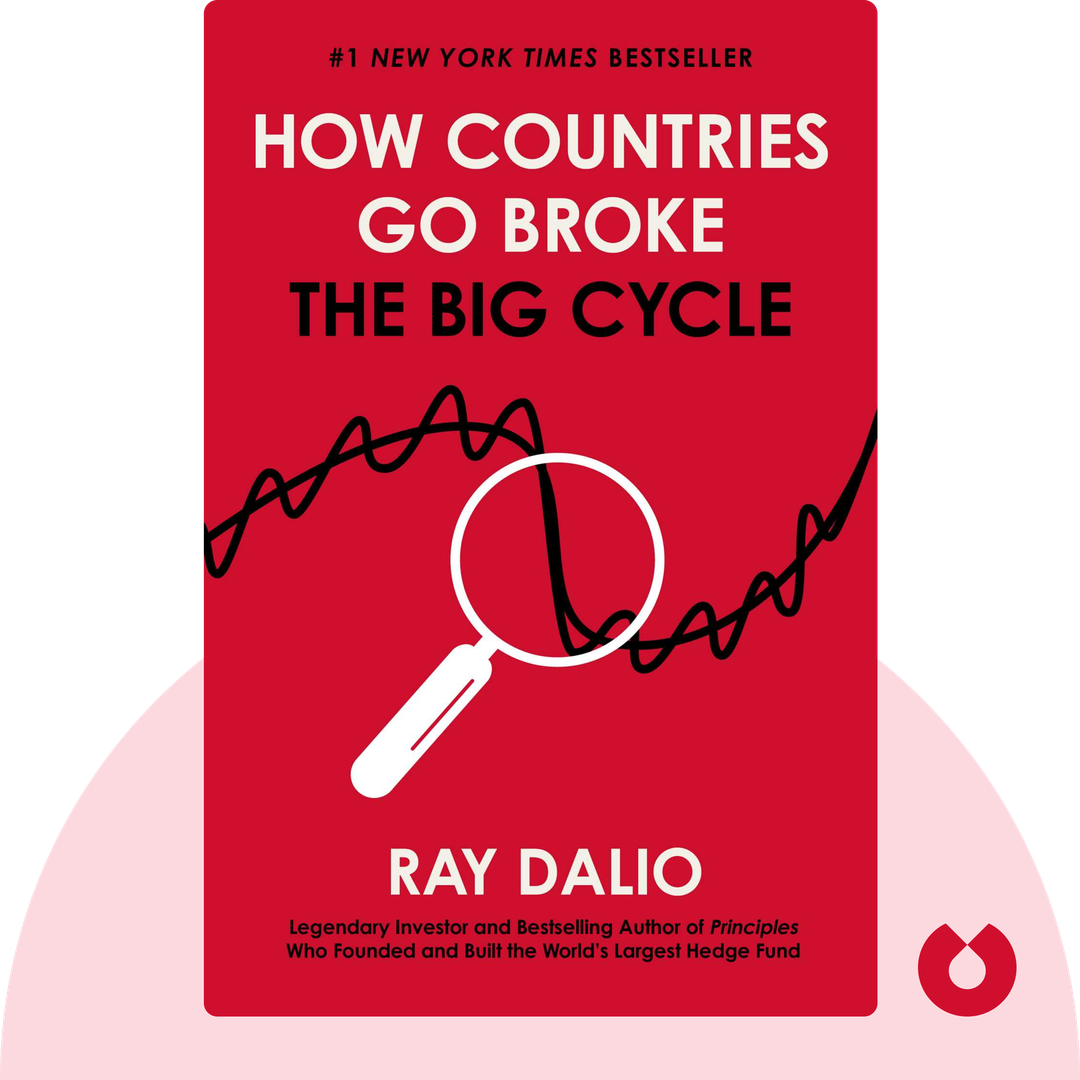
How Countries Go Broke
Start ListeningDownload Try free on iPhoneScan to start in 5 seconds
Categories:
If You're Curious About These Questions...
You should listen to this audiobook
- Did you know that the same hidden patterns have signaled the rise and fall of every major empire throughout history?
- Have you ever wondered which specific red flags consistently appear right before a national economy spirals into ruin?
- What if you could decode the cyclical forces of debt and politics to anticipate the world's next major financial shift?
Listen to How Countries Go Broke — Cinematic Audio Edition
Loading player...
Key Takeaways from How Countries Go Broke
- Discover why the world's most powerful nations inevitably rise and fall according to predictable, repeating historical patterns known as Big Cycles.
- Understand the mechanics behind the 75-to-100-year Big Debt Cycle, and learn how stacking short-term credit booms eventually pushes a country to financial collapse.
- Explore the nine distinct stages of a national financial breakdown, tracking the slow-motion trainwreck from excessive private borrowing to drastic government interventions like capital controls.
- Learn how unsustainable government debt forces leaders into grim choices, such as defaulting or printing money, which ultimately destroys the wealth of savers, pensioners, and investors.
- Find out how human nature, our blind spots for risk, and a relentless desire to extend economic booms trap nations in devastating, repeating financial crises.
Learning Tools
Reinforce what you learned from How Countries Go Broke
Mind Map
How Countries Go Broke
The Big Cycle Concept+
The 9 Stages of Debt Crisis+
The 5 Forces of the Overall Cycle+
US Monetary History+
Current Global State+
Fixing the Crisis+
Quiz — Test Your Understanding
Question 1 of 7
What is the primary reason that each short-term debt cycle tends to peak at a higher debt level than the previous one?
Question 2 of 7
During the Big Debt Cycle, what action characterizes Stage Five when interest rates are already at or near zero?
Question 3 of 7
According to Dalio's concept of the "Overall Big Cycle," which of the following is NOT one of the five major interconnected forces that drive historical change?
Question 4 of 7
What was the defining characteristic of Monetary Policy 2 (MP2), which emerged after the 2008 financial crisis?
Question 5 of 7
How does the current era, Monetary Policy 3 (MP3), fundamentally differ from previous monetary policies?
Question 6 of 7
What is Dalio's proposed "3 Percent 3-Part Solution" to avoid a US debt disaster?
Question 7 of 7
Based on Dalio's historical timeline, where does the United States currently stand in the context of the long-term Big Cycle?
How Countries Go Broke — Full Chapter Overview
- 1Recommendation
- 2Short- and Long-Term Debt Cycles
- 3The Big Debt Cycle’s Nine Stages
- 4The Other Cycles in Motion
- 5Cycles Throughout US History
- 6Where Things Stand Today
- 7How to Fix the Debt Problem
- 8Making Sense of an Uncertain Future
- 9Final summary
How Countries Go Broke Summary & Overview
How Countries Go Broke (2025) offers a sweeping tour through history, tracing the recurring patterns that shape the rise and fall of national economies. It shows how financial, political, and social forces repeatedly converge, creating cycles that drive countries toward prosperity… or ruin. While we can’t predict the future with perfect accuracy, we can see that certain warning signs – like mounting debt and systemic vulnerabilities – consistently play a central role in economic collapse.
Who Should Listen to How Countries Go Broke?
- Anyone curious about economic history and financial crises
- Investors and financial professionals
- People concerned about the world’s economic future
Books Similar to How Countries Go Broke
Readers who enjoyed this also liked these titles.