Principles For Dealing With the Changing World Order
Start ListeningDownload Try free on iPhoneScan to start in 5 seconds
Categories:
If You're Curious About These Questions...
You should listen to this audiobook
- Did you know that the rise and fall of global superpowers follow a predictable, repeatable pattern that has played out almost exactly the same way for the last 500 years?
- Have you ever wondered why certain economic warning signs—like massive debt and rising internal conflict—have historically signaled the exact moment a world power begins its decline?
- What if you could use the hidden 'Big Cycle' of history to see past the headlines and anticipate which global shifts will redefine the world order in your lifetime?
Listen to Principles For Dealing With the Changing World Order — Cinematic Audio Edition
Loading player...
Key Takeaways from Principles For Dealing With the Changing World Order
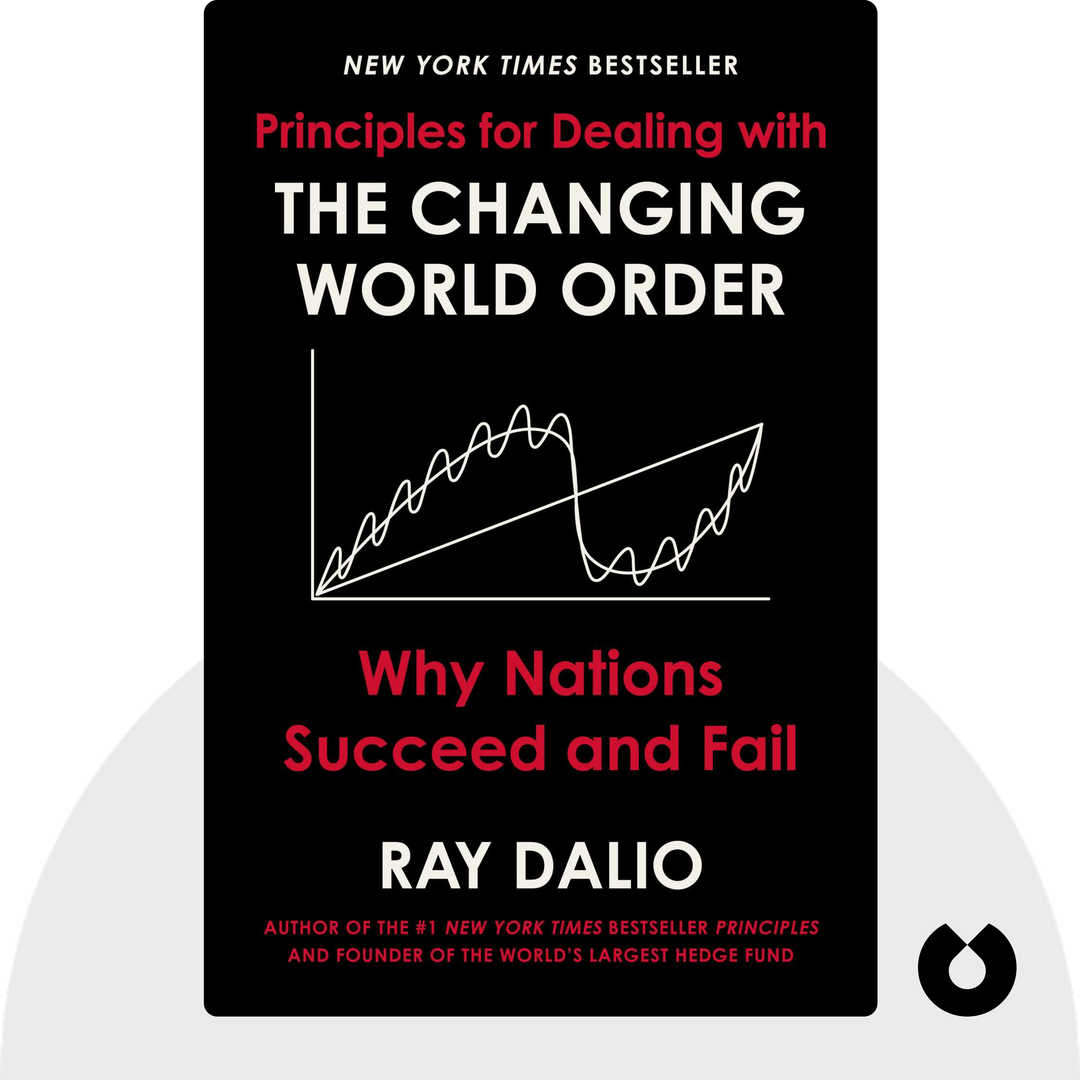
- Discover the 'Big Cycle' theory that reveals how major empires consistently rise, peak, and inevitably decline over predictable 250-year periods.
- Learn how to safeguard your investment portfolio by using historical patterns to navigate upcoming geopolitical, technological, and economic storms.
- Track the eight key indicators of a nation's strength, including educational quality, economic productivity, and currency dominance, to determine its global trajectory.
- Understand how new superpowers emerge from major conflicts by strategically prioritizing highly-skilled workforces, technological innovation, and robust institutions.
- Recognize the internal warning signs of an empire's decay, where prolonged prosperity and wealth inheritance lead to societal complacency and a weakened work ethic.
Learning Tools
Reinforce what you learned from Principles For Dealing With the Changing World Order
Mind Map
Principles For Dealing With the Changing World Order
The Big Cycle Theory+
The Rise of Powers+
Decay and Decline+
The US-China Rivalry+
Investment Strategies & Risks+
Quiz — Test Your Understanding
Question 1 of 8
What is the core premise of the "Big Cycle" theory described in the book?
Question 2 of 8
Which of the following is NOT listed as one of the eight indicators used to measure a nation's power?
Question 3 of 8
According to the book, what factor sows the seeds of an empire's downfall during its peak?
Question 4 of 8
What internal societal issue, seen in both the Roman Empire and modern America, is identified as a key symptom of an empire's decline?
Question 5 of 8
Despite facing internal challenges, what is highlighted as one of the United States' most significant, unmatched strengths?
Question 6 of 8
What is identified as a potential major obstacle that could slow China's rise toward global dominance?
Question 7 of 8
To navigate the uncertainty of the changing world order, what is the primary investment strategy recommended for individuals?
Question 8 of 8
The book suggests that innovation in which specific technology could accelerate the decline of fossil fuel-reliant economies?
Principles For Dealing With the Changing World Order — Full Chapter Overview
- 1Recommendation
- 2The rise and decline of empires
- 3The ascent of modern powers
- 4Deterioration and decline
- 5The US–China rivalry
- 6Risks and opportunities on the global stage
Principles For Dealing With the Changing World Order Summary & Overview
Principles for Dealing with the Changing World Order (2021) examines the patterns underpinning the rise and fall of past empires – and demonstrates that they can be equally applied to empires today. It explores how our current global dynamics mirror those of past centuries, with the US and China at the forefront, and argues that understanding these dynamics will prepare us for what’s ahead.
Who Should Listen to Principles For Dealing With the Changing World Order?
- History buffs intrigued with the rise and fall of empires.
- Investors seeking to navigate global economic trends
- Students of political science and international relations
Books Similar to Principles For Dealing With the Changing World Order
Readers who enjoyed this also liked these titles.