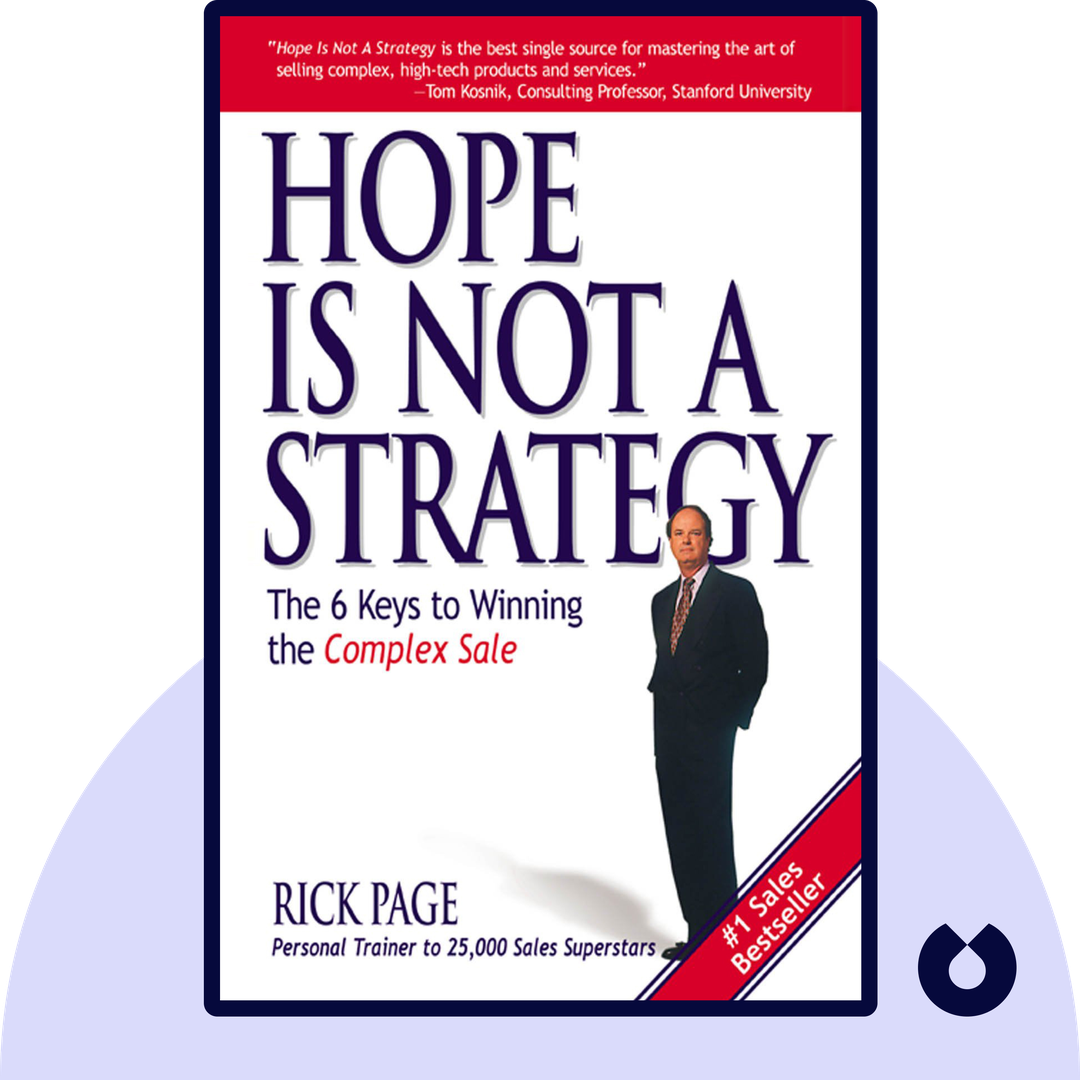
Hope Is Not a Strategy
Start ListeningDownload Try free on iPhoneScan to start in 5 seconds
Categories:
If You're Curious About These Questions...
You should listen to this audiobook
- Have you ever wondered why some sales professionals consistently win high-stakes deals while others are left hoping for a lucky break?
- What if you could master the hidden political landscape of a complex sale and influence every key decision-maker before you even walk into the room?
- What’s the secret to building a competitive advantage so strong that it makes your solution the only logical choice for your prospect?
Listen to Hope Is Not a Strategy — Free Audiobook
Loading player...
Key Takeaways from Hope Is Not a Strategy
- Learn how to shift your focus from simply selling products to solving specific client problems by building trust and delivering complete solutions.
- Discover why a client's hesitation to act is often your biggest competitor, and how to create urgency by directly linking your solution to their most pressing business pain.
- Master the six-step RADAR process to strategically allocate your resources, rigorously qualify prospects, and avoid wasting time on deals that lack budget or political support.
- Understand how to build competitive preference early in the sales cycle by controlling the narrative, highlighting your unique advantages, and proactively countering competitor moves.
- Find out how to navigate complex organizational politics by identifying true decision-makers and selling directly to informal power brokers whose influence exceeds their titles.
Learning Tools
Reinforce what you learned from Hope Is Not a Strategy
Mind Map
Hope Is Not a Strategy
The Modern Complex Sale+
The RADAR Process (Steps 1-3)+
The RADAR Process (Steps 4-6)+
Strategy and Timing+
Account Management & Long-term Success+
Quiz — Test Your Understanding
Question 1 of 7
According to the text, what is often a salesperson's biggest competitor in a complex sale?
Question 2 of 7
What does the acronym RADAR stand for in the context of managing complex sales?
Question 3 of 7
In the RADAR process, what is the primary purpose of 'Qualifying the Prospect'?
Question 4 of 7
When attempting to 'Sell to Power', why does the author warn that titles can be deceiving?
Question 5 of 7
How should a salesperson adjust their pitch when selling to high-level executives?
Question 6 of 7
What strategy does the author suggest if you sense the client's decision-making process is unfair or biased toward another vendor?
Question 7 of 7
What is described as the ultimate goal of effective account management?
Hope Is Not a Strategy — Full Chapter Overview
- 1Recommendation
- 2Focus on Solving Client Problems, Not Just Selling Products
- 3Build Trust to Navigate Complex Sales Confidently
- 4Find the Decision-Makers and Sell to Power
- 5Use Strategy and Timing to Stay Ahead in Sales
- 6Account Management Builds Trust for Long-Term Success
- 7Final summary
Hope Is Not a Strategy Summary & Overview
Hope Is Not a Strategy (2003) offers a strategic framework for handling complex sales, emphasizing that success depends on more than just closing skills. It outlines a six-step process for identifying prospects’ needs, qualifying opportunities, and building competitive advantages, all aimed at increasing sales effectiveness.
Who Should Listen to Hope Is Not a Strategy?
- Sales professionals managing complex, high-stakes deals with multiple stakeholders
- Account managers seeking to build long-term client relationships
- Business leaders aiming to improve their team’s sales strategy
Books Similar to Hope Is Not a Strategy
Readers who enjoyed this also liked these titles.