Theme Song
If You're Curious About These Questions...
You should listen to this audiobook
- Have you ever wondered how it’s possible to truly encounter God in the noise and complexity of the modern world?
- What if the secret to being a more authentic humanist is actually hidden within the core tenets of Christian faith?
- Are you curious about how to bridge the gap between ancient scripture and the practical ethical dilemmas we face today?
Listen to God Here and Now — Free Audiobook
Loading player...
Key Takeaways from God Here and Now
- Understand the foundational definition of theology as the act of speaking about God, and why Barth questioned whether flawed humans are even capable of this task.
- Discover Barth’s core concept of God as 'the wholly other,' a divine creator who exists completely outside of human understanding and physical reality.
- Learn why Barth rejected both strict scriptural orthodoxy and human spiritual intuition, arguing that humans cannot simply reach out to the divine on their own terms.
- Explore how Immanuel Kant's Enlightenment philosophy challenged modern theology by arguing that metaphysical entities like God cannot be empirically experienced or proven.
- Grasp why treating God as an object to be analyzed is impossible, and how Barth's theology emphasizes that the divine always remains the active, uncontainable creator.
Learning Tools
Reinforce what you learned from God Here and Now
Mind Map
God Here and Now
The Nature of God and Theology+
The Enlightenment Challenge+
Critiques of Modern Theology+
The Power of Revelation+
The Three Forms of Revelation+
Quiz — Test Your Understanding
Question 1 of 6
How does Karl Barth describe the relationship and nature of God compared to humanity?
Question 2 of 6
According to the text, why did Immanuel Kant argue that God cannot be an object of empirical knowledge?
Question 3 of 6
Why did Barth ultimately reject Friedrich Schleiermacher's idea of a 'religious feeling' or spiritual sixth sense?
Question 4 of 6
According to Barth, how is it possible for flawed humans to know an inherently unknowable God?
Question 5 of 6
What are the three ordered sources of revelation identified by Barth?
Question 6 of 6
How does Barth respond to the post-Enlightenment idea that Christianity is just a historical 'husk' containing a universal, rational 'kernel' of truth?
God Here and Now — Full Chapter Overview
- 1Recommendation
- 2God is entirely other.
- 3Immanuel Kant’s influence loomed large over Protestant theology.
- 4Barth embraced one of Kant’s key ideas – and rejected the rest.
- 5Revelation turns the impossible into the possible.
- 6God reveals himself here and now.
- 7Final summary
God Here and Now Summary & Overview
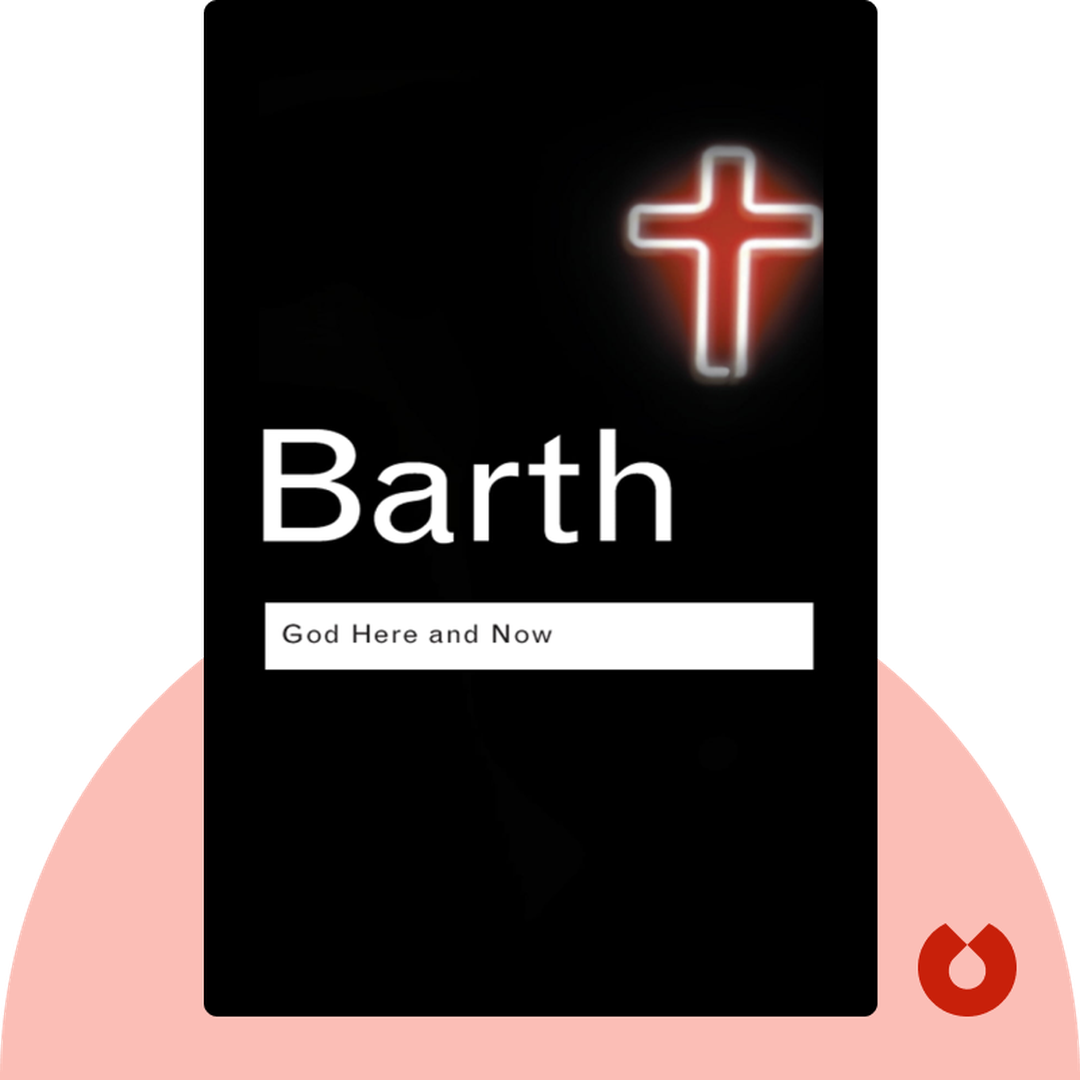
God Here and Now (1964) is a collection of addresses and essays that explore fundamental tenets of Christianity from a Protestant theologian’s point of view. Covering the gospel, faith, grace, the Bible, the Church, ethics, and humanism, it poses questions on what it means to meet God in today’s world.
Who Should Listen to God Here and Now?
- People curious about the perspective of a modern Protestant thinker
- Christians who want to better understand and implement scripture
- Anyone grappling with questions regarding faith, ethics, or humanism
Books Similar to God Here and Now
Readers who enjoyed this also liked these titles.