If You're Curious About These Questions...
You should listen to this audiobook
- Have you ever wondered why the sheer complexity of the universe is actually one of the strongest arguments against the existence of a divine creator?
- Are you curious about how we can build a more compassionate and ethical society by moving beyond religious foundations for our morals?
- What if you could logically deconstruct the world’s most popular arguments for faith and discover the surprising statistical improbability of a higher being?
Listen to The God Delusion — Cinematic Audio Edition
Loading player...
Key Takeaways from The God Delusion
- Understand why traditional arguments for God's existence, such as the cosmological 'First Cause' and ontological proofs, are logically flawed and fail to persuade.
- Discover how historical inaccuracies and contradictions within the Bible prove that scripture is a product of human storytelling rather than a reliable record of divine truth.
- Learn how Charles Darwin’s theory of evolution provides a far more statistically probable explanation for complex life on Earth than the existence of an intelligent creator.
- Find out why religion itself serves no direct evolutionary purpose, functioning instead as an unintended psychological by-product of human evolution.
- Explore a critical perspective on religious morality and question whether biblical scriptures, given their often amoral stories, are truly essential for guiding our lives.
Learning Tools
Reinforce what you learned from The God Delusion
Mind Map
The God Delusion
Arguments for God+
Flaws of Scripture+
Evolution vs. Creationism+
Morality and Society+
Religion and Children+
Societal Privilege and Science+
Quiz — Test Your Understanding
Question 1 of 10
What is the primary logical flaw Richard Dawkins points out regarding Thomas Aquinas's Cosmological Argument (the 'First Cause' proof)?
Question 2 of 10
According to the text, why do reputable biblical scholars consider the New Testament to be an inaccurate historical record?
Question 3 of 10
How does the author use the concept of probability to argue against the existence of a divine creator?
Question 4 of 10
The book compares religion to a moth flying into a candle flame. What does this analogy illustrate?
Question 5 of 10
According to the text, what is the evolutionary basis for human altruism and sympathy?
Question 6 of 10
Why does the author use the biblical story of Lot offering his daughters to an angry mob?
Question 7 of 10
According to the text, how do societal morals actually shift over time?
Question 8 of 10
What is the author's stance on parents assigning a religion to their children?
Question 9 of 10
What example is used in the text to demonstrate that religious beliefs are given unjustified legal protection compared to other beliefs?
Question 10 of 10
Why does the author suggest that the comfort offered by religious belief regarding the afterlife is hypocritical?
The God Delusion — Full Chapter Overview
- 1Recommendation
- 2The best-known arguments for God’s existence are not convincing.
- 3Scripture can’t prove God exists because it contains gaps and contradictions.
- 4Natural selection and evolution explain life on Earth more plausibly than God’s existence.
- 5Religion is an evolutionary by-product and has no purpose in itself.
- 6Goodness is an evolutionary by-product with self-serving motives, not divine origins.
- 7Our morals shouldn’t be based on the Bible, since its values conflict with modern society.
- 8Morals reflect their time and change as society changes.
- 9Taken literally, the scriptures harm society’s moral values.
- 10Children assigned a religion without choice often suffer mental and physical abuse.
- 11Religious beliefs receive stronger protection than other beliefs, even when discriminatory.
- 12Science is a better source of creative inspiration than religion, and seeking consolation in religion is hypocritical.
- 13Final summary
The God Delusion Summary & Overview
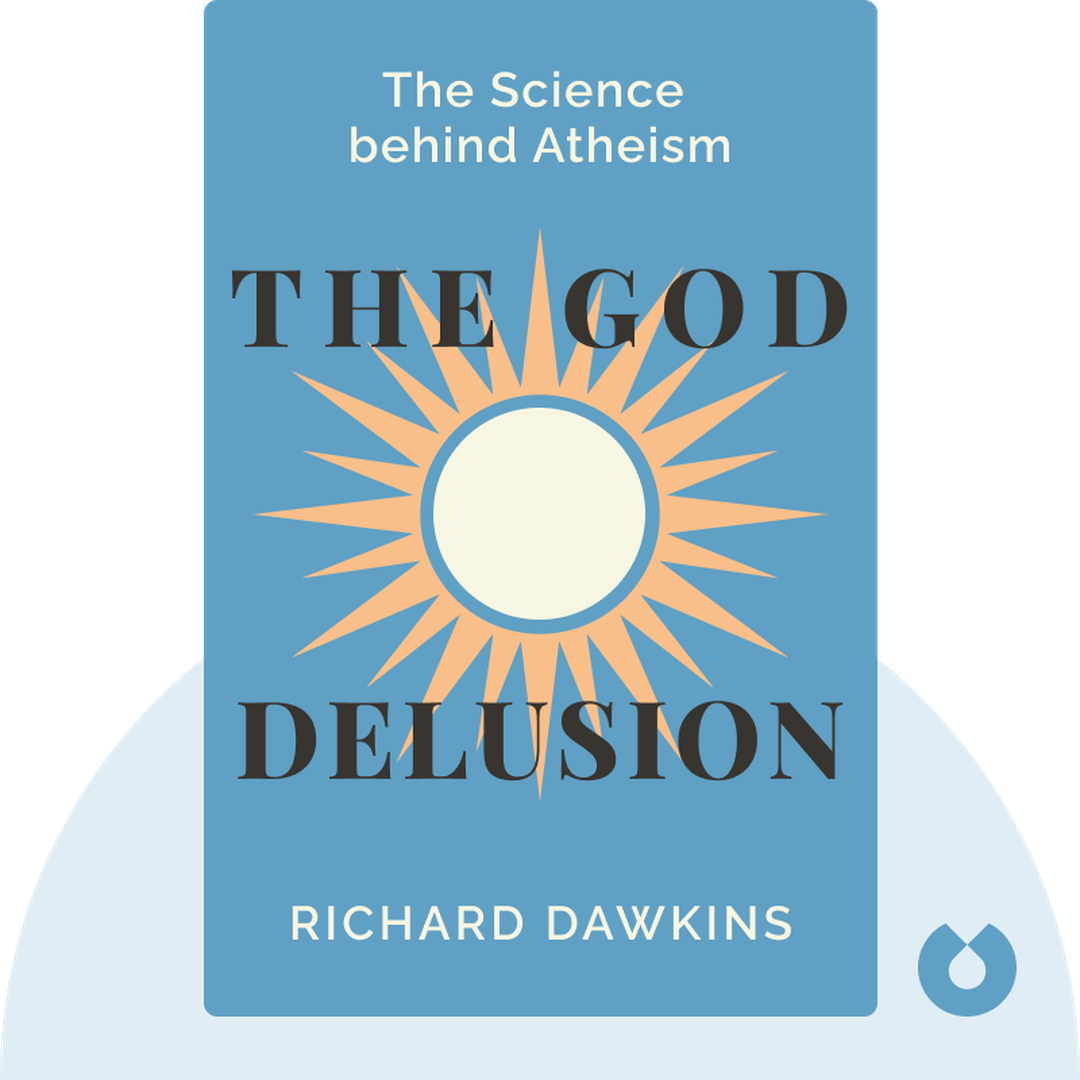
The God Delusion (2006) deconstructs the most popular arguments and reasoning for the existence of God to show the statistical and logical improbability of a higher being’s actual existence. These blinks explain why religion shouldn’t be the foundation for society’s morals and how it can actually be harmful to our ethical standards.
Who Should Listen to The God Delusion?
- Anyone interested in religion or philosophy
- Agnostics and atheists who want solid arguments to back up their beliefs
Books Similar to The God Delusion
Readers who enjoyed this also liked these titles.