If You're Curious About These Questions...
You should listen to this audiobook
- Have you ever wondered why humans across all cultures share a mysterious sense of 'right and wrong'—and what that reveals about the origin of the universe?
- Did you know that there is one 'Great Sin' that C.S. Lewis claims is the root of every other evil, yet it’s the one flaw we almost never recognize in ourselves?
- What if the ultimate goal of the Christian life isn't just to make you a 'better' person, but to transform you into an entirely different kind of being?
Listen to Mere Christianity — Cinematic Audio Edition
Loading player...
Key Takeaways from Mere Christianity
- Discover how timeless reflections on morality and faith can restore your spirit and combat modern feelings of hopelessness, skepticism, and nihilism.
- Understand why the human tendency to quarrel reveals an intuitive, shared knowledge of a universal moral law rather than an arbitrary human invention.
- Learn why moral values are consistent across different times and cultures, functioning much like universal mathematical truths rather than subjective societal constructs.
- Realize why the scientific method is ill-equipped to answer fundamental 'why' questions about the universe, and how introspection reveals the deeper forces guiding our behavior.
- Find out how the undeniable existence of a universal moral law provides compelling evidence for a spiritual, intentionally designed universe over a purely materialistic one.
Learning Tools
Reinforce what you learned from Mere Christianity
Mind Map
Mere Christianity
The Universal Moral Law+
The Trilemma of Christ+
The Problem of Evil+
Christian Morality & Character+
Christianity and Science+
Quiz — Test Your Understanding
Question 1 of 10
Under what historical circumstances did C.S. Lewis originally deliver the reflections that make up 'Mere Christianity'?
Question 2 of 10
According to the text, what does the human tendency to quarrel and make excuses reveal about us?
Question 3 of 10
How does Lewis respond to the cultural relativist argument that different societies have completely different moral rules?
Question 4 of 10
Why does Lewis believe the existence of the moral law points to a theistic universe rather than a purely materialistic one?
Question 5 of 10
In Lewis's 'trilemma' regarding Jesus's claim to divinity, which commonly held view does he completely reject as an unacceptable option?
Question 6 of 10
How does the book describe the relationship between good and evil in order to address the 'problem of evil'?
Question 7 of 10
What is the true purpose of Christian morality, according to Lewis's argument against the idea of God as a 'Grinch-like' figure?
Question 8 of 10
How does Lewis define the Christian virtue of 'faith'?
Question 9 of 10
According to the text, what 'secret reward' comes from practicing the virtue of charity?
Question 10 of 10
How does the text view the relationship between Christianity and the theory of evolution?
Mere Christianity — Full Chapter Overview
- 1Recommendation
- 2All humans have an intuitive sense of universal moral law.
- 3Moral values are largely consistent across cultures and eras.
- 4The existence of moral law points to theism.
- 5Of all logical possibilities, the most likely is that Jesus truly was, and is, God.
- 6Human free will is the cause of evil in the world.
- 7Christian morality centers on inner character and intention.
- 8Christians worship Christ because he is the model of human virtue on Earth.
- 9Virtue helps us rise above our base, material existence and reach spiritual perfection.
- 10Christianity marks an evolutionary step forward in human history.
- 11Final summary
Mere Christianity Summary & Overview
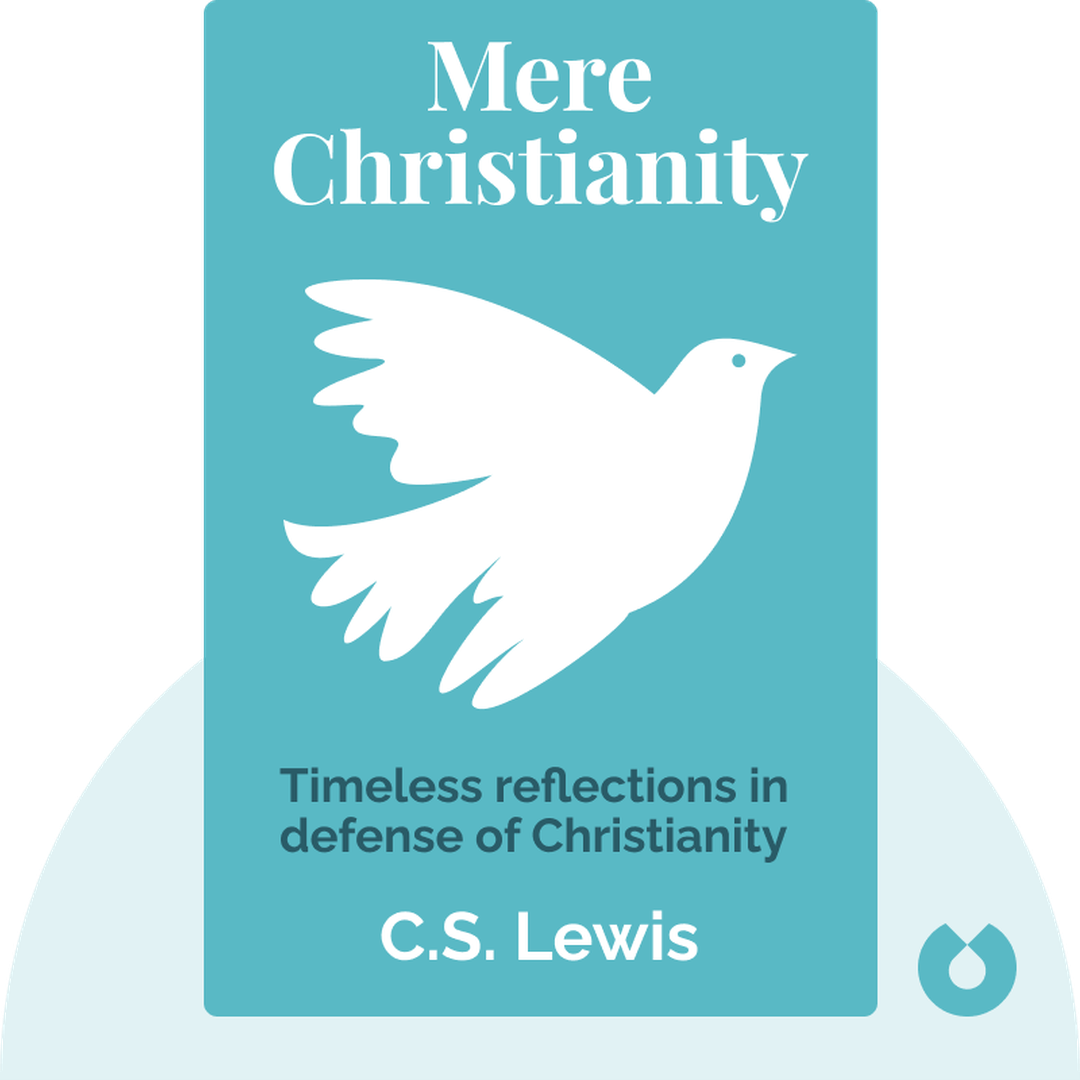
Mere Christianity (1952) is one of the most famous and influential apologetics for the Christian faith ever written. Compiled from C.S. Lewis’s legendary World War II radio broadcasts, it brings together a series of timeless reflections designed to explain and defend Christianity. Mere Christianity outlines Lewis’s arguments for the truth of the Christian doctrine. It also explores what Christian life involves and why Lewis thinks we’re all better off as Christians.
Who Should Listen to Mere Christianity?
- Believers who want to strengthen their faith
- Nonbelievers who like to challenge their worldview
- Non-Christians looking for a clear introduction to Christian beliefs
Books Similar to Mere Christianity
Readers who enjoyed this also liked these titles.