If You're Curious About These Questions...
You should listen to this audiobook
- Have you ever wondered why one tiny three-letter word might be the only thing standing between you and your biggest dreams?
- What if you could discover the six essential lessons for transforming your deepest insecurities into a source of permanent confidence?
- Are you curious about the secret mindset shifts that allow you to stop making excuses and finally take full control of your life?
Listen to Get Off Your "But" — Cinematic Audio Edition
Loading player...
Key Takeaways from Get Off Your "But"
- Discover how to reframe your life's most painful moments, choosing to view them as gifts for personal growth rather than heavy burdens to bear.
- Learn how to identify and eliminate the 'BUTs' in your life, removing the cushioned excuses that prevent you from unlocking your true potential.
- Understand the crucial difference between merely communicating and genuinely connecting by shifting your focus away from your own shyness and toward helping others.
- Master your inner dialogue by eavesdropping on your thoughts and replacing fear-based language with the same kindness and encouragement you would offer a best friend.
- Find out how to instantly improve your emotional state and exude physical confidence simply by adjusting your posture, breathing, and facial expressions.
Learning Tools
Reinforce what you learned from Get Off Your "But"
Mind Map
Get Off Your "But"
Overcoming Adversity+
Lesson 1: Making Connections+
Lesson 2: Choosing Better Words+
Lesson 3: The Mind-Body Connection+
Lesson 4: Staying on the Bright Side+
Lesson 5: You Can Pick Your Friends+
Lesson 6: Take Control+
Quiz — Test Your Understanding
Question 1 of 8
What profound question did the author's mother ask him when he broke his femur at age nine, which permanently shifted his perspective on adversity?
Question 2 of 8
According to the author, what is the most effective way to overcome the shyness that prevents us from connecting with others?
Question 3 of 8
In the context of managing our inner dialogue, how does the author suggest we redefine the concept of 'fear'?
Question 4 of 8
What is the core message of the 'mind-body connection' demonstrated by the author's friend Andréa?
Question 5 of 8
What is the purpose of the 'Egg-Timer Technique' described in Lesson 4?
Question 6 of 8
How does the author suggest true friends should act, using the 'pit crew' analogy?
Question 7 of 8
According to the 'Freedom Formula' (C > E), what does it mean to live on the 'Effect' side of the equation?
Question 8 of 8
How does the author define true learning at the conclusion of the book?
Get Off Your "But" — Full Chapter Overview
- 1Recommendation
- 2Overcoming Hardship
- 3Lesson 1: Building Connections
- 4Lesson 2: Choosing Better Words
- 5Lesson 3: The Mind-Body Link
- 6Lesson 4: Staying Positive
- 7Lesson 5: Choosing Your Friends
- 8Lesson 6: Taking Control
- 9Final summary
Get Off Your "But" Summary & Overview
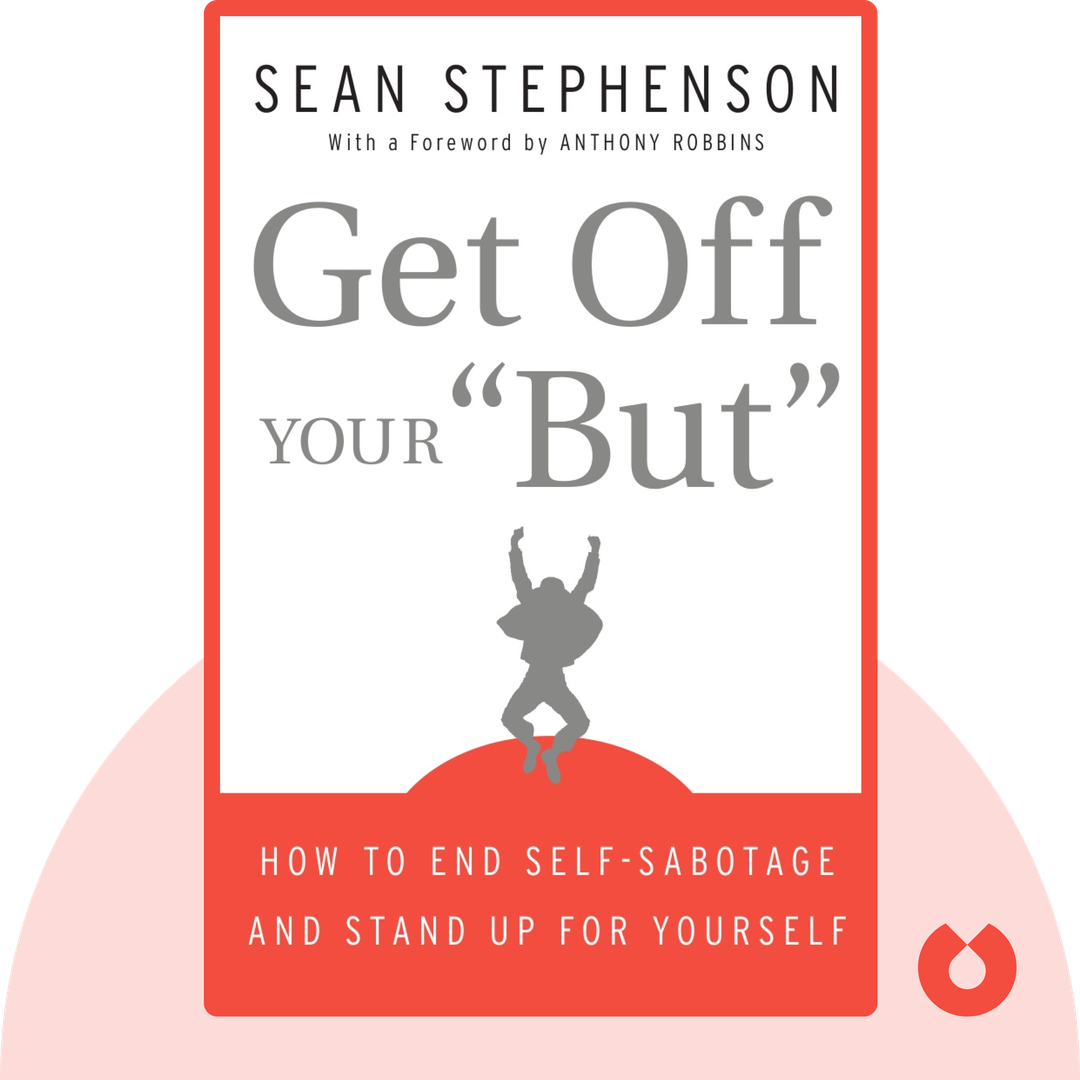
Get Off Your “But” (2009) offers a thorough look into the methods and mindset of the popular therapist and motivational speaker Sean Stephenson. You’ll learn his six lessons for getting past your excuses, becoming more confident, and taking control over your life.
Who Should Listen to Get Off Your "But"?
- People eager for a motivational kick in the butt
- Those struggling with unrealized dreams
- Fans of uplifting stories
Books Similar to Get Off Your "But"
Readers who enjoyed this also liked these titles.