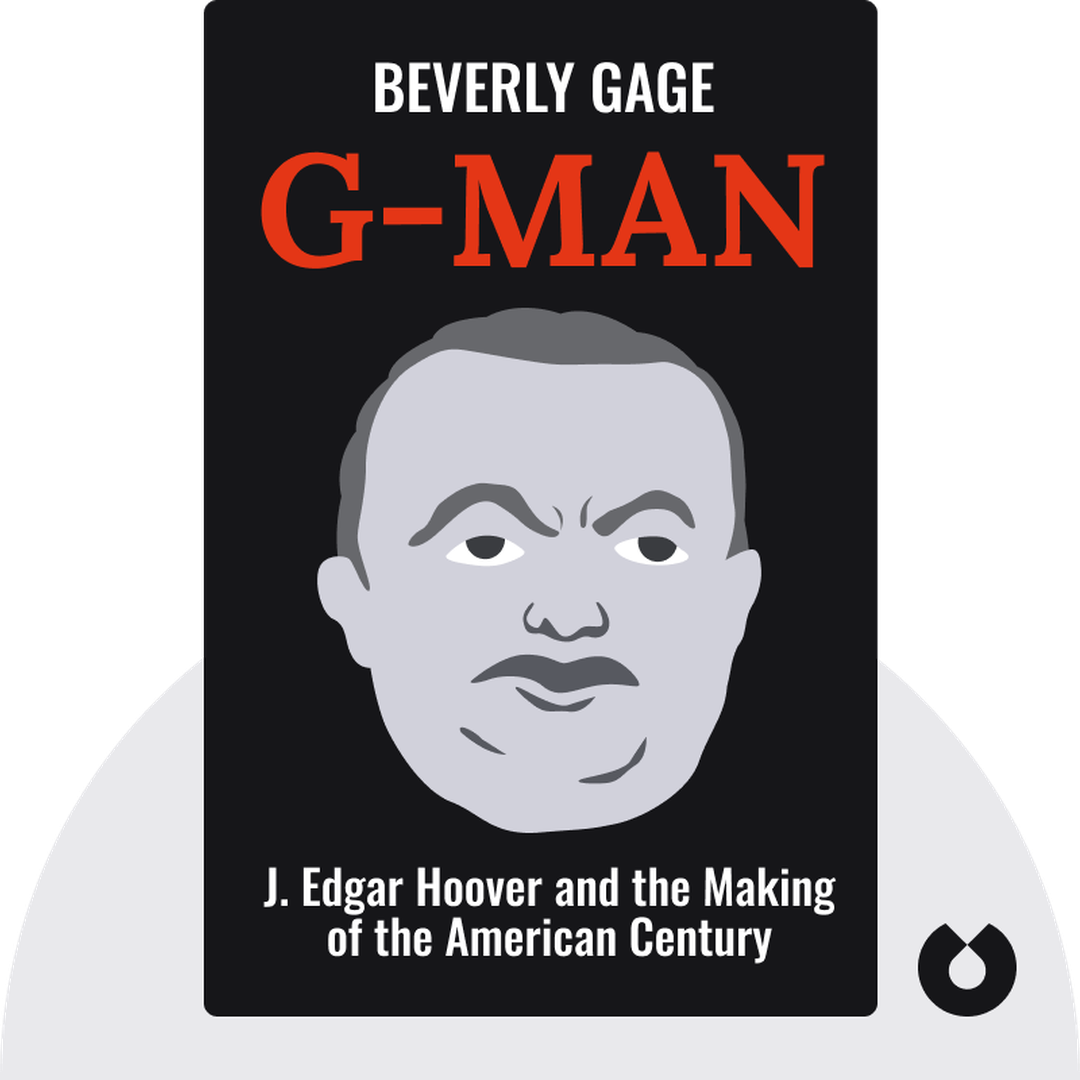
If You're Curious About These Questions...
You should listen to this audiobook
- Did you know that one man managed to hold onto the reins of American power for nearly half a century, serving under eight different presidents?
- Have you ever wondered how J. Edgar Hoover used a massive web of secret files and surveillance to shape the very foundations of modern American politics?
- Are you curious about the hidden personal life and the private contradictions of the man who turned the FBI into one of the most influential organizations in the world?
Listen to G-Man — Free Audiobook
Loading player...
Key Takeaways from G-Man
- Discover how J. Edgar Hoover's early exposure to rigid masculine ideals and a white supremacist fraternity shaped his personal flaws and the exclusionary hiring practices of the early FBI.
- Learn how Hoover utilized his exceptional data-cataloging skills to build the FBI's fingerprint database and weaponized this information to dig up dirt on his political critics.
- Find out how Hoover initially legitimized the Bureau of Investigation in 1924 by separating it from politics and implementing strict, merit-based hiring standards for agents.
- Understand the catalyst behind the FBI's transformation from unarmed intellectual investigators into heavily armed 'G-Men' in response to Prohibition-era gangsters and the Lindbergh baby kidnapping.
- Explore how a Hollywood mandate to portray law enforcement positively during the Great Depression catapulted Hoover to celebrity status and transformed the FBI's public image.
Learning Tools
Reinforce what you learned from G-Man
Mind Map
G-Man
Early Life & Formation+
Building the FBI+
Public Persona & Private Reality+
WWII & Intelligence Expansion+
Cold War & Social Crusades+
Decline & Legacy+
Quiz — Test Your Understanding
Question 1 of 9
How did J. Edgar Hoover's family background influence his personal development and later ideals?
Question 2 of 9
How did Hoover respond to the public backlash and criticism he received following the Palmer Raids?
Question 3 of 9
When Hoover was appointed director of the bureau of investigation in 1924, what were his initial requirements for new agents?
Question 4 of 9
What event or circumstance was primarily responsible for turning Hoover's 'gentleman detectives' into armed, tommy-gun-toting G-Men?
Question 5 of 9
What was a notable contradiction between Hoover's public persona and his private life?
Question 6 of 9
Why was Hoover able to immediately round up thousands of Japanese, German, and Italian individuals right after the attack on Pearl Harbor?
Question 7 of 9
What was Hoover's only significant and proactive public stand in favor of civil rights during his career?
Question 8 of 9
How did Hoover respond to the civil rights movement of the 1960s?
Question 9 of 9
According to the text, what was the primary reason Hoover was able to shape the US political system so deeply?
G-Man — Full Chapter Overview
- 1Recommendation
- 2How the Man Was Made
- 3Fidelity, Bravery, and Integrity
- 4Hoover in Hollywood
- 5In the Lead-Up to the Big War
- 6Communists and Homosexual People
- 7Civil Rights and the Close of an Era
- 8Final Summary
G-Man Summary & Overview
G-Man (2022) is a thorough and comprehensive biography of J. Edgar Hoover and the history of the FBI. Drawing from established history as well as newly uncovered documents, it covers the entire timeline of Hoover’s personal life as well as his role in shaping America as we know it.
Who Should Listen to G-Man?
- American history buffs
- People curious about J. Edgar Hoover
- Anyone interested in the hidden forces influencing American politics
Books Similar to G-Man
Readers who enjoyed this also liked these titles.