If You're Curious About These Questions...
You should listen to this audiobook
- Have you ever wondered if you are truly the master of your own choices, or just a biological machine governed by the laws of physics?
- Did you know that the capacity for free will isn't just a philosophical concept, but a survival strategy that began evolving billions of years ago?
- Are you curious about how your brain uses tools like imagination and introspection to break free from the chains of cause and effect?
Listen to Free Agents — Free Audiobook
Loading player...
Key Takeaways from Free Agents
- Understand the intricate debate between determinism and free will, exploring why some physicists suggest our sense of making choices might just be a grand illusion governed by physical laws.
- Discover how life originally distinguished itself from inert matter by using continuous energy to fight entropy, forming the earliest biological goals and self-preserving interests.
- Explore the evolutionary origins of agency by seeing how simple organisms used primitive sensors and information exchange to adapt to their environments rather than relying on fixed cues.
- Learn how the emergence of mediating neurons changed biology forever by allowing organisms to pause, integrate sensory data, and make considered decisions instead of reacting with automatic reflexes.
- Uncover the hidden biases behind historical arguments for free will, and see how human volition ultimately evolved from a long biological chain of sensing, analyzing, and deciding.
Learning Tools
Reinforce what you learned from Free Agents
Mind Map
Free Agents
The Determinism Debate+
Biological Roots of Agency+
Evolution of Cognition+
Sense of Self and Intentionality+
Randomness and Decision-Making+
Character and Identity+
Quiz — Test Your Understanding
Question 1 of 7
According to the text, how is determinism characterized in the debate about free will?
Question 2 of 7
How do physicists fundamentally define 'life' in contrast to non-living things like rocks?
Question 3 of 7
What crucial role did 'mediating neurons' play in the evolution of cognition?
Question 4 of 7
According to the text, what gives human beings their 'intentional decision-making powers'?
Question 5 of 7
What does the 'two-stage model of action selection' involve?
Question 6 of 7
How does the text describe the trajectory of free will as a person matures?
Question 7 of 7
What is the ultimate conclusion the book draws regarding determinism and human free will?
Free Agents — Full Chapter Overview
- 1Recommendation
- 2Free Will vs. Determinism
- 3What Does It Mean to Be Alive?
- 4Sensing, Analyzing, and Making Decisions
- 5How Cognition Evolved
- 6The Sense of Self and the Power to Choose
- 7Randomness in Decision-Making
- 8Your Character and the Choices You Make
- 9Final summary
Free Agents Summary & Overview
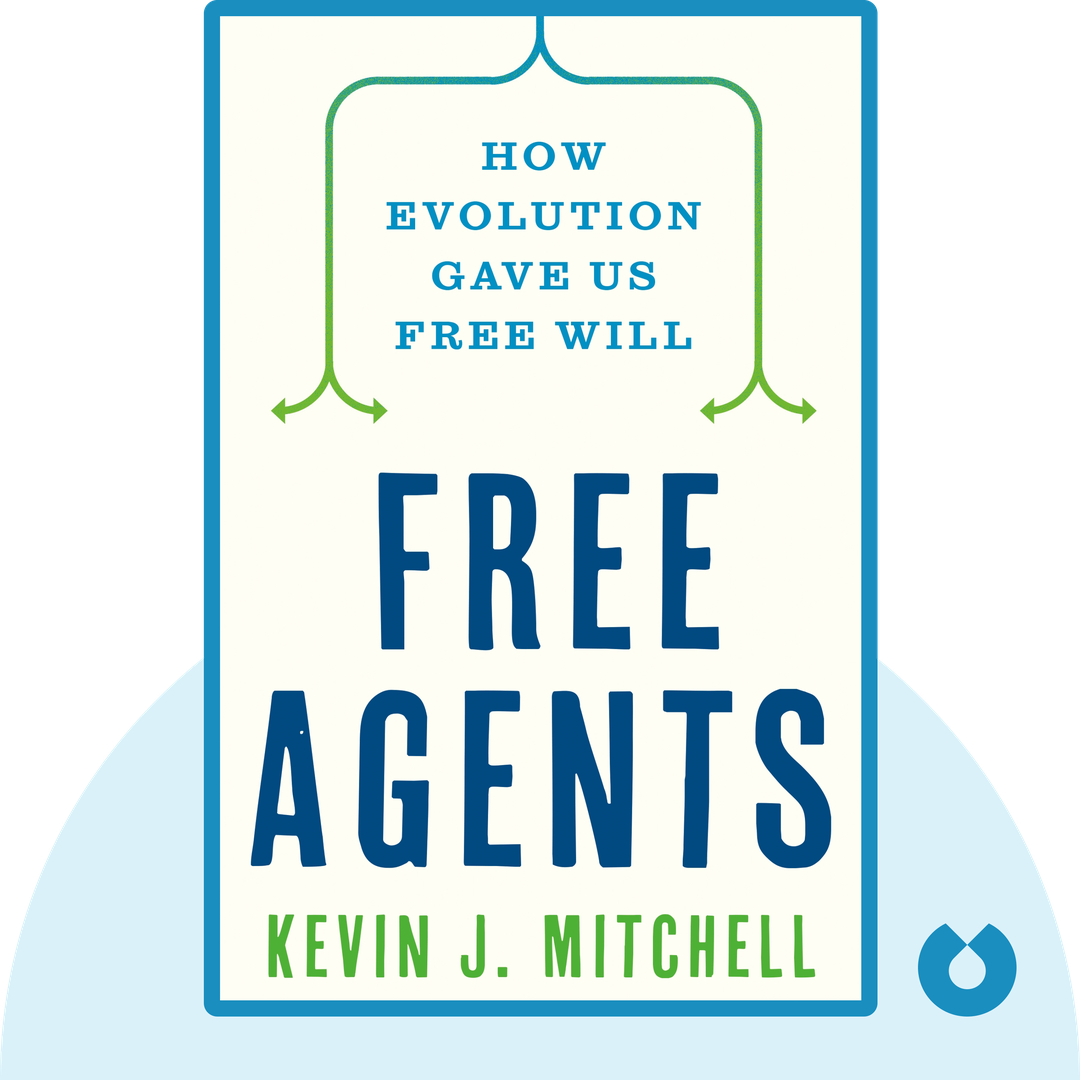
Free Agents (2023) makes the case that we do have free will and are not just machines responding to physics. Tracing the evolutionary history of purposeful decision-making back billions of years, the book explores abilities like imagination, introspection, and causal reasoning that developed over time to allow us to predict outcomes, shape our futures based on our sense of identity, and exercise individual and collective agency over our lives.
Who Should Listen to Free Agents?
- Philosophers and thinkers
- Science enthusiasts
- Anyone interested in the question free will
Books Similar to Free Agents
Readers who enjoyed this also liked these titles.