Theme Song
If You're Curious About These Questions...
You should listen to this audiobook
- Have you ever wondered if the choices you make are truly yours, or if they’re just the inevitable result of biological forces you can’t control?
- Did you know that letting go of the concept of free will might actually be the secret to building a more compassionate and just society?
- What if every decision you’ve ever made was actually determined by a complex chain of events starting long before you were even born?
Listen to Determined — Cinematic Audio Edition
Loading player...
Key Takeaways from Determined
- Understand why the concept of free will is an illusion and how your behavior is fundamentally predetermined by biological and environmental factors outside your control.
- Discover the logic of determinism and learn how every action traces back to a continuous chain of genetics, childhood development, and cultural influences.
- Learn about the 'readiness potential' and how your brain's neurons actually commit to an action milliseconds before you consciously decide to do it.
- Master the concept of 'free won't' to understand how you possess a split-second window to consciously veto an unconscious urge before taking action.
- Explore why even the most spontaneous, high-stakes decisions are never truly random, but are actually the direct result of decades of deep cognitive conditioning.
Learning Tools
Reinforce what you learned from Determined
Mind Map
Determined
The Illusion of Free Will+
Unconscious Decision Making+
The Timeline of Conditioning+
Rethinking Justice+
Quiz — Test Your Understanding
Question 1 of 6
Why does the author use the anecdote about the world balancing on a series of turtles?
Question 2 of 6
What did neuroscientist Benjamin Libet's experiments reveal about human decision-making?
Question 3 of 6
According to the text, what is the concept of 'free won't'?
Question 4 of 6
How does the development of the frontal cortex relate to the book's argument against free will?
Question 5 of 6
According to the text, how do immediate physical states and sensory inputs affect split-second decisions?
Question 6 of 6
If society accepts that free will does not exist, how does the author suggest we handle dangerous individuals?
Determined — Full Chapter Overview
- 1Recommendation
- 2Your life is shaped by biological and cultural factors beyond your control
- 3Your decisions are made unconsciously
- 4Decisions are shaped by decades of cognitive and cultural conditioning
- 5Can accountability exist without free will?
- 6Final summary
Determined Summary & Overview
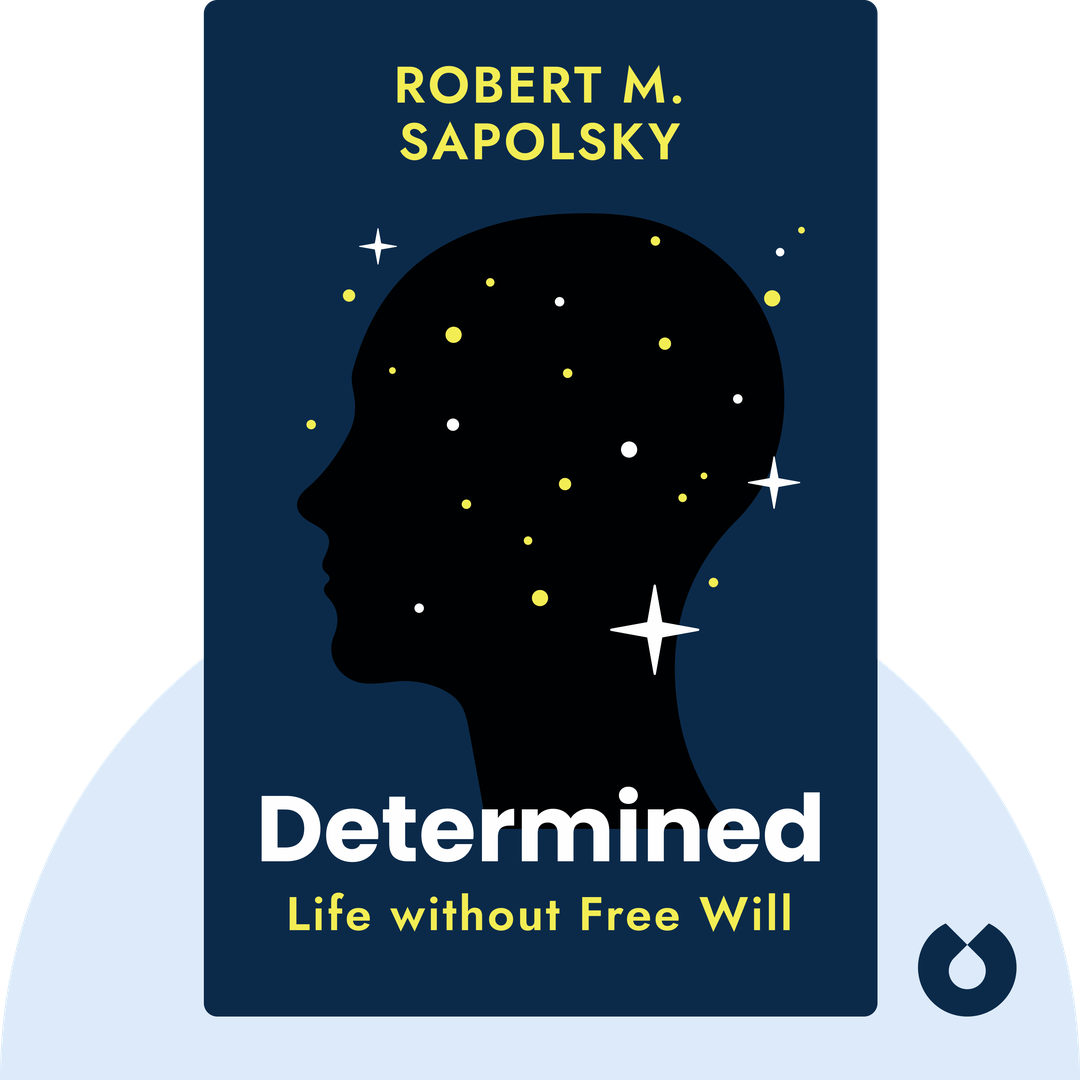
Determined (2023) argues that free will is an illusion – all human behavior stems from biological and cultural factors we don't control. Through scientific research and case studies, it lays out the argument in favor of determinism, and aims to persuade why rejecting the notion of free will might be a positive step.
Who Should Listen to Determined?
- Philosophers interested in free will, determinism, and human agency
- Neuroscientists and psychologists studying decision-making
- Anyone curious about what guides human behavior and choices
Books Similar to Determined
Readers who enjoyed this also liked these titles.