If You're Curious About These Questions...
You should listen to this audiobook
- Have you ever wondered why even the most well-intentioned diversity initiatives often fail to create lasting fairness in the workplace?
- What’s the secret to moving beyond diversity as a buzzword and building a system where every single employee can actually thrive?
- Did you know that the very design of your organizational systems could be reinforcing bias without you even realizing it?
Listen to Equity — Free Audiobook
Loading player...
Key Takeaways from Equity
- Understand the crucial difference between equality and equity, and learn why diversity and inclusion initiatives are toothless without systems that accommodate individual differences.
- Discover how the myth of pure individual effort blinds us to systemic inequities, and learn to identify the structural biases baked into our institutions.
- Learn how to offset systemic bias using human-centered design by actively involving diverse end-users at every stage of the problem-solving and prototyping process.
- Find out why 'putting yourself in someone else's shoes' fails to create true empathy, and discover how genuine connection actually comes from simply listening to what marginalized people have to say.
- Master the three essential traits of an equitable leader by adopting the right values, recognizing systemic barriers, and humbly acknowledging the structural advantages that aided your own success.
Learning Tools
Reinforce what you learned from Equity
Mind Map
Equity
Core Definitions & Systemic Bias+
Human-Centered Design+
Equitable Leadership+
Behavioral Change Communication+
The REACH Marketing Model+
Taking Action+
Quiz — Test Your Understanding
Question 1 of 7
According to the text, what is the fundamental difference between equality and equity?
Question 2 of 7
What does the author identify as one of the greatest obstacles to addressing systemic inequity in the US?
Question 3 of 7
Why does the author argue that 'putting yourself in someone else's shoes' is a flawed way to practice empathy?
Question 4 of 7
Which of the following is NOT one of the three conditions an equitable leader must meet?
Question 5 of 7
How can an organization make equitable outcomes 'effortless' according to the text?
Question 6 of 7
In the context of Behavioral Change Communication (BCC), what is the purpose of 'framing' a message?
Question 7 of 7
What does the 'A' in the REACH model for marketing communications stand for?
Equity — Full Chapter Overview
- 1Recommendation
- 2We need to recognize the inequity built into our systems.
- 3We can counter systemic bias by learning from human-centered design.
- 4Equitable leaders take a systems-oriented approach to change.
- 5Organizations can be redesigned to make equitable outcomes effortless.
- 6Clear communication can reinforce positive behavioral change.
- 7Review marketing communications to ensure positive messaging.
- 8Final summary
Equity Summary & Overview
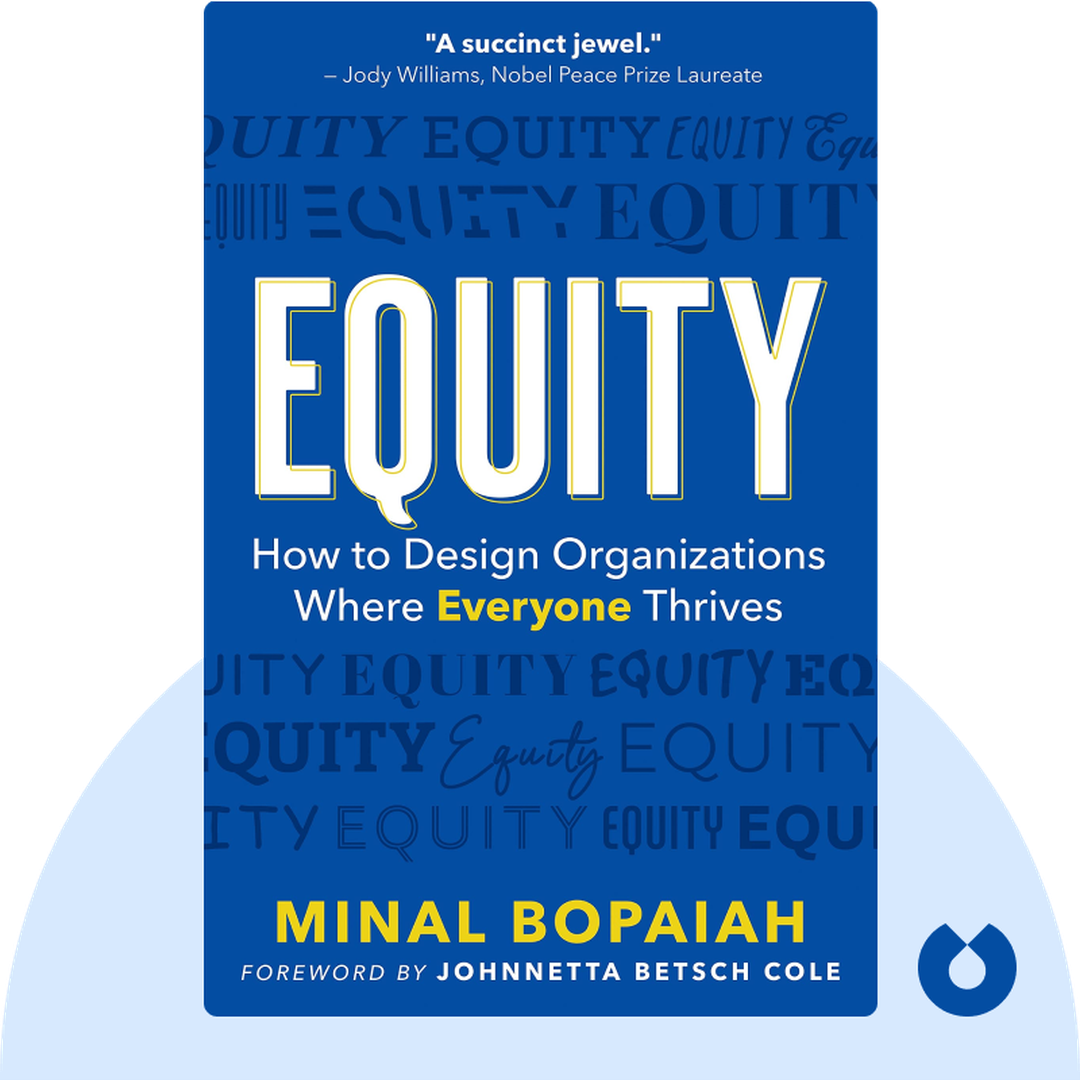
Equity (2021) is your guide to building equitable systems in the twenty-first century. It was designed to help socially conscious leaders with the challenging task of creating fair and inclusive organizations that work for everybody.
Who Should Listen to Equity?
- Leaders who want to embed their values into their business or nonprofit
- Diversity officers tasked with promoting a diverse and inclusive office culture
- Anyone who wants to be more mindful of bias in their thinking and behavior
Books Similar to Equity
Readers who enjoyed this also liked these titles.