If You're Curious About These Questions...
You should listen to this audiobook
- Did you know that your insurance company might be using a hidden, three-step playbook specifically designed to keep your money in their pockets instead of yours?
- Have you ever wondered why insurance companies shifted from being your "good neighbor" to an aggressive adversary, and how this change impacts your financial security?
- Are you curious about the secret internal strategies that allow multi-billion dollar corporations to systematically delay and deny valid claims without consequence?
Listen to Delay, Deny, Defend — Free Audiobook
Loading player...
Key Takeaways from Delay, Deny, Defend
- Understand how the 'Delay, Deny, Defend' strategy works, where insurance companies intentionally stall claims to maximize investment income on your premium dollars.
- Discover how the American insurance industry shifted its claims departments from fair-minded customer service centers into aggressive profit machines.
- Learn how McKinsey & Company introduced the concept of 'leakage,' teaching insurers to view full claim payouts as lost profits rather than fulfilled promises.
- Find out why insurers specifically target Minor Impact, Soft Tissue (MIST) claims, using the lack of x-ray evidence to systematically underpay millions of injured drivers.
- Uncover the deceptive math behind modern insurance policies, where every dollar delayed or denied from legitimate claimants directly boosts shareholder profits.
Learning Tools
Reinforce what you learned from Delay, Deny, Defend
Mind Map
Delay, Deny, Defend
Core Strategy & Industry Shift+
The McKinsey Influence+
The MIST Playbook+
Mass Scale Denials (Hurricane Katrina)+
Fighting Back & Reforms+
Quiz — Test Your Understanding
Question 1 of 6
What is the primary financial incentive behind the insurance industry's 'delay, deny, defend' strategy?
Question 2 of 6
How did McKinsey & Company redefine the concept of 'leakage' for the insurance industry?
Question 3 of 6
Why did insurance companies specifically target MIST (Minor Impact, Soft Tissue) claims for their aggressive denial strategies?
Question 4 of 6
During Hurricane Katrina, how did insurers use the 'anti-concurrent causation clause' to avoid paying claims?
Question 5 of 6
According to the text, what is a major systemic obstacle to achieving fair insurance reform?
Question 6 of 6
What is one of the key recommendations the author makes for consumers dealing with a major property damage claim?
Delay, Deny, Defend — Full Chapter Overview
- 1Recommendation
- 2A great betrayal
- 3When McKinsey arrived
- 4The MIST strategy
- 5Mass-scale broken promises
- 6A path toward fair insurance
- 7Final summary
Delay, Deny, Defend Summary & Overview
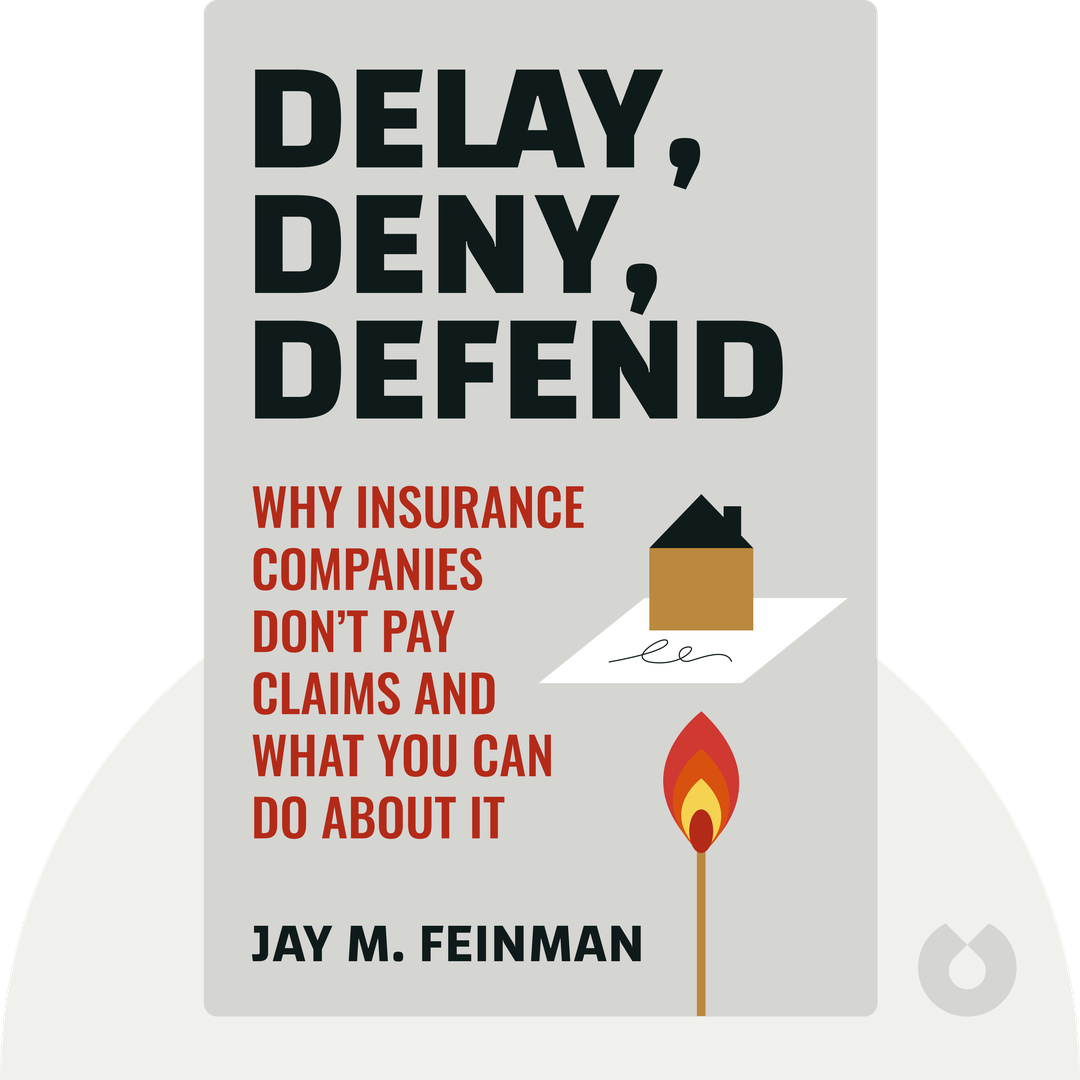
Delay, Deny, Defend (2010) exposes the insurance industry’s playbook for maximizing profit and minimizing claim payouts. You’ll see how “delay, deny, defend” became a profitable strategy, all at your expense. And by the end, you’ll have an understanding of how we got here – and where we go from here.
Who Should Listen to Delay, Deny, Defend?
- Policyholders tired of being ripped off by insurers
- Lawyers and advocates fighting systemic corporate abuse
- Anyone angered by corporate corruption and financial injustice
Books Similar to Delay, Deny, Defend
Readers who enjoyed this also liked these titles.