If You're Curious About These Questions...
You should listen to this audiobook
- Did you know that some of the most vulnerable creatures in nature survive by flawlessly impersonating their deadliest enemies?
- Have you ever wondered how the intricate patterns of a butterfly's wing eventually revolutionized the way modern militaries hide their ships and soldiers?
- What is the secret link between the world of avant-garde art and the high-stakes science of staying invisible on the battlefield?
Listen to Dazzled and Deceived — Free Audiobook
Loading player...
Key Takeaways from Dazzled and Deceived
- Discover how nineteenth-century pioneers like Darwin and Wallace used the study of harmless butterflies mimicking poisonous ones to shape the foundational theories of evolution.
- Understand why mimicry is used for both protection and predation, allowing cunning creatures like spiders to masquerade as bird droppings to lure unsuspecting prey.
- Learn how modern science uses epigenetics to explain how animals can adapt their fur color to diverse environments without altering their underlying genetic code.
- Explore the unsolved biological mysteries of camouflage, such as the octopus's baffling ability to instantly alter its skin texture to match rough or smooth ocean floors.
- Find out how nature’s survival tactics directly influenced human culture and art, inspiring painters to study animal countershading to manipulate light and visibility.
Learning Tools
Reinforce what you learned from Dazzled and Deceived
Mind Map
Dazzled and Deceived
Scientific Origins+
Nature's Strategies+
Influence on Art+
Military Camouflage+
Quiz — Test Your Understanding
Question 1 of 8
What is the defining characteristic of Batesian mimicry?
Question 2 of 8
How does the Celaenia excavata spider utilize mimicry for predatory purposes?
Question 3 of 8
According to the text, why did the population of black-winged peppered moths outnumber light-colored moths during the Industrial Revolution?
Question 4 of 8
How does the concept of epigenetics explain the different fur colors of the same mouse species in different environments?
Question 5 of 8
What is 'countershading,' a concept studied by American artist Abbott Handerson Thayer?
Question 6 of 8
What was the primary purpose of 'dazzling' ships with black and white zig-zag patterns during World War I?
Question 7 of 8
What major shift in military camouflage did British zoologist Hugh Cott advocate for during World War II?
Question 8 of 8
Why are traditional camouflage uniforms and 'dazzled' boats considered only marginally useful in modern warfare?
Dazzled and Deceived — Full Chapter Overview
- 1Recommendation
- 2Distinguished scientists such as Darwin, Wallace, and Bates studied mimicry in nature for more than a century.
- 3Mimicry in nature is used for both protection and predation.
- 4There is still much to learn about how mimicry and camouflage develop biologically.
- 5Mimicry and camouflage have strongly influenced art and artists.
- 6Early military camouflage in World War I was inspired by the natural world.
- 7World War II showed that texture matters more than color in camouflage.
- 8The science of military camouflage is more popular than ever.
- 9Final summary
Dazzled and Deceived Summary & Overview
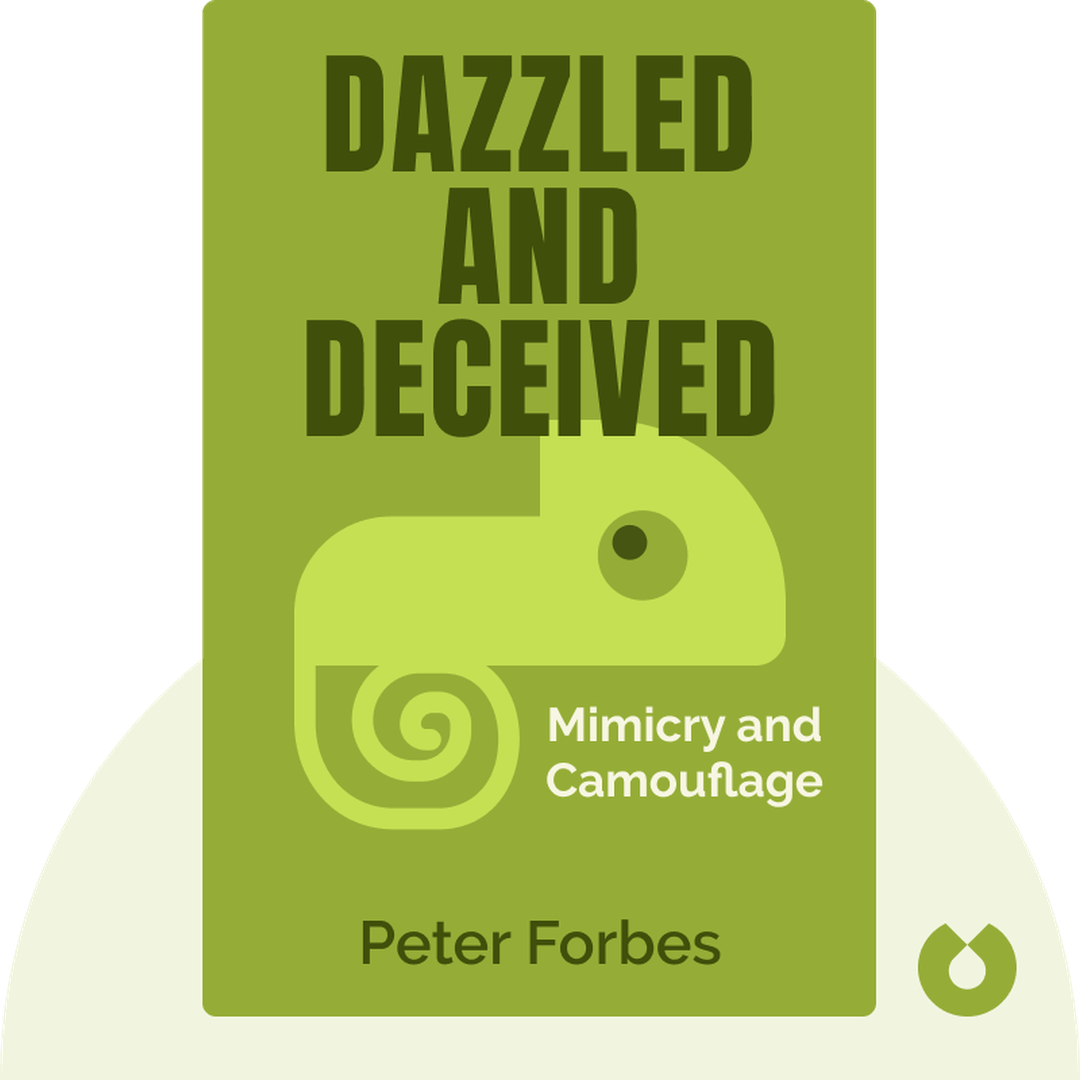
Dazzled and Deceived (2009) explores the fascinating phenomenon of camouflage and mimicry in nature, where animals act like leaves and harmless prey look like ferocious predators. These blinks examine how the science of camouflage has influenced not only artistic expression but also how humans fight and win wars.
Who Should Listen to Dazzled and Deceived?
- Biology lovers
- Artists looking for inspiration
- Fans of military history
Books Similar to Dazzled and Deceived
Readers who enjoyed this also liked these titles.