If You're Curious About These Questions...
You should listen to this audiobook
- Did you know that the highly intelligent octopus actually evolved from a simple, shell-bound creature similar to a snail?
- Have you ever wondered what it would be like to encounter a truly "alien" intelligence that evolved completely independently from our own?
- What's the secret to how an octopus manages to process information and "think" using its entire body rather than just a central brain?
Listen to Other Minds — Free Audiobook
Loading player...
Key Takeaways from Other Minds
- Explore how the remarkable intelligence and complex biology of the octopus challenge traditional scientific beliefs about animal consciousness and self-awareness.
- Discover how complex animal life originated from single-celled organisms that already displayed remarkable social behaviors, such as collaborative sensing and signaling.
- Learn how the octopus evolved over millions of years from a harmless, shelled mollusk with a single foot into a jet-propelled, highly intelligent marine predator.
- Understand the fascinating paradox of cephalopod camouflage, where completely colorblind creatures use skin that reacts to the environment independently of their brains.
- Find out why highly intelligent cephalopods like octopuses and cuttlefish have surprisingly short lifespans of just one to two years due to their evolutionary design.
Learning Tools
Reinforce what you learned from Other Minds
Mind Map
Other Minds
Evolutionary Origins+
Biology and Physiology+
Consciousness and Intelligence+
Quiz — Test Your Understanding
Question 1 of 6
How do the bacteria inside Hawaiian squids demonstrate a form of social behavior?
Question 2 of 6
What major evolutionary change allowed the octopus to transition from a harmless prey animal into a formidable predator?
Question 3 of 6
What is considered highly surprising about the spectacular color-changing abilities of octopuses and cuttlefish?
Question 4 of 6
What is the primary reason for the extremely short lifespan of female octopuses?
Question 5 of 6
According to the prevailing scientific attitude discussed in the text, how do animals like the octopus process complex information?
Question 6 of 6
How do jay birds challenge Charles Darwin's theory about language and complex thought?
Other Minds — Full Chapter Overview
- 1Recommendation
- 2Animals evolved from unicellular organisms that still displayed behavioral responses.
- 3The octopus, once a harmless mollusk, transformed into a jet-propelled predator.
- 4Octopus skin can alter color and react to its surroundings without any aid from the brain.
- 5Octopuses and cuttlefish both lead short lives due to evolutionary changes and the birthing process.
- 6There is still no agreement on whether animals experience complex consciousness.
- 7Darwin and modern science maintain language is needed for complex thought, although some animals clearly disagree.
Other Minds Summary & Overview
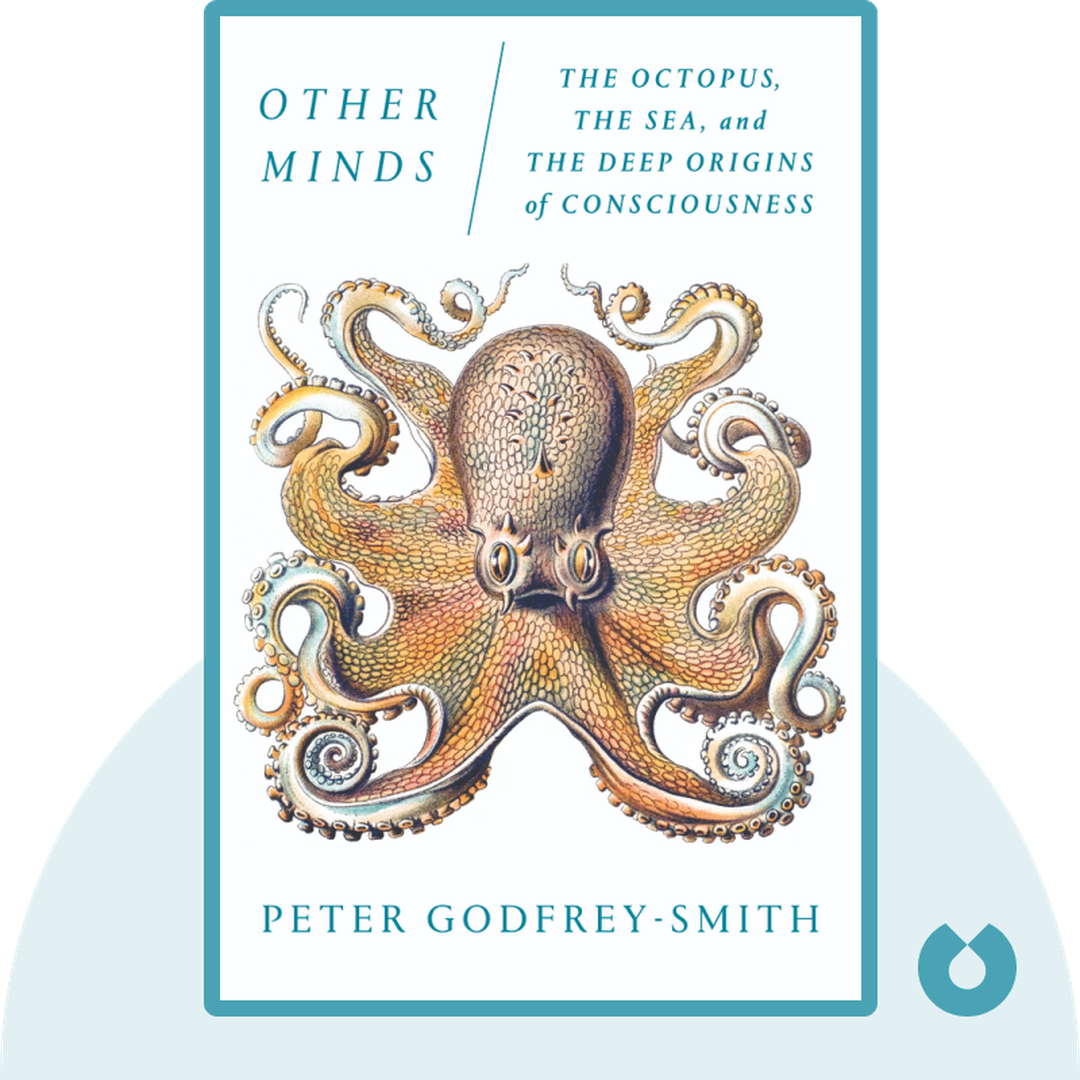
Other Minds (2016) is an exploration of the evolution of the octopus. Once a limpet-like creature that crawled along the bottom of the ocean, the octopus is now an intelligent and unique predator. Peter Godfrey-Smith guides the reader through billions of years of evolutionary history to explain the development of complex life, while shedding light on one of the world’s most intriguing animals.
Who Should Listen to Other Minds?
- Students of biology and zoology
- Readers interested in evolutionary science
- Animal lovers
Books Similar to Other Minds
Readers who enjoyed this also liked these titles.