If You're Curious About These Questions...
You should listen to this audiobook
- What's the secret to predicting the unpredictable, and how can understanding chaos theory help us make sense of the world's most complex systems?
- Are you curious about the hidden patterns behind the apparent randomness of life, from the weather to our heartbeats?
- Can the study of chaos theory reveal the underlying order in the universe, and what would it mean for our understanding of the world and ourselves?
Listen to Chaos — Free Audiobook
Loading player...
Key Takeaways from Chaos
- Discover why a butterfly flapping its wings in Beijing can cause a storm in New York due to the principle of sensitive dependence on initial conditions.
- Learn how a tiny rounding error in a 1961 meteorological simulation birthed chaos theory and proved that long-term weather prediction is fundamentally impossible.
- Understand how simple, nonlinear equations produce incredibly complex and chaotic behavior in everyday systems like waterwheels and playground swings.
- Find out how seemingly random and chaotic systems actually hide strange, aperiodic patterns that almost repeat themselves but never truly do.
- Uncover why early scientists like Galileo overlooked the inherent chaos in simple objects like pendulums by clinging to the illusion of perfectly predictable, linear systems.
Learning Tools
Reinforce what you learned from Chaos
Mind Map
Chaos
Origins & The Butterfly Effect+
Nonlinear Dynamics+
Ecology & Population Biology+
Fractals & Geometry+
Turbulence & Strange Attractors+
Universality+
Information & Popularization+
Biology & Medicine+
Quiz — Test Your Understanding
Question 1 of 9
What did meteorologist Edward Lorenz discover about weather systems that led to the concept of the 'butterfly effect'?
Question 2 of 9
According to the text, what is a defining characteristic of a nonlinear dynamical system?
Question 3 of 9
What surprising discovery did mathematician Stephen Smale make regarding the stability of nonlinear systems?
Question 4 of 9
When ecologist Robert May studied mathematical models of animal populations, what happened as he increased the 'boom-and-bustiness' of the population?
Question 5 of 9
Benoit Mandelbrot used the question 'How long is the coast of Britain?' to illustrate which mathematical concept?
Question 6 of 9
How did David Ruelle's concept of 'strange attractors' help explain the phenomenon of fluid turbulence?
Question 7 of 9
What was Mitchell Feigenbaum's major contribution that elevated the credibility of chaos theory?
Question 8 of 9
How did the Dynamical Systems Collective at Santa Cruz connect chaos theory to information theory?
Question 9 of 9
According to the text, how does chaos theory explain dangerous medical conditions like ventricular fibrillation?
Chaos — Full Chapter Overview
- 1Recommendation
- 2Meteorologist Edward Lorenz became the intellectual founder of chaos theory after uncovering weather’s unpredictability.
- 3Simple nonlinear systems can generate astonishingly complex behavior.
- 4In the 1970s, physicists and mathematicians began seriously investigating nonlinear systems.
- 5Animal populations act like nonlinear dynamical systems.
- 6Mandelbrot’s fractal geometry uncovered the endlessly intricate patterns of complex dynamical systems.
- 7Strange attractors helped physicists make sense of the complex motions of turbulence.
- 8By discovering universal principles of nonlinear systems, Mitchell Feigenbaum brought chaos theory new credibility.
- 9Young mathematicians at Santa Cruz used computer visuals and everyday examples to popularize chaos theory.
- 10Nonlinear dynamical systems appear throughout nature—and are especially important in biology.
- 11Final summary
Chaos Summary & Overview
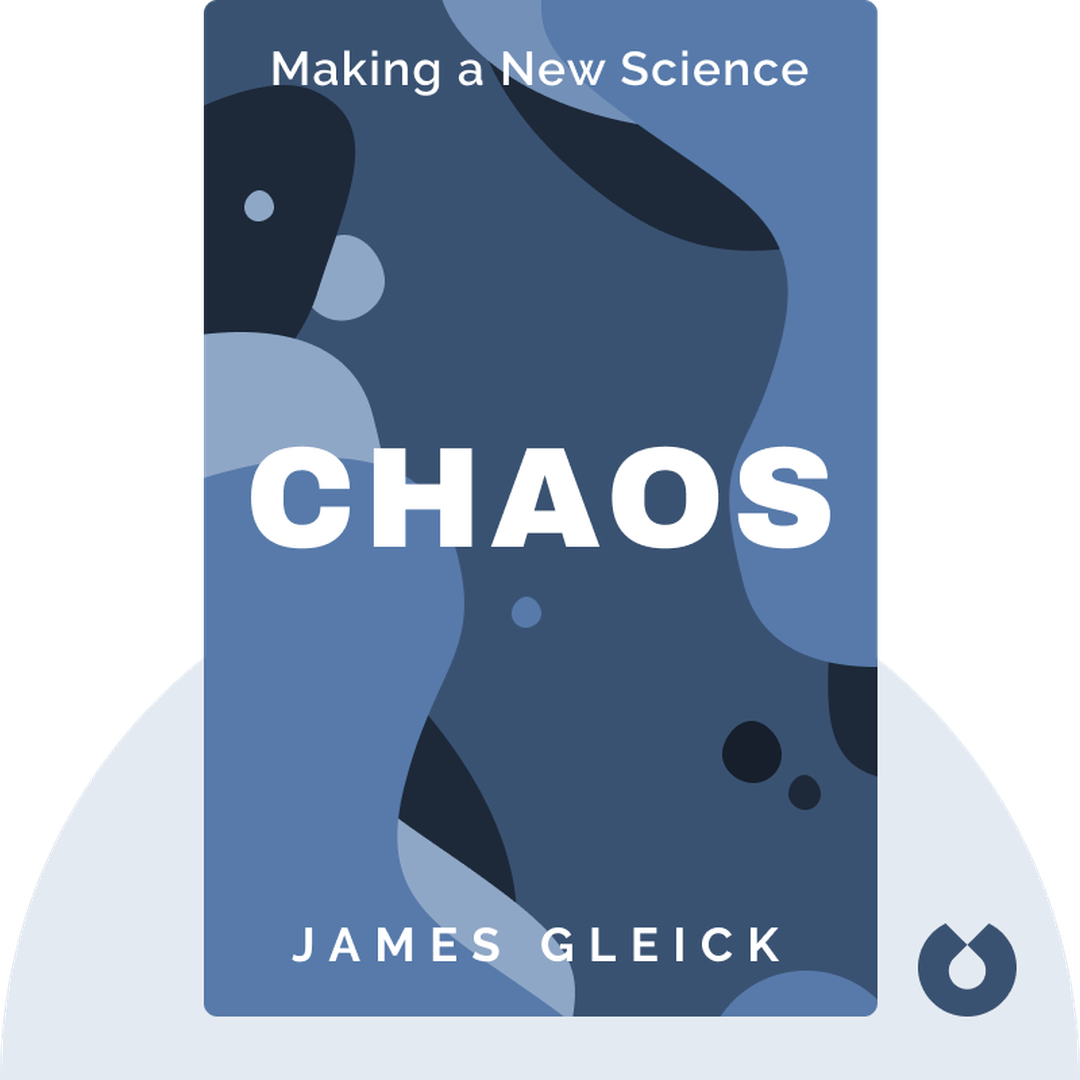
Chaos (1987) delves into the most recent theoretical revolution in physics: chaos theory. In the 1970s, scientists began discovering that the world doesn’t behave as neatly as classical physics suggests. From the weather to animal populations to our heartbeats – irregularities, disorder, and chaos pervade our universe. And yet, there seems to be a strange order to the chaos of life. Chaos explores the history of this new science, revealing its startling findings, and pondering its implications.
Who Should Listen to Chaos?
- Curious minds interested in unraveling the mysteries of the universe
- People interested in the history of modern science
- Anyone looking to understand and appreciate the chaos of life
Books Similar to Chaos
Readers who enjoyed this also liked these titles.