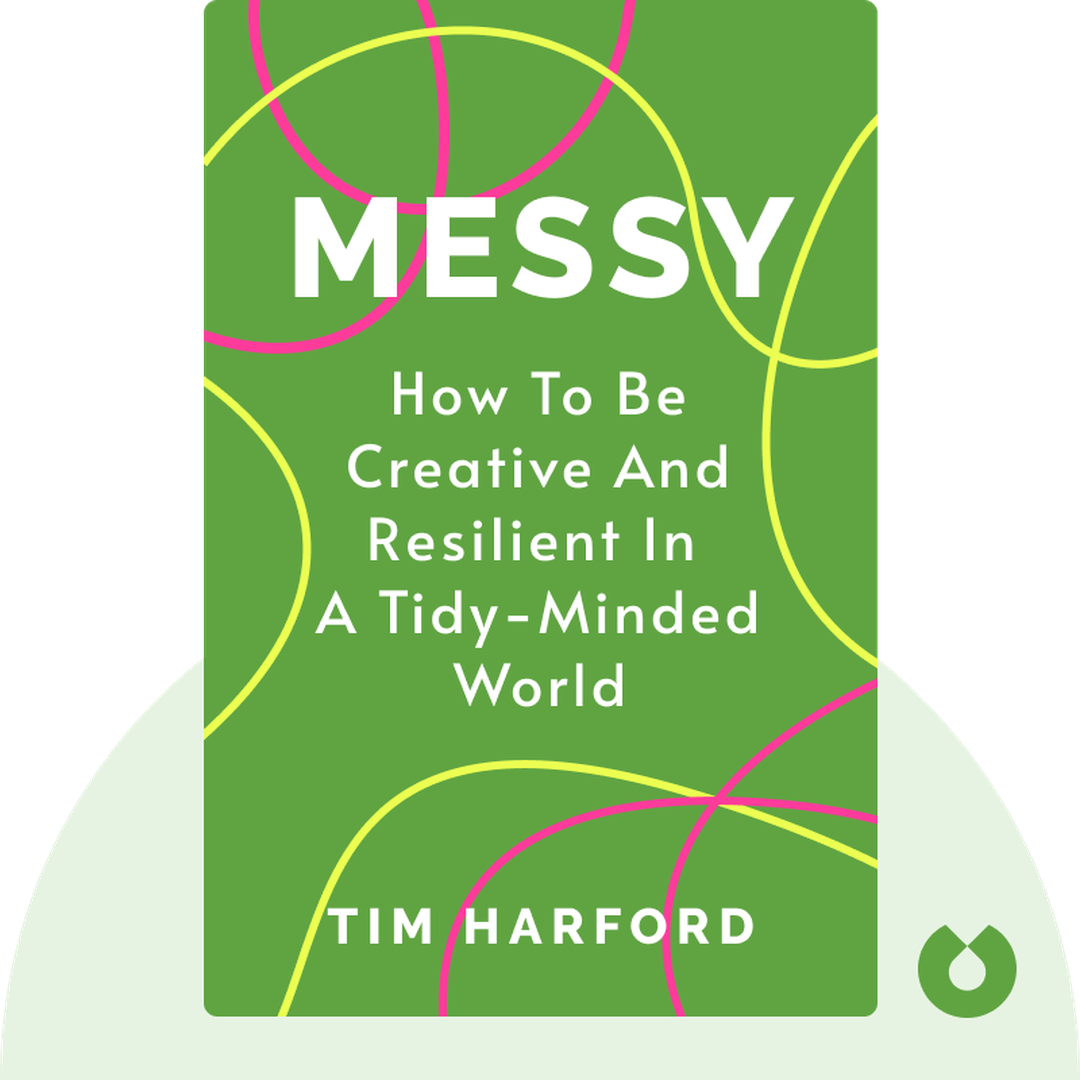
If You're Curious About These Questions...
You should listen to this audiobook
- Did you know that some of the world's greatest creative breakthroughs were the direct result of a broken piano, a messy desk, or a complete lack of planning?
- Have you ever wondered why your obsession with a perfectly organized workspace might actually be the very thing holding back your productivity?
- What if the secret to outsmarting your competition isn't a more detailed plan, but the ability to embrace a little bit of chaos and improvisation?
Listen to Messy — Cinematic Audio Edition
Loading player...
Key Takeaways from Messy
- Understand why imposing strict order and relying heavily on big data often backfires, and how a slightly disorganized environment actually fosters innovation.
- Discover how unexpected disruptions and distractions can be your greatest assets by forcing you out of routine and sparking original thinking.
- Learn how collaborating outside of close-knit teams and leveraging a network of 'weak ties' exposes you to diverse perspectives that challenge your ideas.
- Find out why perfectly tidy offices are overrated, and how empowering yourself to physically shape your own workspace leads to greater professional engagement.
- Master the art of improvisation by silencing your inner critic, allowing you to embrace unpredictability and gain a powerful competitive advantage.
Learning Tools
Reinforce what you learned from Messy
Mind Map
Messy
Pitfalls of Order & Quantification+
Power of Disruptions & Distractions+
Networks & Workspaces+
Advantage of Improvisation+
Dangers of Over-Automation & Tidy Systems+
Embracing Messiness in Life+
Quiz — Test Your Understanding
Question 1 of 8
What is a major pitfall of relying too heavily on big data and quantification?
Question 2 of 8
According to AnnaLee Saxenian's study, why did Silicon Valley outperform Route 128 in Massachusetts?
Question 3 of 8
What does the story of Keith Jarrett’s 1975 piano concert in Cologne illustrate?
Question 4 of 8
Why is a network of 'weak ties' often more beneficial for creativity than a closely-knit team?
Question 5 of 8
What is the true lesson behind the success of creative workspaces like the Googleplex?
Question 6 of 8
What happens in the brains of professional jazz pianists when they improvise, which allows their ideas to flow?
Question 7 of 8
How does the book suggest we should handle emails, files, and daily schedules?
Question 8 of 8
Why does the author recommend encouraging informal, unstructured play for children?
Messy — Full Chapter Overview
- 1Recommendation
- 2We try to measure and organize the world, but that comes with pitfalls.
- 3Disruptions and distractions push us to find new paths and get creative.
- 4The right workspace and social network can boost your creativity.
- 5Being willing to improvise can give you a major competitive edge.
- 6Too much order and automation can get in the way of success.
- 7Final summary
Messy Summary & Overview
Messy (2016) is all about order and tidiness, or rather, why they’re overrated. These blinks explain how a preoccupation with neatness can stand between us and success, how messiness can boost creativity and why everyone should embrace a little disorder.
Who Should Listen to Messy?
- Anyone who’s afraid of messiness
- Entrepreneurs looking for a creative spark
- Professionals who are wary of improvisation
Books Similar to Messy
Readers who enjoyed this also liked these titles.