If You're Curious About These Questions...
You should listen to this audiobook
- Have you ever wondered why traditional economic models often fail to predict major crashes, and what radical new computational approach could finally change that?
- What if we could use the same simulation power behind weather forecasting to navigate the turbulence of global inflation and financial crises?
- Are you curious about how the hidden laws of complexity might be the key to solving our most persistent economic problems, from wealth inequality to market instability?
Listen to Making Sense of Chaos — Free Audiobook
Loading player...
Key Takeaways from Making Sense of Chaos
- Understand why traditional economic models, built on outdated assumptions of fixed-point equilibrium and rational expectations, fail to capture the chaotic and dynamic nature of the real world.
- Discover how complexity economics uses modern computing and chaos theory to more accurately predict crucial economic variables like GDP, unemployment, and inflation.
- Learn to view the economy as a highly interconnected ecosystem where specialized entities, financial contracts, and human behaviors create massive ripple effects.
- Explore how the concept of emergent behavior proves that economies function as nonlinear systems, operating through complex individual interactions rather than central control.
- Find out how advanced complexity models can guide effective real-world policies, such as mapping practical workforce retraining paths during the shift toward automation and green energy.
Learning Tools
Reinforce what you learned from Making Sense of Chaos
Mind Map
Making Sense of Chaos
The Failure of Traditional Economics+
Principles of Complexity Economics+
Agent-Based Modeling+
Solving Future Global Challenges+
Quiz — Test Your Understanding
Question 1 of 7
How does complexity economics view the concept of market equilibrium compared to traditional economics?
Question 2 of 7
When addressing the displacement of workers due to automation, what practical solution do complex economic models suggest?
Question 3 of 7
Which of the following is one of the three foundational pillars of standard economic theory that complexity economics challenges?
Question 4 of 7
In complexity economics, how do individual agents (like people or firms) typically make decisions in unpredictable environments?
Question 5 of 7
How does complexity economics explain the origin of major financial crises, such as the one in 2008?
Question 6 of 7
According to the text, what was the unintended consequence of introducing risk management tools like Value-at-Risk (VaR) in the financial sector?
Question 7 of 7
What does J. Doyne Farmer's research suggest about a rapid, large-scale transition to green energy?
Making Sense of Chaos — Full Chapter Overview
- 1Recommendation
- 2Questioning Basic Assumptions
- 3The Economy as an Ecosystem
- 4Moving Beyond Standard Theory
- 5The Shock That Comes from Within
- 6Modeling a Better Tomorrow
- 7Final summary
Making Sense of Chaos Summary & Overview
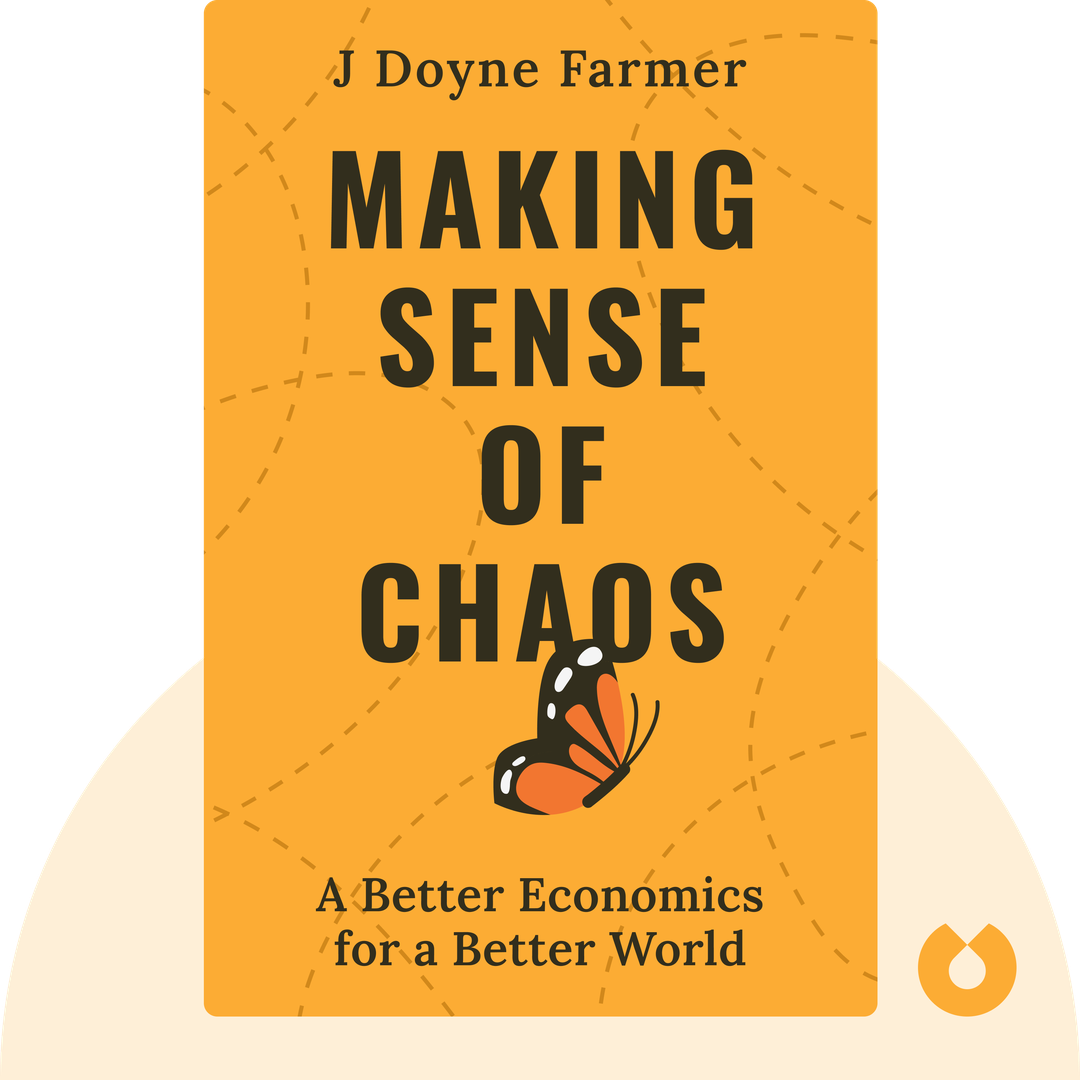
Making Sense of Chaos (2024) offers a fresh take on our complex economic world through the lens of complexity economics. It explores new computational tools and models that address issues like inflation, inequality, and financial crises – and shows how we can make better predictions and craft smarter policies in an increasingly interconnected and turbulent global economy.
Who Should Listen to Making Sense of Chaos?
- Economics enthusiasts
- Tech and data science buffs
- Policymakers and analysts
Books Similar to Making Sense of Chaos
Readers who enjoyed this also liked these titles.