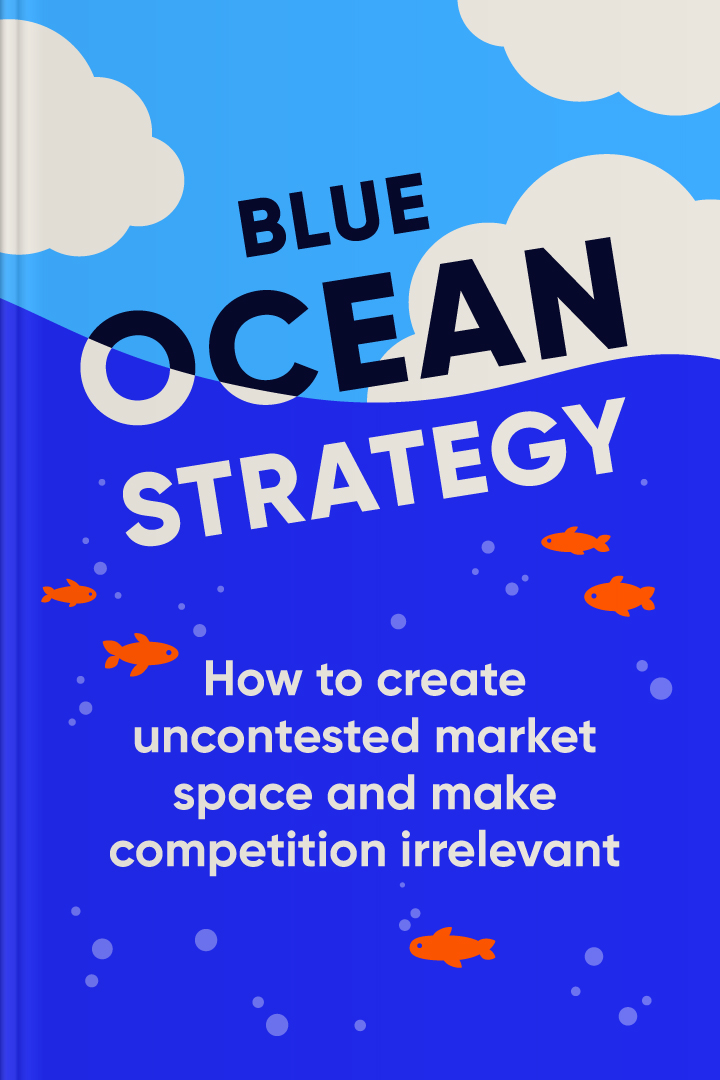
Blue Ocean Strategy (Summary) audiobook cover - If business competition has started to feel like a tiring fight over the same customers, this narration gently walks through how “blue ocean” thinking can help create fresh market space—by pairing meaningful innovation with real buyer value, instead of battling head-to-head.

Blue Ocean Strategy (Summary)

If business competition has started to feel like a tiring fight over the same customers, this narration gently walks through how “blue ocean” thinking can help create fresh market space—by pairing meaningful innovation with real buyer value, instead of battling head-to-head.

W. Chan Kim

4.2 / 5(5 ratings)

If You're Curious About These Questions...

You should listen to this audiobook

Listen to Blue Ocean Strategy (Summary) — Free Audiobook

Loading player...

Key Takeaways from Blue Ocean Strategy (Summary)

Learning Tools

Reinforce what you learned from Blue Ocean Strategy (Summary)

Mind Map

Blue Ocean Strategy
Red Oceans+
Blue Oceans+
The Four Actions Framework+
Proven Successes+

Quiz — Test Your Understanding

Question 1 of 10
What is the core concept of "value innovation" as described in the book?
  • A. Innovation focused on technology that customers may not understand or want.
  • B. The combination of delivering a meaningful leap in value and genuine, useful innovation.
  • C. Improving value by copying competitors' features but offering them at a lower price.
  • D. Delivering value in the same old way, but with better marketing and packaging.
Question 2 of 10
The book introduces a four-part framework for reshaping value. What is the purpose of the 'Eliminate' step?
  • A. To scale down spending in areas that don't create meaningful value.
  • B. To introduce new features or services that the market has never offered before.
  • C. To remove factors the industry takes for granted, thereby shedding inherited costs and habits.
  • D. To raise undervalued factors far above the industry standard to surprise customers.
Question 3 of 10
How does the book distinguish an 'alternative' from a 'substitute' when creating a blue ocean?
  • A. An alternative is a cheaper version of the original, while a substitute is a higher-quality one.
  • B. A substitute loses its advantage when the original improves, while an alternative comes from a different model or industry, serving similar needs differently.
  • C. An alternative is a direct competitor, while a substitute serves a completely different function.
  • D. A substitute is designed for a niche market, while an alternative aims for mass-market appeal.
Question 4 of 10
In the four-stage process for visualizing strategy, what is the 'visual strategy fair' intended to achieve?
  • A. To have leaders create a sense of urgency for change by disrupting old assumptions.
  • B. To have managers conduct fieldwork to observe how customers actually use products.
  • C. To evaluate new strategic ideas based on customer value, reducing the influence of internal politics.
  • D. To communicate the final, locked-in strategy to the entire company.
Question 5 of 10
The book describes three tiers of noncustomers. Which tier represents the 'refusing sector'?
  • A. People who participate minimally in the market and can switch easily.
  • B. People who are completely uninterested or are served by another industry.
  • C. People who actively choose not to buy from the market because it's too expensive or doesn't fit their needs.
  • D. People who influence purchasing decisions but do not use the product themselves.
Question 6 of 10
What is the 'cognitive hurdle' that can hinder the execution of a blue ocean strategy?
  • A. The lack of budget and financial resources to fund the new initiative.
  • B. Internal power struggles and politics that undermine the new strategy.
  • C. The team's lack of motivation and inspiration to push through uncertainty.
  • D. An organization's attachment to the old way of doing things and a failure to see the need for a shift.
Question 7 of 10
How can a brand's 'ridicule's quality' help protect its blue ocean position?
  • A. By making the product so cheap that competitors find it ridiculous to try to match the price.
  • B. By creating a brand image so exclusive that it ridicules non-customers.
  • C. The venture seems so unusual that competitors initially dismiss it, delaying imitation until it's too late.
  • D. The marketing is so humorous that it goes viral, creating brand loyalty through ridicule.
Question 8 of 10
According to the book, what is a key difference between a 'red ocean' and a 'blue ocean'?
  • A. Red oceans are for new companies, while blue oceans are for established market leaders.
  • B. Red oceans involve head-to-head competition in crowded markets, while blue oceans represent new, uncontested market space.
  • C. Red oceans focus on product quality, while blue oceans focus exclusively on low prices.
  • D. Red oceans are technology-driven industries, while blue oceans are service-based industries.
Question 9 of 10
When analyzing buyer groups, who does the book define as the 'user'?
  • A. The person who relies on expert advice and reviews before a purchase.
  • B. The person who signs off on the expense, such as a corporate buyer.
  • C. The person who actually experiences the product or service in their daily life.
  • D. The person in the company who influences the strategic direction of the product.
Question 10 of 10
What is the ultimate strategic outcome that a blue ocean strategy aims to achieve regarding competition?
  • A. To attract competitors and then defeat them with superior resources.
  • B. To make competition less central by building unique, hard-to-imitate value.
  • C. To form partnerships with all major competitors to control the market.
  • D. To temporarily dominate a niche before selling the business to a larger red ocean player.

Blue Ocean Strategy (Summary) — Full Chapter Overview

Blue Ocean Strategy (Summary) Summary & Overview

This audio summary explores the core ideas behind blue ocean strategy: the shift from crowded, competitive “red oceans” into open, uncontested “blue oceans” where growth becomes easier to sustain. Rather than trying to win by matching rivals feature-for-feature, it focuses on designing a leap in value that customers actually feel and appreciate.

Across the chapters, you’ll hear practical frameworks—like eliminate, reduce, raise, and create—and supportive guidance on how to shape a strategy that is both imaginative and realistic. The arc of the narration moves from understanding the concept, to planning, to execution, to staying relevant over time through continuous value innovation.

Who Should Listen to Blue Ocean Strategy (Summary)?

  • Founders, leaders, and teams who feel stuck competing on the same features, pricing, or messaging as everyone else and want a calmer, clearer path to differentiation.
  • Strategists and marketers who want practical tools—like the strategy canvas and the eliminate-reduce-raise-create framework—to redesign an offering around what buyers truly value.
  • Anyone building a product or service who wants to grow demand by understanding noncustomers, not just fighting harder for the same existing customer base.

About the Author: W. Chan Kim

W. Chan Kim is known for his work on strategy and value innovation, and for articulating the “blue ocean” approach—creating new market space by delivering a leap in buyer value rather than competing head-to-head in crowded markets.

🎧
Listen in the AppOffline playback & background play
Get App