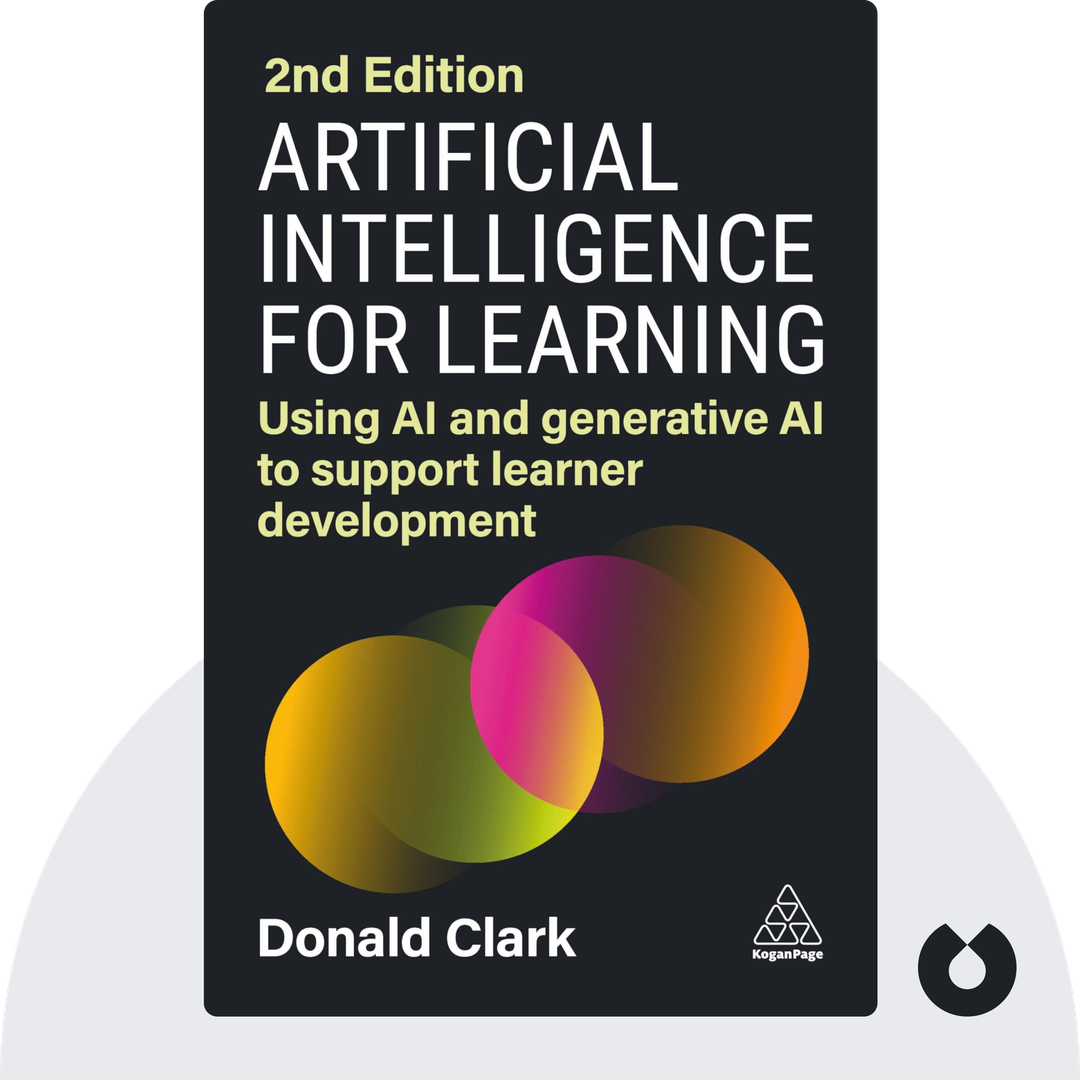
Artificial Intelligence for Learning
Start ListeningDownload Try free on iPhoneScan to start in 5 seconds
Categories:
If You're Curious About These Questions...
You should listen to this audiobook
- What if you could provide every single learner in your organization with a private, 24/7 AI tutor that adapts perfectly to their unique pace and needs?
- Did you know that the secret to more effective training isn't more content, but how generative AI applies specific learning science to make knowledge stick?
- Are you curious about how AI is moving beyond simple automation to completely reinvent the strategic role of the instructional designer?
Listen to Artificial Intelligence for Learning — Free Audiobook
Loading player...
Key Takeaways from Artificial Intelligence for Learning
- Discover how AI is shifting education from static content delivery into a personalized, real-time cognitive partnership.
- Understand why AI is best described as having 'competence without comprehension,' functioning as a collection of targeted tools rather than a unified, sentient mind.
- Learn how generative systems transform studying into an interactive dialogue, using Socratic questioning to keep you learning at the edge of your ability.
- Explore how AI finally solves the challenge of scaling one-on-one tutoring by offering instant, individualized feedback that adapts to your unique pace.
- Find out how AI empowers educators by automating logistical tasks like grading and scheduling, while adapting content formats to support diverse accessibility needs.
Learning Tools
Reinforce what you learned from Artificial Intelligence for Learning
Mind Map
Artificial Intelligence for Learning
The Nature of AI in Learning+
How AI Learns and Adapts+
Reshaping the Educator's Role+
Seamless & Invisible Interfaces+
Smart & Adaptive Systems+
Challenges, Fairness, and the Future+
Quiz — Test Your Understanding
Question 1 of 8
How does the author characterize the impact of AI on learning compared to past historical shifts?
Question 2 of 8
Which phrase best describes how AI systems process information, according to the text?
Question 3 of 8
How does generative AI mirror classic educational strategies like Socratic questioning?
Question 4 of 8
What is identified as the primary goal of introducing AI into classrooms?
Question 5 of 8
Why does the author advocate for 'invisible' AI tools and seamless interfaces in learning platforms?
Question 6 of 8
According to the text, what should adaptive learning systems base their real-time adjustments on?
Question 7 of 8
How does the role of an instructional designer change in an AI-driven learning environment?
Question 8 of 8
What is an optimistic point the author makes regarding bias in AI systems?
Artificial Intelligence for Learning — Full Chapter Overview
- 1Recommendation
- 2AI is a set of tools, not one all-powerful mind
- 3AI learns by observing how you learn
- 4How AI is reshaping teaching and learning
- 5Invisible tools make learning easier, smarter, and more personal
- 6Smart systems adapt to your learning style
- 7Fairness, fear, and what comes next
- 8Final summary
Artificial Intelligence for Learning Summary & Overview
Artificial Intelligence for Learning (2024) explores how AI can be strategically and practically applied to improve learning and development in organizations. It clarifies common misconceptions, explains the learning science behind generative AI, and offers guidance in areas such as personalized content, chatbot support, and ethical considerations.
Who Should Listen to Artificial Intelligence for Learning?
- Educators and instructional designers adopting AI in learning
- Corporate training and development leaders using edtech
- Curious professionals exploring the future of education
Books Similar to Artificial Intelligence for Learning
Readers who enjoyed this also liked these titles.