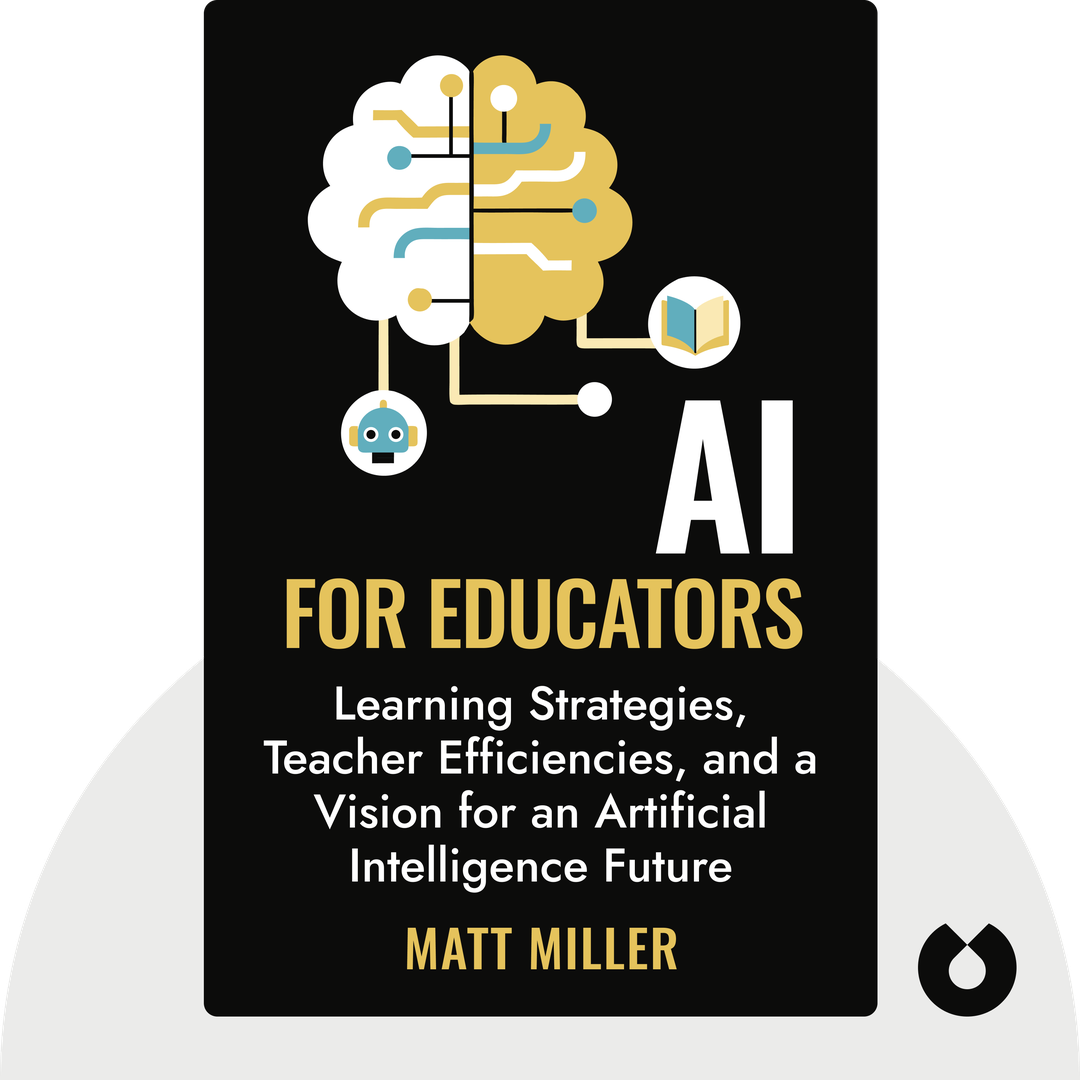
If You're Curious About These Questions...
You should listen to this audiobook
- What if you could reclaim your evenings and weekends by letting AI handle the heavy lifting of lesson planning and grading?
- Are you curious about how to move beyond playing 'essay detective' and instead design assignments that empower students to use AI responsibly?
- What’s the secret to preparing your students for an AI-driven workforce while the technology is still evolving in real-time?
Listen to AI for Educators — Cinematic Audio Edition
Loading player...
Key Takeaways from AI for Educators
- Discover how to AI-proof student assessments by replacing easily faked essays with verbal explanations, monitored in-class problem solving, and creative group projects.
- Understand why the rise of AI in education mirrors past technological disruptions like calculators and search engines, offering a unique opportunity to elevate higher-level thinking.
- Learn how to leverage AI as a teaching assistant to generate customized reading materials and provide instant draft feedback, freeing up your time for meaningful human mentorship.
- Find out how integrating live AI queries into classroom discussions helps you model critical thinking and teach students essential digital literacy skills.
- Master an AI-enhanced version of the Think-Pair-Share method, allowing students to consult AI to test their reasoning and explore counterarguments before presenting their work.
Learning Tools
Reinforce what you learned from AI for Educators
Mind Map
AI for Educators
Reimagining Assessments+
Historical Perspective on Disruption+
Amplifying Good Teaching+
Accessing New Perspectives+
Reclaiming Teacher Time+
Preparing for an AI Future+
Quiz — Test Your Understanding
Question 1 of 7
According to the text, what is an effective way to 'AI-proof' assessments and gauge genuine student comprehension?
Question 2 of 7
How does the author use the history of chess to illustrate the potential impact of AI on education?
Question 3 of 7
How does the text suggest modifying the traditional 'Think-Pair-Share' classroom activity using AI?
Question 4 of 7
What is one specific pedagogical benefit of having students use AI as a debate partner?
Question 5 of 7
Which of the following best describes the 'tiered feedback system' proposed in the text?
Question 6 of 7
Why does the text suggest a shift away from prioritizing traditional coding skills for future careers?
Question 7 of 7
What risk does the text specifically identify regarding AI-generated content, requiring students to become critical consumers?
AI for Educators — Full Chapter Overview
- 1Recommendation
- 2Making your assessments AI-proof
- 3Disrupting the classroom experience
- 4Strengthening good teaching
- 5Exploring new points of view
- 6Reclaiming time for what matters most
- 7Preparing students for an AI-powered world
- 8Final summary
AI for Educators Summary & Overview
AI for Educators (2023) explores how artificial intelligence will fundamentally transform teaching and learning. It serves as a practical handbook to help teachers understand and use AI, while offering classroom strategies and time-saving techniques. It also prepares educators to help students navigate the AI-driven future they will inherit.
Who Should Listen to AI for Educators?
- School administrators crafting policies for the era of ChatGPT
- Professors tired of playing detective with student essays
- Teachers drowning in grading who want their evenings back
Books Similar to AI for Educators
Readers who enjoyed this also liked these titles.