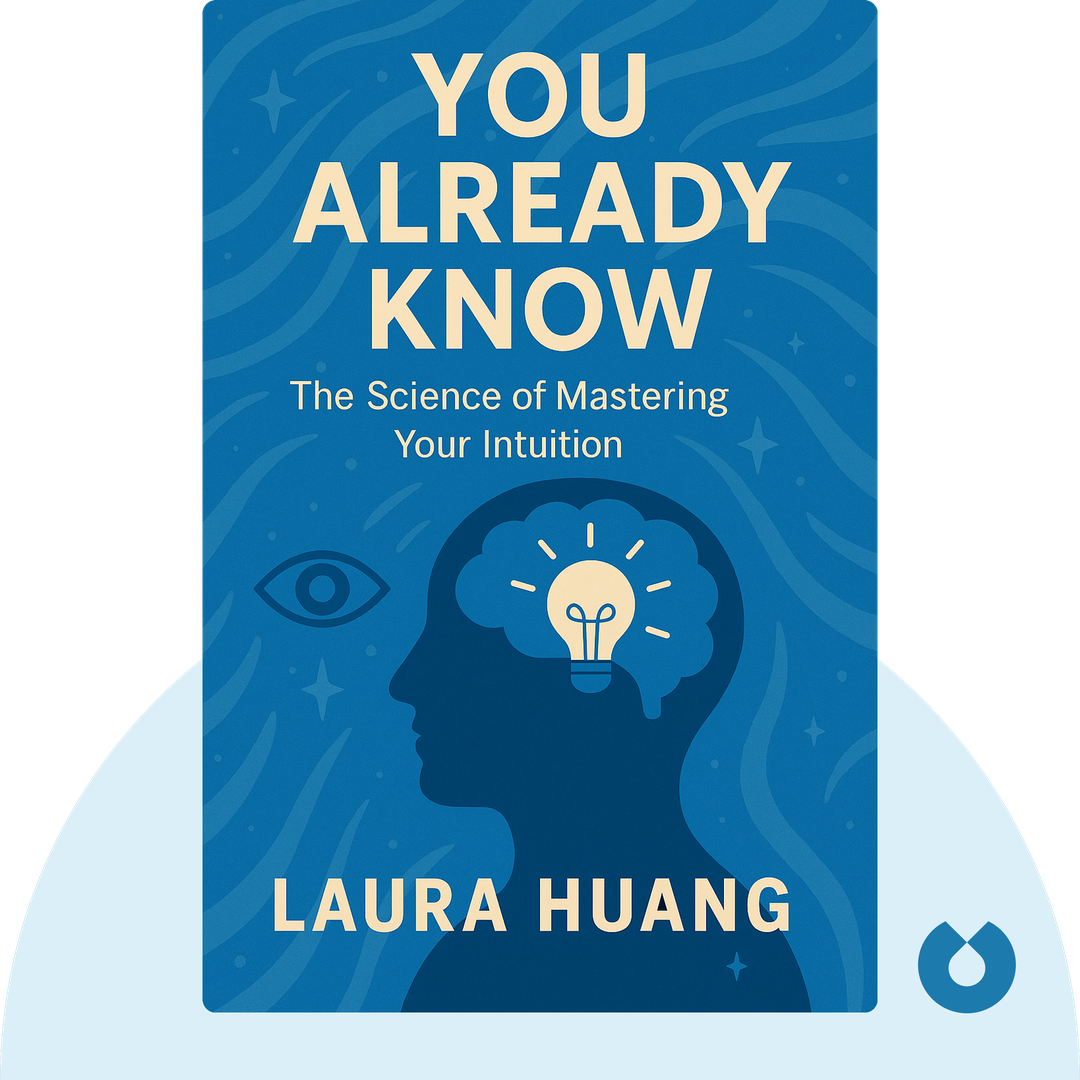
If You're Curious About These Questions...
You should listen to this audiobook
- Have you ever wondered why your most brilliant 'Eureka' moments seem to strike out of nowhere, and what’s actually happening in your brain when they do?
- What if you could transform your 'Spidey Sense' from a random hunch into a reliable, science-backed tool for making high-stakes decisions?
- Are you curious about the secret to mastering the 'Jolts' of intuition that can suddenly reshape your perspective and prompt your next big move?
Listen to You Already Know — Free Audiobook
Loading player...
Key Takeaways from You Already Know
- Discover why your intuition isn't a random flash of luck, but a powerful subconscious process that actively weaves together your past experiences and knowledge.
- Learn why logical analysis works for straightforward issues, but trusting your gut is absolutely essential for navigating highly complex, unstable, or chaotic situations.
- Master the four dimensions of introspection—personality, embodiment, emotions, and cognition—to transform vague instincts into a highly reliable internal guide.
- Find out how to quiet the constant noise of daily life and stop second-guessing your own lived experience so you can hear the subtle whispers of your inner voice.
- Learn to identify real-time intuitive signals, such as 'Eureka' moments, by paying close attention to how your body and mind react when new information aligns with what you already know.
Learning Tools
Reinforce what you learned from You Already Know
Mind Map
You Already Know
Understanding Intuition+
Hone via Introspection+
Refine via Interaction+
Master via Iteration+
Quiz — Test Your Understanding
Question 1 of 6
According to the book, what is the actual process behind a sudden 'gut feeling'?
Question 2 of 6
How does the author recommend approaching straightforward problems versus complex or unstable situations?
Question 3 of 6
When honing intuition through introspection, what specific role does 'cognitive intuition' play?
Question 4 of 6
During the 'interaction' phase of refining intuition, how does a 'Jolt' (Whoa moment) differ from a 'Eureka' (A-ha moment)?
Question 5 of 6
What does the author identify as a major risk that can distort our instincts and cause us to dismiss subtle intuitive cues?
Question 6 of 6
How does the book suggest we handle the inevitable mistakes that come from taking bold actions?
You Already Know — Full Chapter Overview
- 1Recommendation
- 2Intuition Basics
- 3Sharpen your intuition through introspection
- 4Refine your intuition through interaction
- 5Master your intuition through iteration
You Already Know Summary & Overview
You Already Know (2025) explores how intuition arises from the natural synthesis of external data and accumulated experience, emerging as a “Eureka” moment, your “Spidey Sense,” or a “Jolt” that reshapes perspective and prompts action. It then provides a science-based, practical model – complete with exercises – for honing, refining, and mastering that intuition to support better decision-making.
Who Should Listen to You Already Know?
- Anyone wanting to harness their intuition
- Entrepreneurs and professionals seeking to sharpen decision-making
- Coaches and mentors guiding clients toward clarity
Books Similar to You Already Know
Readers who enjoyed this also liked these titles.