If You're Curious About These Questions...
You should listen to this audiobook
- Have you ever wondered why your split-second gut feeling is often more accurate than hours of careful analysis?
- What if you could learn to master the 'art of the glance' and make better decisions in the blink of an eye?
- Are you curious about how your unconscious mind can sometimes lead you into hidden traps—and how you can stop it?
Listen to Blink — Free Audiobook
Loading player...
Key Takeaways from Blink
- Discover how to tap into your innate intuition to sense subtle warning signs and navigate uncertain situations with confidence.
- Learn how psychologists use 'thin slicing' and quick appraisals of conflict to accurately predict long-term relationship compatibility.
- Understand why strangers can sometimes evaluate your personality more accurately than close friends, whose emotional attachments often cloud objective judgment.
- Uncover the mystery of snap judgments and see how subtle subconscious priming can heavily influence human behavior without our awareness.
- Master the ability to avoid the 'Warren Harding effect' by recognizing how superficial traits like height or charisma can trick your unconscious mind into making flawed decisions.
Learning Tools
Reinforce what you learned from Blink
Mind Map
Blink
Decision-Making Strategies+
Thin-Slicing & Filtering+
The Illusion of Rationality+
Associations & Prejudices+
Stress & Temporary Autism+
Market Research Pitfalls+
Improving Snap Judgments+
Quiz — Test Your Understanding
Question 1 of 9
According to the text, why can intuitive snap judgments sometimes be superior to conscious, thoughtful analysis?
Question 2 of 9
When predicting whether a couple's relationship will last, what approach does the text suggest is most effective?
Question 3 of 9
How do people typically explain the snap judgments they make in everyday life, such as feeling instantly attracted to someone or making a sudden save in sports?
Question 4 of 9
What did the Trivial Pursuit study involving 'professors' and 'football hooligans' demonstrate?
Question 5 of 9
What does the election of President Warren Harding illustrate about human decision-making?
Question 6 of 9
According to the text, how does severe stress and time pressure affect our ability to read non-verbal signals?
Question 7 of 9
Why did the market research for 'New Coke' fail to predict actual consumer behavior?
Question 8 of 9
What is recommended as the most effective way to rid yourself of deeply anchored unconscious prejudices?
Question 9 of 9
How did the music industry successfully overcome gender prejudice when hiring musicians for orchestras?
Blink — Full Chapter Overview
- 1Recommendation
- 2Don’t dismiss your intuitive judgments—they can often outperform conscious reasoning.
- 3Your unconscious can separate relevant from irrelevant information in a split second.
- 4We make many more snap judgments than we realize, then create rational explanations afterward.
- 5Our choices are strongly shaped by unconscious associations.
- 6Stress can make us temporarily autistic and lead us to poor judgments.
- 7Market research doesn’t always predict real consumer behavior.
- 8To overcome your prejudices, seek out new experiences.
- 9To avoid bad snap judgments, filter out irrelevant information.
- 10Final summary
Blink Summary & Overview
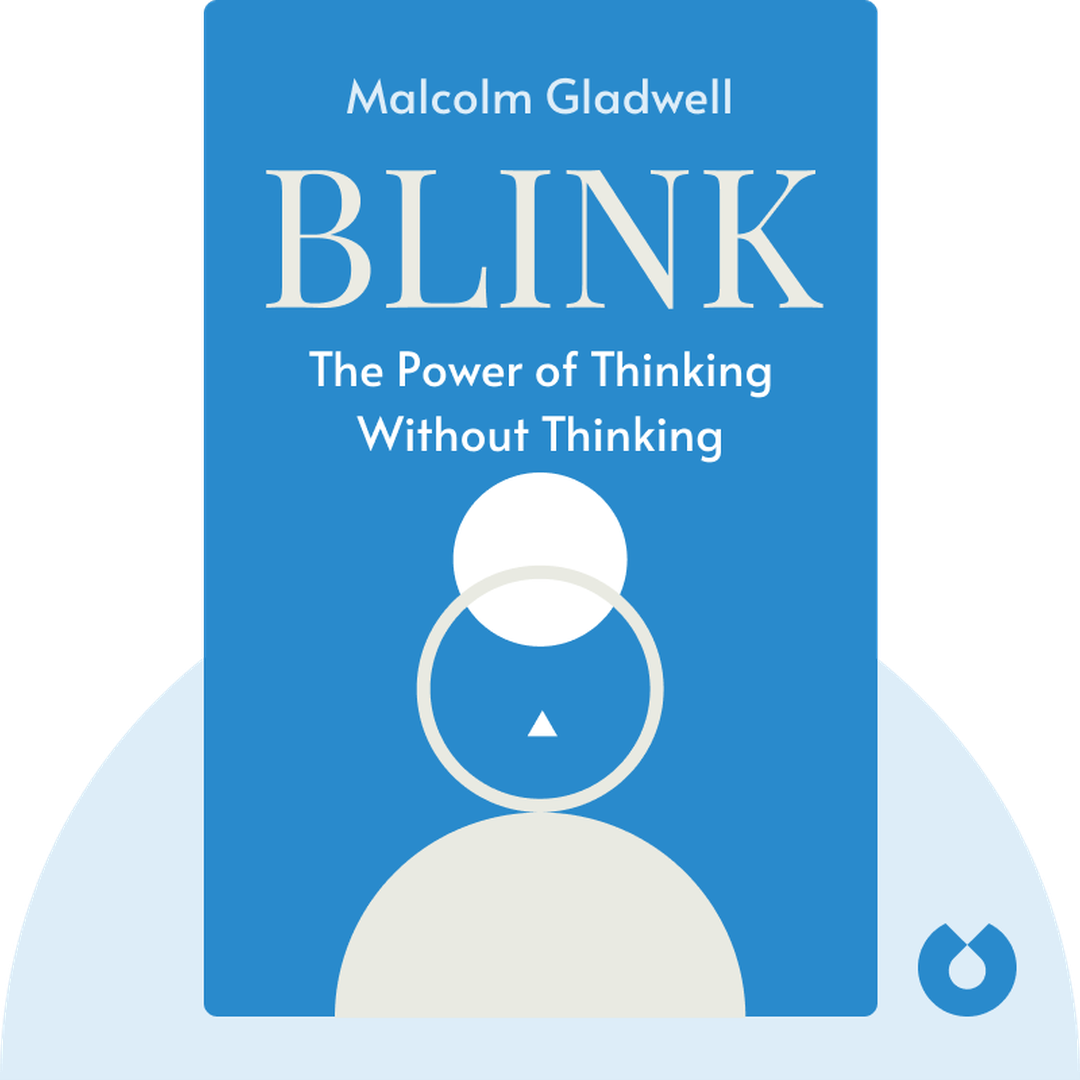
Blink examines the phenomenon of snap judgments, meaning the split-second decisions we make unconsciously. These snap judgments are important decision-making tools, but can also lead to bad choices and all manner of problems. Blink explains how we can best make use of them.
Who Should Listen to Blink?
- Anyone interested in intuition and decision-making
- Anyone interested in ridding themselves of their prejudices and stereotypes
- Anyone who wants to know when to trust their intuition
Books Similar to Blink
Readers who enjoyed this also liked these titles.