If You're Curious About These Questions...
You should listen to this audiobook
- How do ancient classical texts, such as Homer's Odyssey or Ovid's Metamorphoses, establish a historical blueprint for the way women's voices are still silenced or dismissed in public discourse today?
- Why do successful female leaders often feel compelled to adopt traditionally male characteristics—such as Margaret Thatcher lowering her vocal pitch or politicians wearing pantsuits—and what does this reveal about our cultural template for power?
- If achieving a high percentage of women in a national assembly doesn't necessarily equate to true political influence, how does the author suggest we redefine the very concept of 'power' to dismantle structures that inherently exclude women?
Listen to Women and Power — Free Audiobook
Loading player...
Key Takeaways from Women and Power
- Western culture's systemic resistance to women in public discourse is deeply rooted in classical Greco-Roman traditions that defined authoritative speech as an exclusively male trait.
- Historically, when women have been permitted to speak publicly, their voices were strictly confined to niche 'women's issues' or framed through the lens of martyrdom and victimhood.
- Because society's default image of authority remains distinctly male, female leaders often feel pressured to adopt masculine markers, from wearing pantsuits to artificially lowering their voices.
- The modern phenomenon of internet trolls threatening to silence women with gender-based violence strikingly mirrors ancient myths where female characters literally had their tongues cut out.
- Rather than forcing women to fit into male-coded hierarchies, we must redefine power itself, shifting it from a status object to be possessed to a collaborative ability to enact change.
Learning Tools
Reinforce what you learned from Women and Power
Mind Map
Women and Power
Classical Roots of Misogyny+
Oratory as a Male Domain+
Historical Silencing+
Modern Repression and Abuse+
The Male Template of Power+
Redefining Power+
Quiz — Test Your Understanding
Question 1 of 9
How did ancient Greek culture, specifically in plays like Aeschylus's 'Agamemnon', typically depict powerful women?
Question 2 of 9
Why does Mary Beard argue that the goddess Athena is a problematic example of a powerful female figure?
Question 3 of 9
In Homer's 'Odyssey', when Telemachus tells his mother Penelope that 'speech will be the business of men,' what specific type of speech (muthos) is he referring to?
Question 4 of 9
According to classical Roman scientific and cultural theories, how were women's voices perceived in the context of public speaking?
Question 5 of 9
When women like Hortensia were historically permitted to speak in public forums, what was usually the condition or context?
Question 6 of 9
What point does the author make using the 2017 example of Senator Elizabeth Warren being silenced while reading a letter by Coretta Scott King?
Question 7 of 9
Mary Beard notes that modern online abuse directed at women often includes threats to cut out their tongues. Which classical mythological figure does this echo?
Question 8 of 9
Why do female politicians like Hillary Clinton and Angela Merkel often favor wearing pantsuits, according to the text?
Question 9 of 9
How does Mary Beard suggest we should redefine power to make it more inclusive of women?
Women and Power — Full Chapter Overview
- 1Recommendation
- 2The idea of women successfully wielding power was ridiculous or unsettling to Greeks and Romans.
- 3Women participating in public debate have faced hostility since antiquity.
- 4Women’s voices were constrained because public-speaking skills were defined as male.
- 5Women’s voices sometimes appear in classical texts, but only on limited subjects.
- 6In more modern eras, women’s voices are heard more often, yet only as rare exceptions.
- 7The suppression and demonizing of women’s voices by men on flimsy grounds continues.
- 8All too often, it’s not women’s words that offend, but the fact they speak at all.
- 9We lack an easy mental image of what a powerful woman looks like.
- 10If power automatically leaves women out, then power itself must be reimagined.
Women and Power Summary & Overview
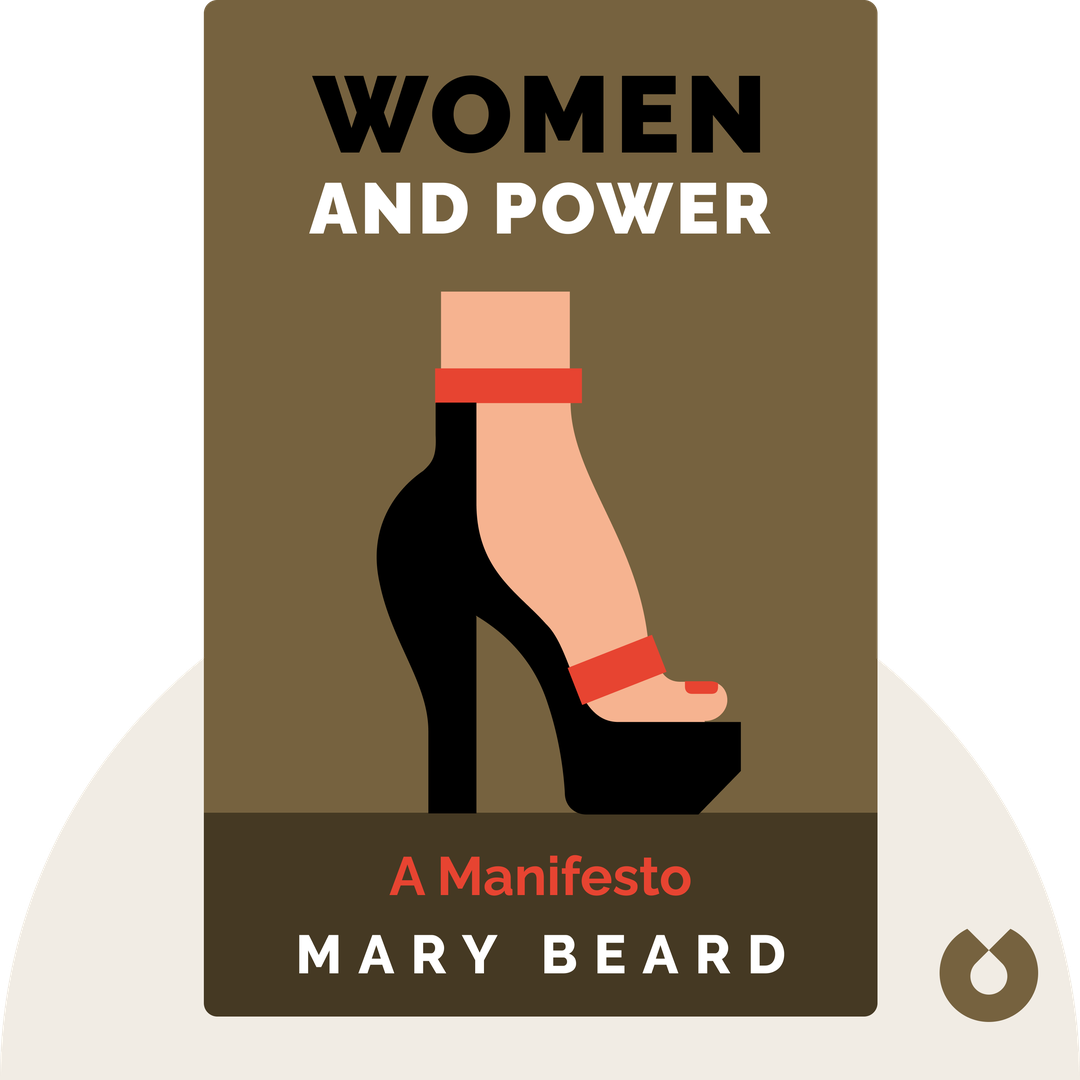
In Women and Power (2017), Mary Beard brings her considerable expertise and wry wit to bear on history's treatment of powerful women. Britain's best-known classicist retells stories from the ancient world and brings her analytical insight to the modern day. Beard explores the cultural roots of misogyny, the vilification of women’s voices, and asks whether it’s time for power to be redefined.
Who Should Listen to Women and Power?
- History buffs
- People interested in feminism
- People looking for context to current discussions about sexual harassment, abuse of power and the #MeToo movement
Books Similar to Women and Power
Readers who enjoyed this also liked these titles.