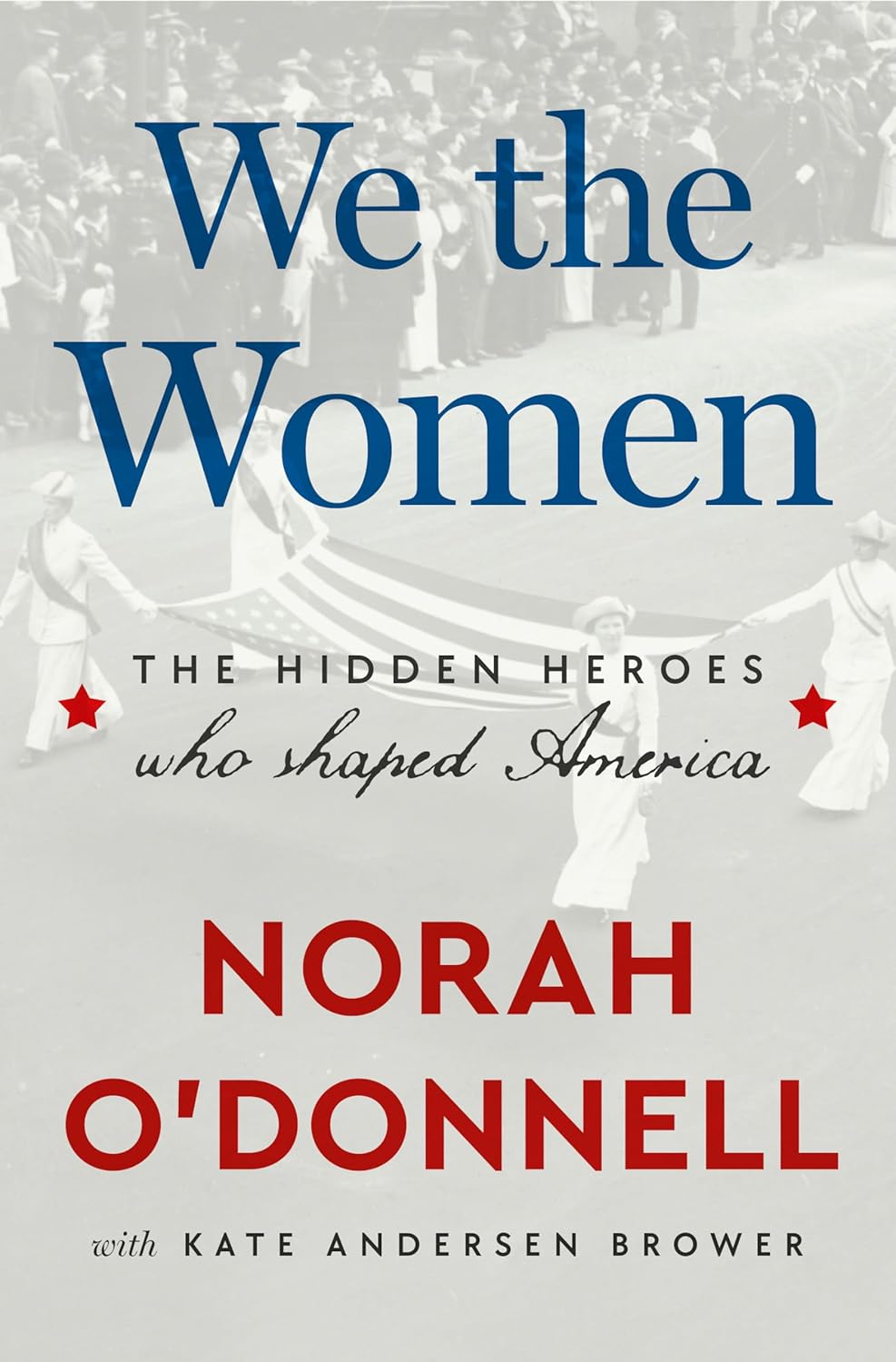
We the Women audiobook cover - Across 250 years, Norah O’Donnell spotlights the women history sidelined—printers, poets, rebels, doctors, soldiers, lawyers, builders, and activists—showing how their risks and victories slowly forced America to live up to its promises of liberty and equality.

We the Women

Across 250 years, Norah O’Donnell spotlights the women history sidelined—printers, poets, rebels, doctors, soldiers, lawyers, builders, and activists—showing how their risks and victories slowly forced America to live up to its promises of liberty and equality.

Norah O’Donnell (with Kate Andersen Brower)

4.3 / 5(4 ratings)
Start ListeningDownloadQR code that opens AudiobookHub on the App StoreTry free on iPhoneScan to start in 5 seconds

If You're Curious About These Questions...

You should listen to this audiobook

Listen to We the Women — Free Audiobook

Loading player...

Key Takeaways from We the Women

Learning Tools

Reinforce what you learned from We the Women

Mind Map

We The Women - Norah Odonnell
Introduction and Thesis+
The Revolutionary Era+
Abolition and Seneca Falls+
Breaking Institutional Barriers+
The Vote and War Service+
Mid-Century Power+
The Unfinished Union+

Quiz — Test Your Understanding

Question 1 of 10
What event serves as the book's opening scene and organizing metaphor for women's role in American history?
  • A. The 1913 Women's Suffrage Procession in Washington, D.C.
  • B. The Seneca Falls Convention of 1848.
  • C. Susan B. Anthony and others interrupting the 1876 Centennial celebration in Philadelphia.
  • D. Mary Katherine Goddard printing the Declaration of Independence in 1777.
Question 2 of 10
What was unique about Mary Katherine Goddard's 1777 printing of the Declaration of Independence?
  • A. It was the first version to be printed on paper instead of parchment.
  • B. It was printed secretly and distributed only to women.
  • C. It was the first version to include the signers' names, and she included her own name on it.
  • D. It was personally commissioned by George Washington to be read to his troops.
Question 3 of 10
How did Elizabeth Freeman (Bett) successfully sue for her freedom in Massachusetts?
  • A. By arguing that her enslaver had broken a written contract.
  • B. By proving she was a veteran of the Revolutionary War.
  • C. By using the language of the new Massachusetts Constitution against the practice of slavery.
  • D. By getting a petition signed by prominent abolitionists and presenting it to the governor.
Question 4 of 10
According to the book, what event was the direct catalyst for Lucretia Mott and Elizabeth Cady Stanton organizing the Seneca Falls Convention?
  • A. Their frustration with the slow progress of the abolitionist movement.
  • B. A request from Frederick Douglass to focus on women's rights.
  • C. Being excluded and forced to sit behind a curtain at the World Anti-Slavery Convention in London.
  • D. The passage of new laws that further restricted women's property rights.
Question 5 of 10
What is the significance of Dr. Mary Edwards Walker's Medal of Honor?
  • A. She is the only woman to have ever received it.
  • B. It was awarded for inventing a new surgical technique.
  • C. It was awarded posthumously alongside the 'Hello Girls.'
  • D. She received it for her role in the Seneca Falls convention.
Question 6 of 10
What was the central paradox faced by the 'Hello Girls' who served in the U.S. Army Signal Corps during World War I?
  • A. They were paid more than male soldiers but were not allowed in combat.
  • B. They were recruited for their essential skills but were denied veteran status and recognition after the war.
  • C. They had to pass a physical fitness test that was harder than the one for men.
  • D. They were required to work in France but were not allowed to speak French.
Question 7 of 10
Who was Ida B. Wells, and how did she respond to segregation at the 1913 Women's Suffrage Procession?
  • A. She was a white organizer who insisted Black women march at the front.
  • B. She was a Black journalist who organized a separate, successful protest on a different day.
  • C. She was a Black activist who, after being told to march in the back, refused and integrated herself into her state's delegation.
  • D. She was the lead speaker who used her platform to condemn the segregation.
Question 8 of 10
What national tragedy motivated Frances Perkins to dedicate her career to labor protections, eventually leading to her work as Secretary of Labor?
  • A. The sinking of the Titanic.
  • B. The Great Depression's unemployment crisis.
  • C. The Triangle Shirtwaist Factory fire.
  • D. The Ku Klux Klan's intimidation of voters.
Question 9 of 10
According to the book, what is the significance of the 6888th Central Postal Directory Battalion (the 'Six Triple Eight')?
  • A. They were the first women to serve in active combat roles in Europe.
  • B. They were a unit of Black women in the WAC who overcame discrimination and exceeded expectations in their mission to clear a massive mail backlog.
  • C. They were codebreakers who helped decrypt enemy communications during World War II.
  • D. They were the first integrated military unit, including both Black and white women.
Question 10 of 10
What is the book's overall conclusion about how rights are gained and secured in America?
  • A. Rights are gradually gifted by benevolent leaders as society progresses.
  • B. Rights are primarily won through singular, heroic acts of defiance.
  • C. Rights are not self-executing and must be constantly forced into the system through sustained moral and legal confrontation.
  • D. Once rights are secured legally in the Constitution, they are permanent and safe from backlash.

We the Women — Full Chapter Overview

We the Women Summary & Overview

We the Women is a sweeping, story-driven history of America told through the lives of overlooked women who shaped the nation’s ideals and institutions from 1776 to today. Norah O’Donnell (with co-author Kate Andersen Brower) connects pivotal moments—from the American Revolution to women’s suffrage, civil rights, world wars, and modern legal and cultural breakthroughs—by following individual women who pushed against the limits of their era.

Rather than offering full biographies, the book presents tightly focused narrative profiles: a printer whose name appears on the Declaration of Independence broadside, an enslaved poet who influenced revolutionary ideals, an abolitionist network that fueled reform, pioneers who broke open medicine and law, wartime heroines denied recognition, and modern leaders who expanded education, labor protections, and civil rights. The through-line is clear: American democracy has always been unfinished—and women have been central to bending it toward justice.

Who Should Listen to We the Women?

  • Listeners who want an accessible, narrative introduction to U.S. women’s history anchored in memorable true stories.
  • Students, educators, and book clubs looking for a decade-by-decade “missing chapter” of American history.
  • Anyone interested in how voting rights, civil rights, labor reforms, medicine, and wartime service evolved through real people and specific turning points.

About the Author: Norah O’Donnell (with Kate Andersen Brower)

Norah O’Donnell is a multiple Emmy Award–winning journalist and senior correspondent for CBS News. She has anchored major election coverage, served as anchor and managing editor of the CBS Evening News, and is a contributing correspondent for 60 Minutes. We the Women extends her long-running focus on amplifying women’s stories, developed with bestselling author Kate Andersen Brower.

🎧
Listen in the AppOffline playback & background play
Get App