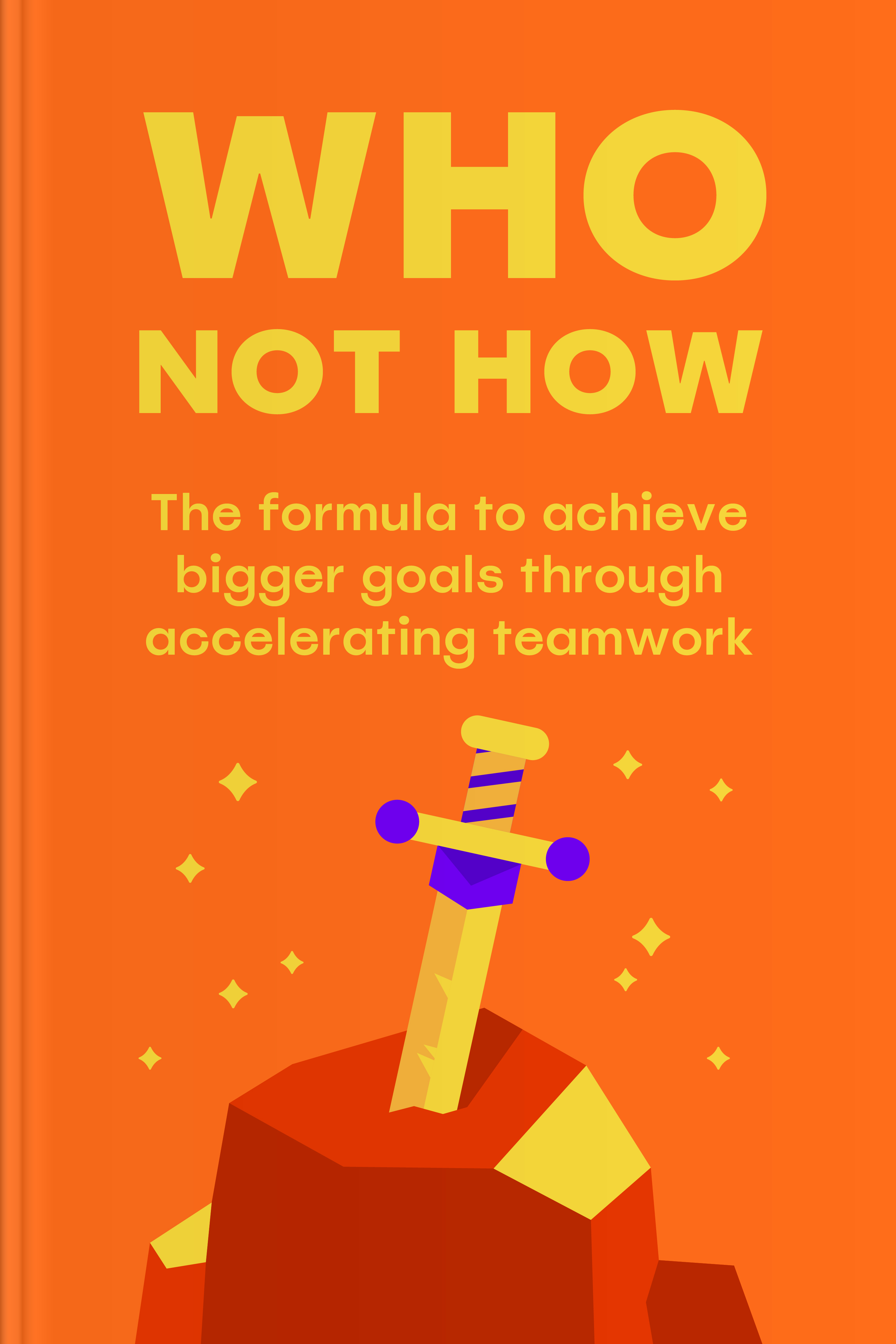
Who Not How audiobook cover - This warm, practical guide invites listeners to stop carrying everything alone and start building with the right people—shifting from the slow question of “How do I do this?” to the empowering question of “Who can help make this happen well?”

Who Not How

This warm, practical guide invites listeners to stop carrying everything alone and start building with the right people—shifting from the slow question of “How do I do this?” to the empowering question of “Who can help make this happen well?”

Dan Sullivan & Benjamin Hardy

4.4 / 5(5 ratings)

If You're Curious About These Questions...

You should listen to this audiobook

Listen to Who Not How — Free Audiobook

Loading player...

Key Takeaways from Who Not How

Learning Tools

Reinforce what you learned from Who Not How

Mind Map

Who Not How
The Core Mindset Shift+
Overcoming Procrastination+
Freedom of Time & Money+
Transformational Leadership+
Transformational Relationships+
Actionable Execution+

Quiz — Test Your Understanding

Question 1 of 9
According to the book, what is the fundamental mindset shift required to effectively achieve your goals and avoid unnecessary stress?
  • A. Asking "How can I improve my skills?" instead of "Why am I failing?"
  • B. Asking "Who can help me achieve this?" instead of "How can I do this myself?"
  • C. Asking "When is the best time to start?" instead of "How long will this take?"
  • D. Asking "What is the cheapest way to do this?" instead of "Who is the most qualified?"
Question 2 of 9
How does Dr. Elaine and Dr. Arthur Aron's Self-Expansion Model describe a person's efficacy?
  • A. Efficacy is a fixed, innate trait that determines your absolute ability.
  • B. Efficacy is determined primarily by your level of formal education and training.
  • C. Efficacy is based on context and changes depending on the people around you.
  • D. Efficacy is solely dependent on the financial resources available to you.
Question 3 of 9
How does the "Who Not How" philosophy view procrastination?
  • A. As a sign of laziness and a lack of true commitment to your goals.
  • B. As evidence that you have a worthy ambition but lack the knowledge or skill to achieve it alone.
  • C. As a permanent psychological block that requires professional therapy to overcome.
  • D. As a deliberate strategy to allow ideas to incubate before taking action.
Question 4 of 9
What is the primary purpose of Dan Sullivan's "Impact Filter" worksheet?
  • A. To track the financial return on investment for each new employee hired.
  • B. To filter out negative feedback and focus only on positive reinforcement.
  • C. To evaluate which tasks can be automated by software rather than delegated to a person.
  • D. To radically clarify your goal, its purpose, and the expected results so a "Who" can help you achieve it.
Question 5 of 9
What key lesson did Jacob Monty learn by hiring a driver for his commutes?
  • A. Hiring a driver is a luxury that ultimately distracts from core business activities.
  • B. Delegating nonessential tasks like driving reduces decision fatigue and frees up time for high-impact work.
  • C. The upfront cost of delegating tasks is rarely recovered in the long term.
  • D. Driving yourself is the best time to listen to audiobooks and improve your skills.
Question 6 of 9
According to the text, what is a primary characteristic of a transformational leader compared to a leader who burns out?
  • A. A transformational leader commits to achieving results rather than obsessing over the processes.
  • B. A transformational leader insists on doing everything themselves to ensure high quality.
  • C. A leader who burns out delegates too much without providing enough supervision.
  • D. A transformational leader avoids hiring full-time staff to keep overhead costs low.
Question 7 of 9
How did Joe Polish build a successful, transformational relationship with Richard Branson?
  • A. By aggressively pitching his own business ideas during a charity dinner.
  • B. By repeatedly asking Branson for mentorship and financial support.
  • C. By focusing on what value he could provide to Branson rather than what he could get from him.
  • D. By matching Branson's charitable donations dollar-for-dollar.
Question 8 of 9
According to the book, why do many adults struggle to embrace collaboration?
  • A. They lack the communication skills necessary to work effectively in teams.
  • B. They were taught from a young age that getting help from others is considered cheating.
  • C. They have had too many negative experiences with incompetent coworkers.
  • D. They believe that sharing credit will reduce their financial compensation.
Question 9 of 9
What is the "80 percent rule" recommended in the final summary of the book?
  • A. You should only delegate tasks if you are 80 percent sure the person can do it perfectly.
  • B. Spend 80 percent of your time planning and 20 percent of your time executing.
  • C. Develop a project rapidly to 80 percent completion, then hand it off to "Whos" to perfect the remaining 20 percent.
  • D. Keep 80 percent of your profits and reinvest 20 percent into hiring new staff.

Who Not How — Full Chapter Overview

Who Not How Summary & Overview

This narration explores a gentle but powerful leadership shift: moving from personal over-responsibility to shared ownership. It highlights how individual talent matters, yet sustainable growth—especially in business and leadership—often comes from trusting others, delegating clearly, and building teams where people feel valued.

Through a simple story about a teenager who earns more by asking his father for guidance than by grinding alone, the script introduces a repeating idea: asking “Who?” can unlock time freedom, reduce decision fatigue, and expand what’s possible. Each chapter offers a calm orientation, supportive reflection, and a clear takeaway you can carry into your work and relationships.

Who Should Listen to Who Not How?

  • Leaders, founders, and high achievers who feel stretched thin because they try to do everything themselves
  • Anyone building a business or team who wants more clarity, healthier collaboration, and stronger results
  • Listeners who procrastinate when goals feel overwhelming and want a more supportive way forward

About the Author: Dan Sullivan & Benjamin Hardy

This summary content draws on an example from Richie Norton’s life and includes quotes attributed to Dan Sullivan and Benjamin Hardy. The narration is written as a supportive guide to the ideas presented: delegation, teamwork, and shifting from “How” to “Who” in order to grow with less strain and more meaning.

🎧
Listen in the AppOffline playback & background play
Get App