If You're Curious About These Questions...
You should listen to this audiobook
- Have you ever wondered why following a traditional business "map" might be the very thing leading your company toward failure in the digital age?
- What if you could stop trying to predict the future and instead harness the power of "emergence" to stay ahead of every technological shift?
- Are you curious about why the most successful innovators are ditching compliance in favor of a strategy that prioritizes "disobedience" and rapid experimentation?
Listen to Whiplash — Free Audiobook
Loading player...
Key Takeaways from Whiplash
- Find out how to navigate a decentralized modern workplace and maintain your innovative edge when the old rules of lifelong employment no longer apply.
- Discover why ingrained paradigms and rigid social beliefs can blind you to groundbreaking innovations, much like the early inventors of motion pictures.
- Understand how the exponential pace of technological and environmental change has made traditional forecasting obsolete, requiring a new approach to the future.
- Learn how the democratization of information is dismantling traditional authority and driving 'emergence,' allowing collaborative communities to create massive change.
- Master the use of a 'pull strategy' to remain agile and react flexibly to unexpected events in today's highly unpredictable business landscape.
Learning Tools
Reinforce what you learned from Whiplash
Mind Map
Whiplash
The New Reality+
Overcoming Paradigms+
The Decline of Authority+
Agile Management+
Disobedience drives Innovation+
Resilience over Strength+
Practice over Theory+
Quiz — Test Your Understanding
Question 1 of 7
Why did the Lumière brothers fail to see the long-term potential of motion pictures?
Question 2 of 7
How does the book use the example of climate change to describe the modern world?
Question 3 of 7
According to the text, what is 'emergence'?
Question 4 of 7
What is the primary flaw of a 'push strategy' in management, as demonstrated by the Fukushima disaster?
Question 5 of 7
What key lesson does the invention of nylon by Wallace Hume Carothers illustrate?
Question 6 of 7
Why does the book suggest that modern companies should be more like a 'reed' than an 'oak'?
Question 7 of 7
What actionable advice does the book give regarding practice and theory, particularly in fields like software development?
Whiplash — Full Chapter Overview
- 1Recommendation
- 2Paradigms can block us from seeing major innovations ahead.
- 3The world around us keeps changing and is ever more unpredictable.
- 4With information now open to all, traditional authorities matter less.
- 5You can stay flexible in crises by adopting a pull-based strategy.
- 6Disobedience is a powerful engine for innovation.
- 7Against flexible threats, resilience matters more than strength.
Whiplash Summary & Overview
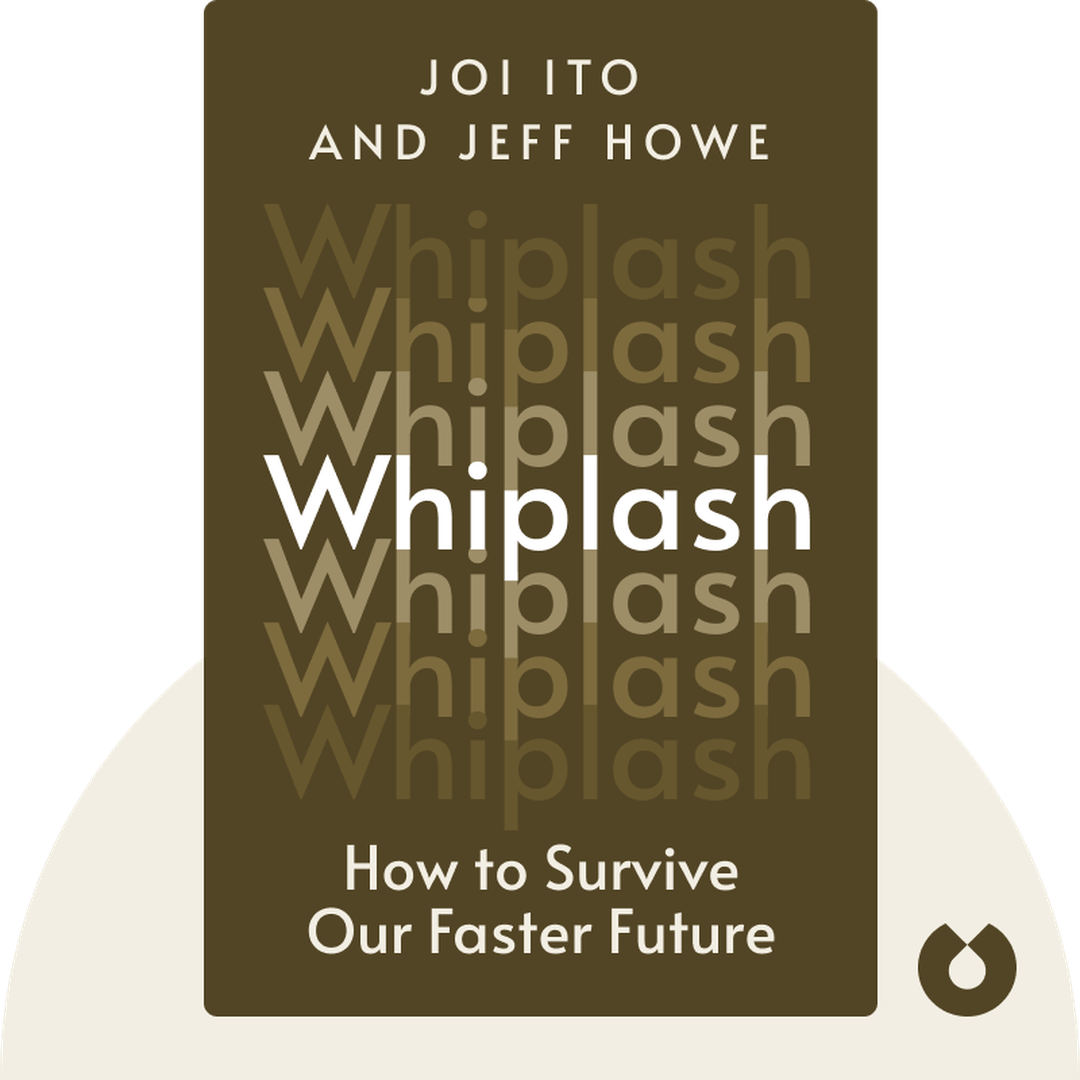
Whiplash (2016) explains the new rules of our fast-changing world. The current moment is defined by emergent technologies and innovative ideas, and the only way to stay afloat is to adapt. Forget the principles of yesterday and start developing strategies that work today.
Who Should Listen to Whiplash?
- People with an interest in technology and digital developments
- Entrepreneurs and start-up owners
- Anyone who wants to learn about business strategies
Books Similar to Whiplash
Readers who enjoyed this also liked these titles.