If You're Curious About These Questions...
You should listen to this audiobook
- Have you ever wondered why financial markets behave more like unpredictable living organisms than the precise mathematical models we’ve been taught to trust?
- Did you know that your primal survival instincts might be more influential in your investment decisions than logic or rational calculation?
- What if the secret to navigating economic volatility is hidden in the laws of biological evolution rather than the rules of traditional physics?
Listen to Adaptive Markets — Free Audiobook
Loading player...
Key Takeaways from Adaptive Markets
- Understand the principles of the Efficient Market Hypothesis, which argues that asset prices reflect collective wisdom and makes a strong case for investing in long-term index funds.
- Discover the Adaptive Market Hypothesis, a new paradigm that combines logical financial theories with evolutionary concepts to explain how human emotion drives market fluctuations.
- Learn how the psychological trap of loss aversion causes everyday investors and professional traders alike to take reckless risks just to avoid losing money.
- Find out how the human tendency for probability matching tricks us into making mathematically illogical financial decisions and predictions.
- Explore the neuroscience behind financial decision-making, revealing why our instinctual emotions are inextricably linked to how we handle our money.
Learning Tools
Reinforce what you learned from Adaptive Markets
Mind Map
Adaptive Markets
Efficient Market Hypothesis (EMH)+
Human Irrationality+
Adaptive Market Hypothesis (AMH)+
Financial Crises+
Fixing the System+
Quiz — Test Your Understanding
Question 1 of 9
According to the Efficient Market Hypothesis (EMH), what is the primary reason it is considered highly unlikely for an individual to 'beat the market'?
Question 2 of 9
How does the Adaptive Market Hypothesis (AMH) primarily differ from the Efficient Market Hypothesis (EMH)?
Question 3 of 9
Based on the research of Kahneman and Tversky mentioned in the text, how does 'loss aversion' affect financial decision-making?
Question 4 of 9
Why do humans often make irrational financial mistakes during market downturns, according to neuroscience?
Question 5 of 9
In the context of the Adaptive Market Hypothesis, how is the creation and rise of hedge funds in the 1940s and 50s viewed?
Question 6 of 9
How does the Adaptive Market Hypothesis suggest an investor should react to prolonged market downturns, such as Japan's 'lost decades'?
Question 7 of 9
According to the text, what was the primary systemic cause of the 2008 financial crisis?
Question 8 of 9
What solution does the author propose to help prevent future financial crises, drawing inspiration from the aviation industry?
Question 9 of 9
How does the author suggest the financial market could be used to cure cancer?
Adaptive Markets — Full Chapter Overview
- 1Recommendation
- 2The Efficient Market Hypothesis is the leading theory of how markets work.
- 3The Adaptive Market Hypothesis accounts for the human side of finance.
- 4People are predictably irrational when it comes to money.
- 5Human behavior is guided by emotions and instincts.
- 6Survival of the richest drives competition, innovation, and adaptation.
- 7The Adaptive Market Hypothesis can help us make better financial decisions.
- 8Financial crises happen when markets evolve without proper oversight.
- 9The Adaptive Market Hypothesis can improve more than the financial system.
- 10Final summary
Adaptive Markets Summary & Overview
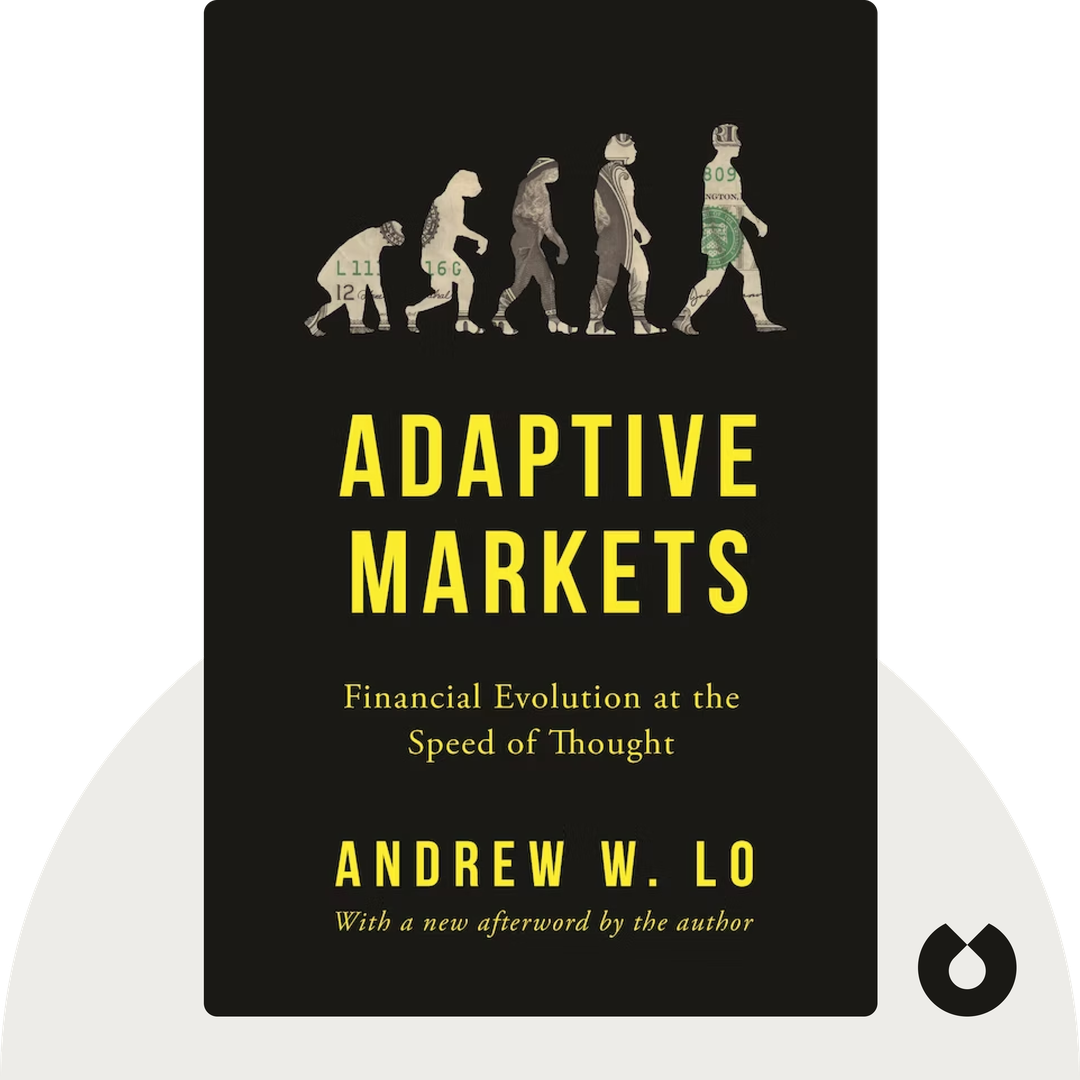
Adaptive Markets (2017) is about a new economic theory that helps us better understand the human element behind financial markets. Andrew W. Lo expertly illustrates the shortcomings of current prevailing economic theories, showing us how finance is less like physics or math and more like a responsive and evolving organism – not unlike ourselves.
Who Should Listen to Adaptive Markets?
- Investors interested in finance and how the market works
- Readers interested in the science of money
- Students of economics
Books Similar to Adaptive Markets
Readers who enjoyed this also liked these titles.