Theme Song
If You're Curious About These Questions...
You should listen to this audiobook
- How did introducing a financial fine for late pickups at an Israeli child-care center actually cause more parents to arrive late, and what does this reveal about how money irrevocably replaces our moral norms?
- If paying female drug addicts to get sterilized successfully reduces the number of drug-addicted babies born, why might this highly effective market-based solution still be morally dangerous for society?
- Is human altruism a scarce, finite resource that should be conserved through financial incentives, or is it a virtuous capacity that grows stronger the more it is exercised?
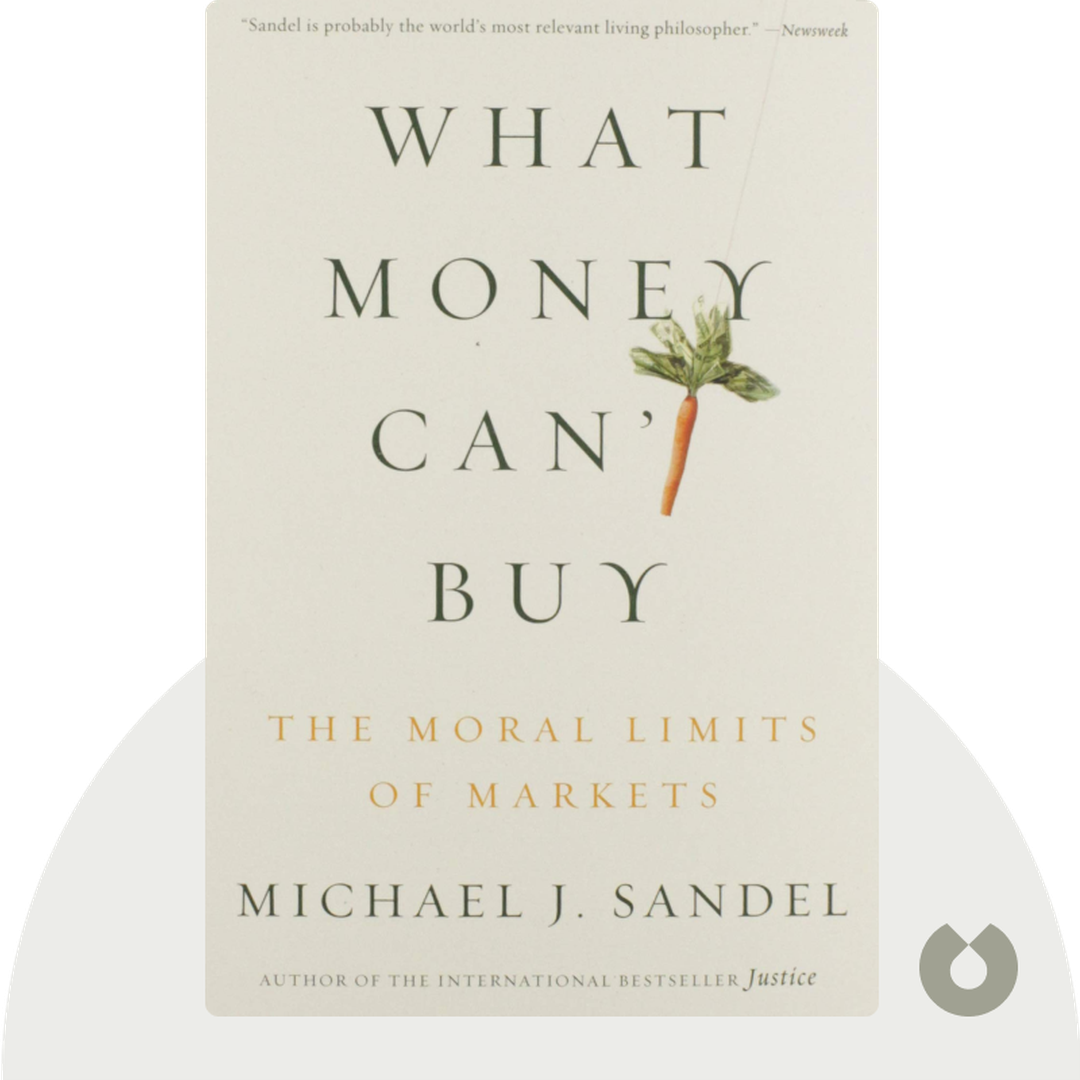
Listen to What Money Can't Buy — Free Audiobook
Loading player...
Key Takeaways from What Money Can't Buy
- Understand how market thinking has silently expanded beyond the economy and into everyday social spheres like education, healthcare, and public security.
- Discover why turning everyday aspects of life into purchasable commodities deepens social inequality and can coerce marginalized individuals into degrading financial exchanges.
- Learn why assigning a monetary value to civic goods, like charging for public celebrations, fundamentally corrupts their intended social meaning and shared values.
- Find out how introducing financial incentives for good behavior, such as paying children to write thank-you notes, irrevocably replaces moral lessons with transactional business norms.
- Evaluate the extreme moral limits of free-market efficiency by exploring controversial, real-world practices like paying female drug addicts to undergo sterilization.
Learning Tools
Reinforce what you learned from What Money Can't Buy
Mind Map
What Money Can't Buy
Spread of Market Thinking+
Implications for Social Justice+
Corruption of Values+
Displacement of Social Norms+
Blind Spots of Economics+
Defining Boundaries+
Quiz — Test Your Understanding
Question 1 of 8
According to the text, why has market thinking expanded so significantly into various social spheres over the past three decades?
Question 2 of 8
How does the widespread adoption of market thinking primarily impact social justice?
Question 3 of 8
What is the primary moral concern raised in the text regarding charging admission for Fourth of July fireworks?
Question 4 of 8
What was the unintended consequence of an Israeli child-care center introducing fines for parents who picked up their children late?
Question 5 of 8
How do mainstream economists typically view the concept of altruism compared to philosophers like Aristotle and Rousseau?
Question 6 of 8
According to the text, what is the only moral theory present in the economic theories that fuel market thinking?
Question 7 of 8
How does the author suggest society should handle the moral ambiguity of market-based policies, such as paying children to read books?
Question 8 of 8
What is the ultimate solution proposed in the text to keep market thinking from invading areas of life where it doesn't belong?
What Money Can't Buy — Full Chapter Overview
- 1Recommendation
- 2Market thinking has quietly spread into nearly every area of social life, creating a challenge for society
- 3The rise of market thinking has serious implications for social justice
- 4Market thinking can shape behavior effectively, but not everything should be bought and sold
- 5Introducing market norms into new areas can bring unintended, harmful, and irreversible consequences
- 6Economists often overlook the moral questions raised by market thinking
- 7Despite economic theory, altruism should be encouraged so people can develop their capacity for it
- 8We must judge case by case whether the benefits of market-based policies outweigh the moral concerns
- 9We need a serious public debate about where market thinking belongs in our society
- 10Final summary
What Money Can't Buy Summary & Overview
The blinks to What Money Can´t Buy (2013) explain how market-driven thinking – like the introduction of incentives and making everything available for a price – has snuck into almost every sphere of our lives. This means we are often suddenly confronted by serious moral concerns when market morality manifests itself in an area where it doesn’t belong.
Who Should Listen to What Money Can't Buy?
- Anyone interested in economics, morality and the way they intersect
- Anyone interested in a critique of the market-driven thinking that has gone unquestioned for three decades
- Anyone who has a view on what kind of society they want to live in
- Anyone who believes everything should be for sale
Books Similar to What Money Can't Buy
Readers who enjoyed this also liked these titles.