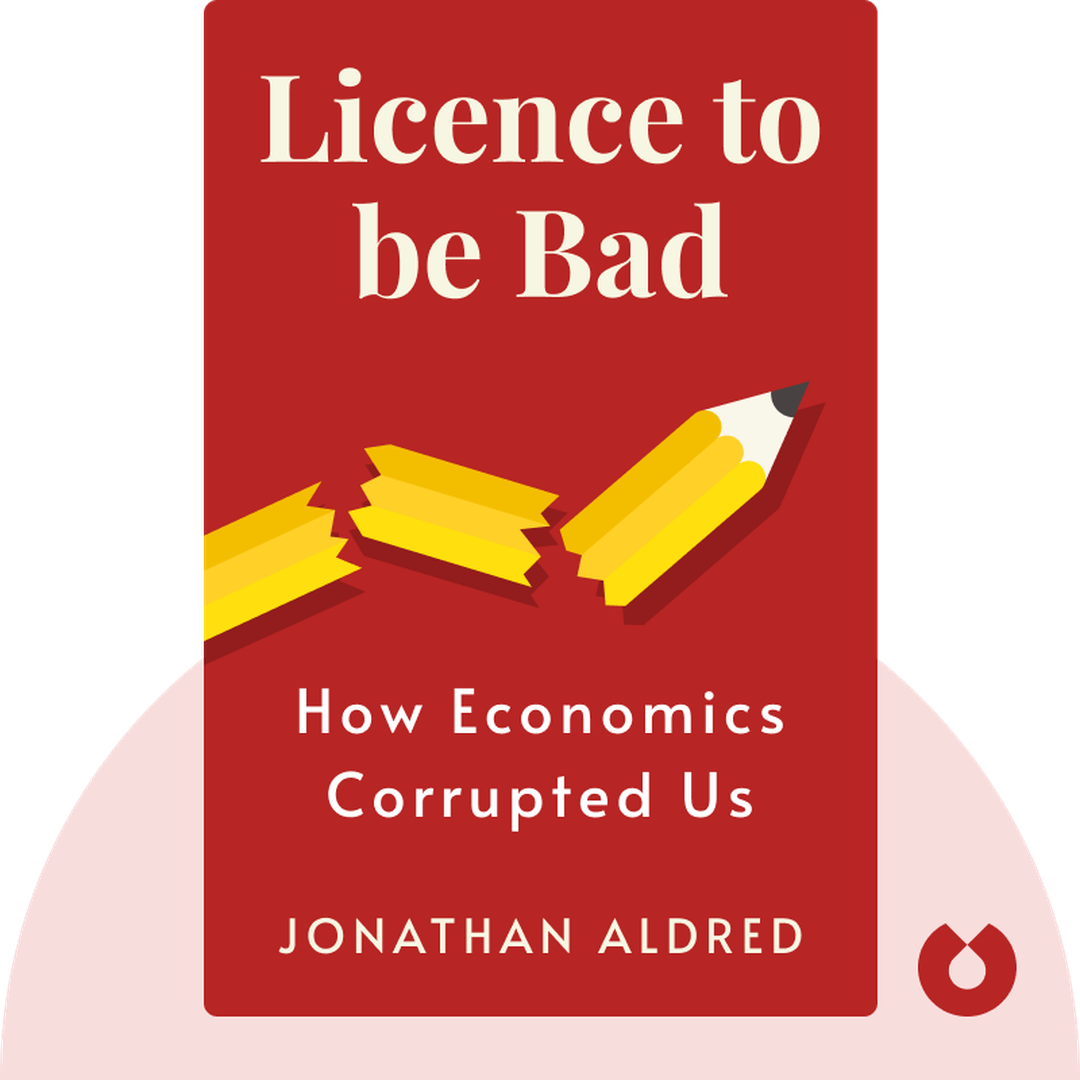
If You're Curious About These Questions...
You should listen to this audiobook
- Have you ever wondered why modern society often views being selfish as "rational" rather than just plain wrong?
- Did you know that a small group of economists over the last 50 years may have fundamentally reshaped your personal sense of right and wrong?
- Are you curious about how academic concepts like "free-riding" and "game theory" have secretly given us a psychological licence to behave badly?
Listen to Licence to be Bad — Free Audiobook
Loading player...
Key Takeaways from Licence to be Bad
- Discover why economics is not a hard, objective science, but rather a collection of fallible human opinions that masquerade as absolute truth.
- Understand how the controversial, free-market ideologies of the Chicago School rose to dominance and fundamentally shaped modern global policies.
- Learn how radical economic theories have dangerously influenced society by encouraging us to blame regulators for financial crashes and ignore climate change.
- Find out why game theory promotes a coldly selfish view of human behavior, despite real-world evidence that people actively prefer to collaborate.
- Explore how Ronald Coase's observations about transaction costs were twisted by economists to put unregulated dealmaking and economic efficiency above the law.
Learning Tools
Reinforce what you learned from Licence to be Bad
Mind Map
Licence to be Bad
The Myth of Objective Economics+
Rise of Free-Market Ideology+
The Danger of Homo Economicus+
Flawed Economic Concepts+
The Failure of Incentives+
Bad Math and Inequality+
Quiz — Test Your Understanding
Question 1 of 10
How has the discipline of economics often been misleadingly characterized in recent decades?
Question 2 of 10
What is the central philosophy of the Chicago School of economics?
Question 3 of 10
According to the book, what is a major negative consequence of relying heavily on game theory to predict human behavior?
Question 4 of 10
How did the Chicago School of economists misinterpret Ronald Coase’s theorem regarding transaction costs?
Question 5 of 10
What does James M. Buchanan's public choice theory argue about the political system?
Question 6 of 10
How does 'free-rider thinking' negatively impact global issues like climate change?
Question 7 of 10
Economist Gary Becker is noted for attempting to apply economic reasoning to everyday life. Which of the following was one of his real-world proposals?
Question 8 of 10
Why did a fine for late parents at Israeli day care centers fail to reduce tardiness, while a tax on plastic bags in the UK successfully reduced usage?
Question 9 of 10
According to the book, why were statistical models so wildly inaccurate regarding the likelihood of the 2007 financial crash?
Question 10 of 10
The book challenges the modern economic consensus that high taxes on the wealthy discourage economic activity. What alternative psychological response to a tax cut does the author suggest?
Licence to be Bad — Full Chapter Overview
- 1Recommendation
- 2A controversial set of free-market economic ideas has come to dominate how we think.
- 3Game theory promotes an unusually selfish view of the world.
- 4Ronald Coase unintentionally led economists to place dealmaking on a pedestal.
- 5Many economic theories are unjustly critical of government.
- 6Free-rider thinking can be tempting, but it may have devastating consequences.
- 7Using economic thinking in everyday life can lead us in strange directions.
- 8People don’t always react to incentives the way economists expect.
- 9Our methods for calculating probability are deeply flawed.
- 10Modern economics is unnecessarily accepting of extreme inequality.
- 11Final summary
Licence to be Bad Summary & Overview
Licence to be Bad (2019) explains how in the past 50 years a small handful of economists has drastically changed the way we think about the subject. Ideas including game theory, public choice theory, and free-riding have worked their way into our minds and our discourse, apparently permitting us to behave badly.
Who Should Listen to Licence to be Bad?
- Economists interested in rethinking the subject
- Ethics enthusiasts with an interest in recent thought
- Anyone wondering why we think the things we do
Books Similar to Licence to be Bad
Readers who enjoyed this also liked these titles.