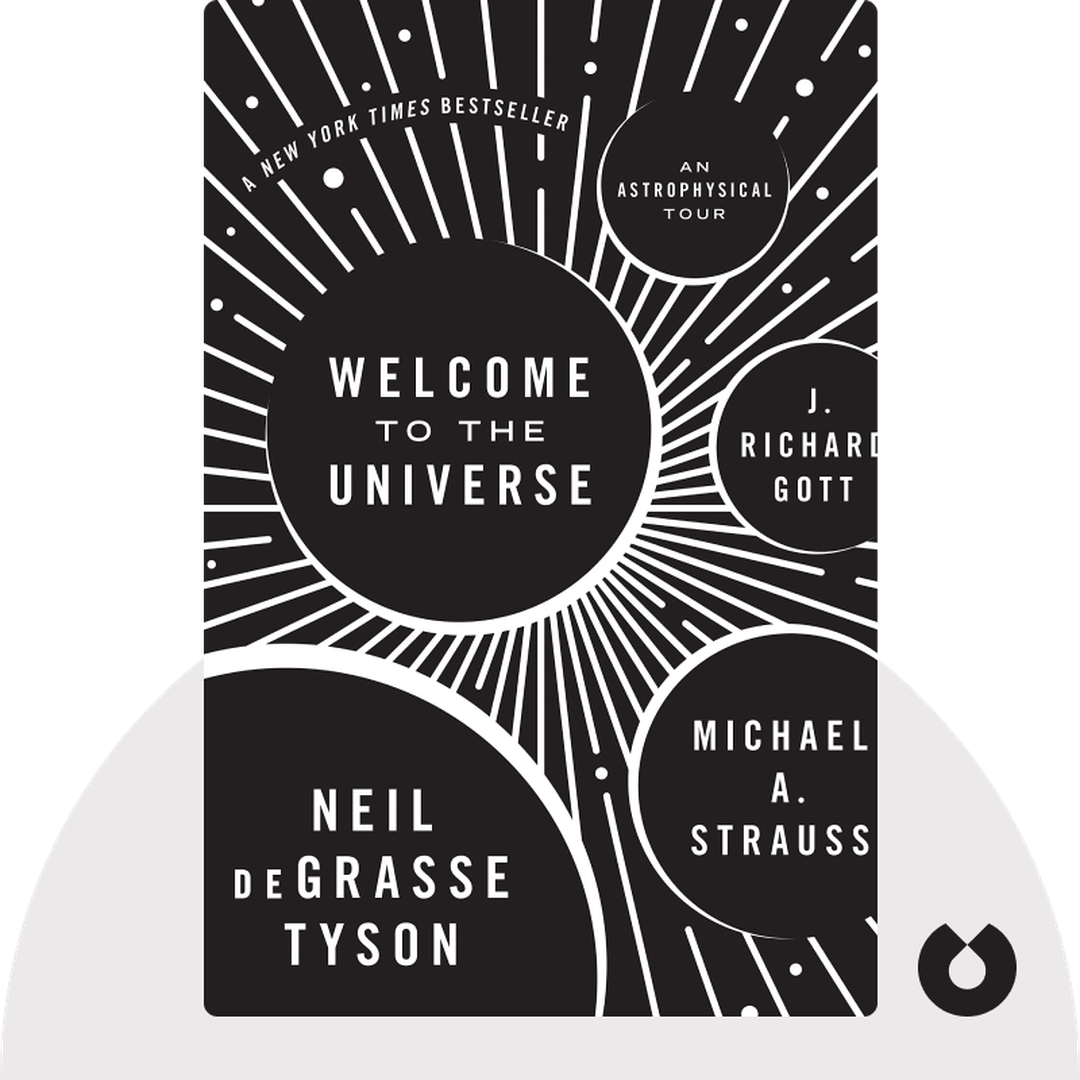
Welcome to the Universe
Start ListeningDownload Try free on iPhoneScan to start in 5 seconds
Categories:
If You're Curious About These Questions...
You should listen to this audiobook
- Have you ever wondered what would happen to your body—and to time itself—if you were to take a plunge into the heart of a black hole?
- What if the laws of physics actually allow for time travel, and what are the mind-bending requirements needed to build a machine that could take you to the past?
- Did you know that the entire observable universe was once smaller than an atom, and are you curious about what triggered the explosive growth that created everything we see today?
Listen to Welcome to the Universe — Cinematic Audio Edition
Loading player...
Key Takeaways from Welcome to the Universe
- Grasp the immense scale of the universe by understanding that all of human history fits into the width of a single hair on a cosmic timeline spanning 13.8 billion years.
- Discover why Earth's constant 23.5-degree tilt dictates everything from the constellations we see to the surprising fact that our planet is always exactly 50 percent illuminated.
- Understand the counterintuitive relationship between a star's color and its lifespan, where cooler, red stars outlive their hotter, blue counterparts by billions of years.
- Learn how the thermonuclear furnace at the center of our sun creates new elements, and why its eventual depletion will turn our star into an expanding red giant.
- Explore the distinct families of our solar system—rocky terrestrials and low-density gas giants—to finally understand exactly why Pluto doesn't fit the planetary mold.
Learning Tools
Reinforce what you learned from Welcome to the Universe
Mind Map
Welcome to the Universe
Earth & Solar System+
Stars & Stellar Evolution+
Light, Distance & Nebulas+
Galaxies & Dark Matter+
Black Holes+
Universe Shape & Expansion+
Time Travel Theories+
Extraterrestrial Life+
Quiz — Test Your Understanding
Question 1 of 9
According to the text, what is true about the amount of sunlight covering Earth at any given time?
Question 2 of 9
How does the temperature of a star relate to its overall lifespan?
Question 3 of 9
Based on the text, why is Pluto no longer considered a proper fit with the other major planets in our solar system?
Question 4 of 9
What is the practical implication of measuring stellar distances in light-years?
Question 5 of 9
What primary observation led scientists to postulate the existence of dark matter in the Milky Way?
Question 6 of 9
What happens once an object crosses a black hole's Schwarzschild radius (event horizon)?
Question 7 of 9
In the "raisin bread" analogy used to describe the expanding universe, what do the expanding dough and the raisins represent?
Question 8 of 9
According to the text, how might time travel to the past theoretically be achieved without breaking the laws of physics?
Question 9 of 9
What is the primary purpose of the Drake equation as discussed in the text?
Welcome to the Universe — Full Chapter Overview
- 1Recommendation
- 2Finding our place.
- 3The Sun.
- 4Inside our solar system.
- 5Light and cosmic distance.
- 6Nebulas, galaxies, and dark matter.
- 7Black holes.
- 8The universe’s shape.
- 9Time travel and wormholes.
- 10Life beyond our solar system.
- 11Final Summary
Welcome to the Universe Summary & Overview
Welcome to the Universe (2016) is a mind-blowing and breathtaking introduction to astrophysics, based on the popular course the three authors cotaught at Princeton University. It takes everyone – even the nonscience-minded – on a trip through the known universe, stopping to examine stars, galaxies, black holes, and more, all while presenting fascinating theories regarding time travel, the big bang, and the prospect of life in other galaxies.
Who Should Listen to Welcome to the Universe?
- Star-gazers who want to explore the far reaches of the universe
- Budding astrophysicists and astronomers
- Anyone curious about space, physics, and time
Books Similar to Welcome to the Universe
Readers who enjoyed this also liked these titles.