If You're Curious About These Questions...
You should listen to this audiobook
- Have you ever wondered how the entire history of our universe would look if it were condensed into a single calendar year?
- Did you know that you are literally made of “star stuff,” and that your very existence is linked to the life cycles of distant suns?
- Are you curious about how a single ancient library in Egypt paved the way for our modern journey into the vast cosmic ocean?
Listen to Cosmos — Free Audiobook
Loading player...
Key Takeaways from Cosmos
- Understand the staggering scale of the Cosmos, where Earth is just one of ten sextillion planets, offering a humbling perspective on our daily human struggles.
- Discover how the third-century BCE scholar Eratosthenes ingeniously proved the Earth was a sphere and calculated its circumference using nothing but the sun's shadows.
- Find out how our ancient nomadic ancestors utilized the predictable movements of the night sky to track seasons, navigate animal migrations, and survive.
- Trace humanity's evolving understanding of the solar system, from Ptolemy's Earth-centric theory to Johannes Kepler's groundbreaking discovery of elliptical orbits.
- Learn why Venus is a scorching, toxic hellscape fueled by an extreme greenhouse effect, and why Mars's Earth-like conditions make it a plausible target for future human habitation.
Learning Tools
Reinforce what you learned from Cosmos
Mind Map
Cosmos
Scale of the Universe+
History of Astronomy+
Planetary Science+
Extraterrestrial Life+
Roots of Modern Science+
Physics of Light+
Space Exploration+
Quiz — Test Your Understanding
Question 1 of 8
How did Eratosthenes, the director of the Library of Alexandria, deduce that the earth was a curved sphere rather than flat?
Question 2 of 8
Based on Tycho Brahe's data, Johannes Kepler calculated that planetary orbits are elliptical. What other major theory did Kepler propose that anticipated a later scientific breakthrough?
Question 3 of 8
According to the text, what primarily causes the extreme surface temperatures on Venus?
Question 4 of 8
If humans were to receive a message from an advanced extraterrestrial civilization, why would it most likely be transmitted via radio waves using a sequence of prime numbers?
Question 5 of 8
Why was Project Orion, a 1958 initiative to create an interstellar aircraft, ultimately abandoned?
Question 6 of 8
Despite their early scientific breakthroughs, the experimental approaches of the ancient Ionians were suppressed for centuries. What was the primary reason for this suppression?
Question 7 of 8
What fundamental rule about the universe did Albert Einstein illustrate through his 'thought experiments' (Gedankenexperimente) involving a moving car and a train?
Question 8 of 8
What was the specific purpose of the gold-plated copper phonograph attached to the Voyager 1 and 2 spacecraft?
Cosmos — Full Chapter Overview
- 1Recommendation
- 2Earth is remarkably tiny.
- 3The stars and planets have always beckoned, showing us Earth’s place in the universe.
- 4Venus is hellish and unwelcoming, but Mars might be habitable.
- 5Life may exist on other planets, but it probably won’t arrive on Earth in spacecraft.
- 6Modern science isn’t entirely modern: the ancient Ionians came first, but their work was suppressed for centuries.
- 7Light has a unique role in our universe.
- 8Voyagers 1 and 2 carry our civilization into space.
- 9Final summary
Cosmos Summary & Overview
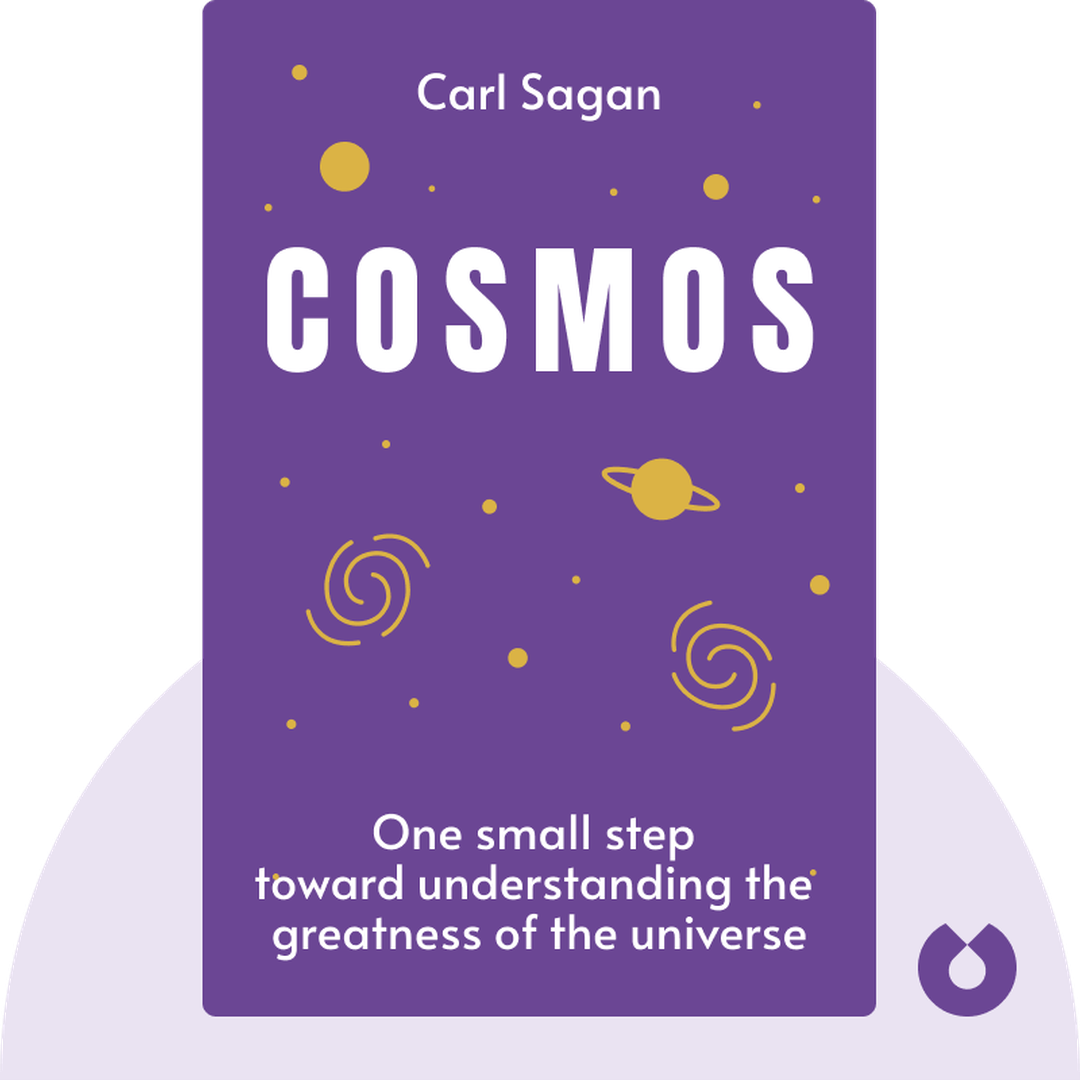
Cosmos (1980) is a milestone in popular science. It shows us the basic concepts behind our understanding of the universe, what the planets and the stars look like and how our comprehension of them has changed and evolved.
Who Should Listen to Cosmos?
- Humanities students unsure of what gets scientists going
- Lovers of science fiction
- Anyone who’s ever looked up at the sky
Books Similar to Cosmos
Readers who enjoyed this also liked these titles.