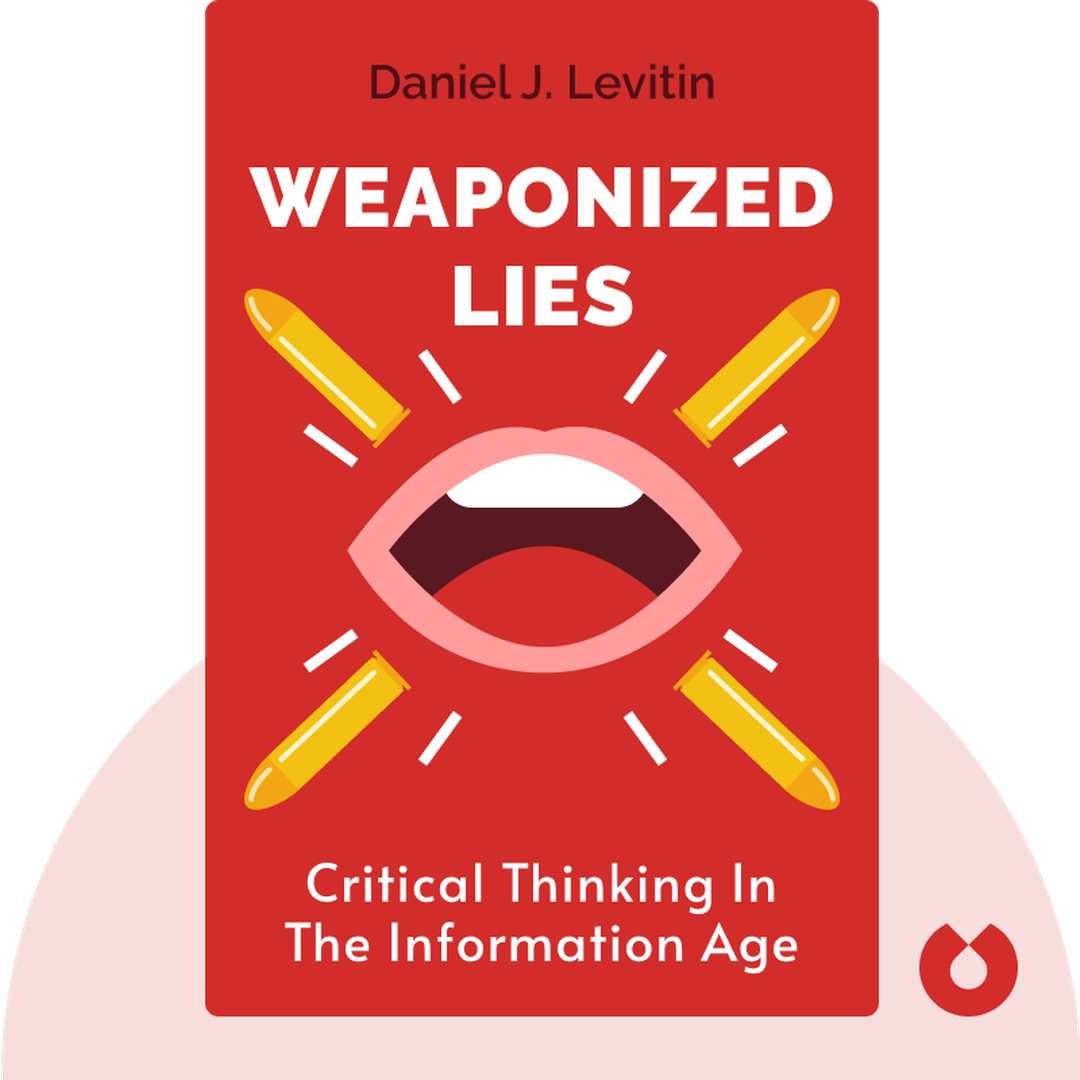
If You're Curious About These Questions...
You should listen to this audiobook
- How can politicians use the different definitions of the word 'average' to manipulate voter statistics and skew reality?
- Why does 'counterknowledge' anchor itself so deeply in our brains, and how do false experts weaponize our own biases against us?
- How can applying the Bayesian method—a concept used by scientists in medical trials—help everyday readers instantly evaluate the truthfulness of a bizarre news headline?
Listen to Weaponized Lies — Free Audiobook
Loading player...
Key Takeaways from Weaponized Lies
- Even highly respected publications can fall victim to biased source material or fake accounts, meaning no news source should be trusted blindly without verification.
- Statistics are frequently manipulated by choosing the most favorable definition of 'average'—mean, median, or mode—or by altering graph axes to exaggerate trends.
- The methodology behind data collection, such as using landline phones or relying on voluntary surveys, often introduces hidden demographic biases that fundamentally alter the findings.
- False information, or 'counterknowledge,' thrives because humans instinctively hate admitting they have been conned, a vulnerability easily exploited by individuals claiming expertise outside their actual field.
- By applying the Bayesian method to news consumption, you can evaluate the probability of a claim based on prior knowledge, demanding significantly more evidence for assertions that contradict established facts.
Learning Tools
Reinforce what you learned from Weaponized Lies
Mind Map
Weaponized Lies
The Information Age Challenge+
Misleading Statistics & Graphs+
Context & Methodology+
Counterknowledge & False Experts+
The Bayesian Method+
Quiz — Test Your Understanding
Question 1 of 7
Why do journalists from highly respected publications sometimes inadvertently report false information?
Question 2 of 7
When evaluating statistics, which type of average should you be especially cautious of because it is most easily skewed by extreme anomalies or outliers?
Question 3 of 7
How can the visual representation of a line graph be easily massaged to mislead a reader?
Question 4 of 7
What is the primary purpose of using a 'stratified sample' when conducting a survey?
Question 5 of 7
What is 'counterknowledge' as described in the text?
Question 6 of 7
Why is citing an 'expert' sometimes a misleading way to validate a claim?
Question 7 of 7
According to the Bayesian method, how should a critical consumer of news evaluate a highly counterintuitive claim?
Weaponized Lies — Full Chapter Overview
- 1Recommendation
- 2Separating truth from falsehood is no simple task.
- 3Don’t accept charts and statistics at face value.
- 4Know the context to grasp the conclusion.
- 5Counterknowledge appears in many guises, and we must stay alert enough to detect it.
- 6Apply the Bayesian method to become a discerning consumer of news.
Weaponized Lies Summary & Overview
Weaponized Lies (2016) is a user’s manual for today’s news media. It teaches you various skills that will help you to analyze the vast amount of information you encounter when skimming the internet or watching the news. Take time to learn what’s real and what’s fake, so you won’t get duped.
Who Should Listen to Weaponized Lies?
- Any consumer of news media
- Media studies and journalism students
- Conspiracy theory aficionados
Books Similar to Weaponized Lies
Readers who enjoyed this also liked these titles.