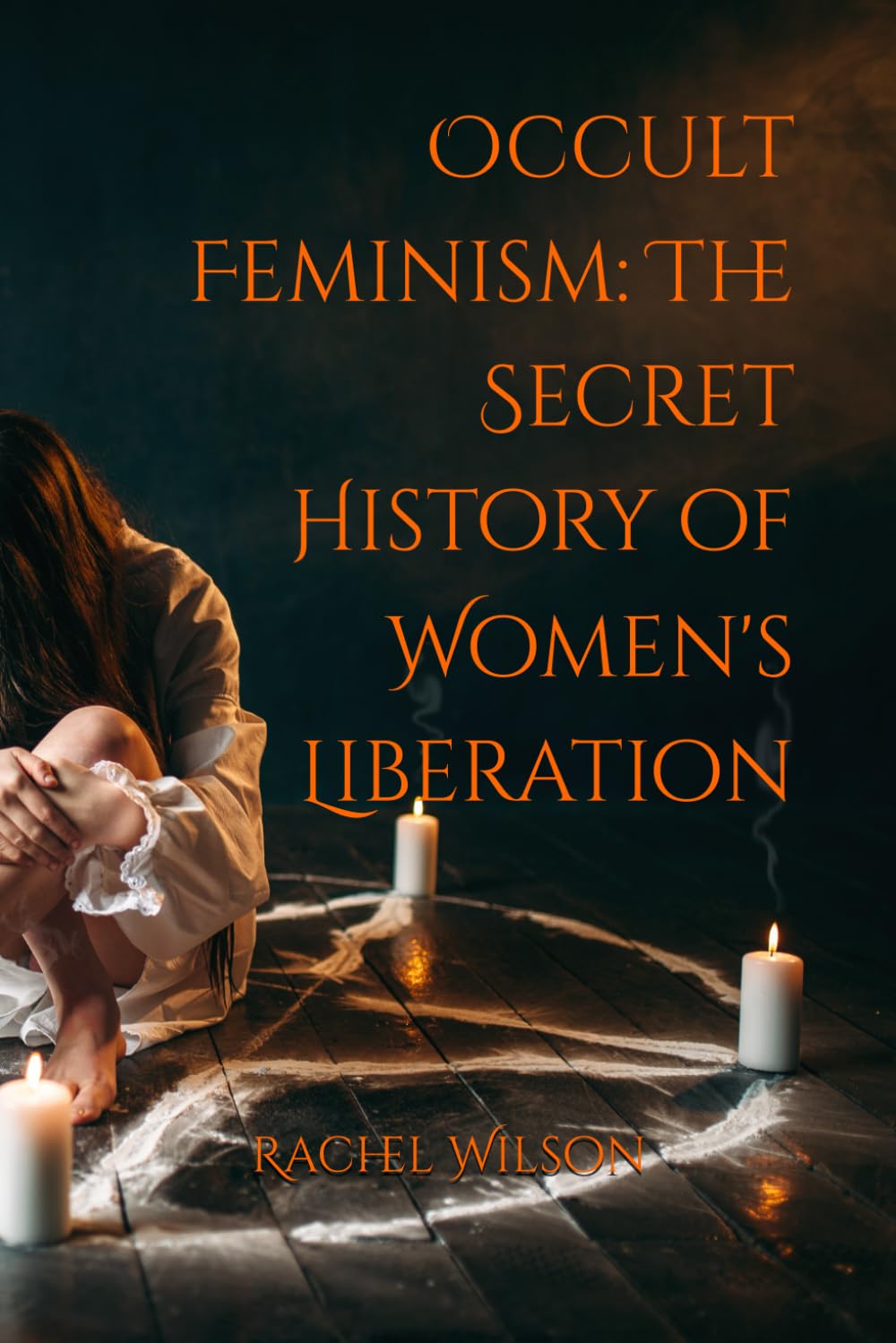
Occult Feminism: The Secret History of Women’s Liberation audiobook cover - This book argues that modern feminism didn’t rise as a purely political, grassroots movement, but as a spiritually driven revolution—shaped by occult ideas, elite funding, and propaganda—whose consequences, the author claims, have remade family life and women’s well-being.

Occult Feminism: The Secret History of Women’s Liberation

This book argues that modern feminism didn’t rise as a purely political, grassroots movement, but as a spiritually driven revolution—shaped by occult ideas, elite funding, and propaganda—whose consequences, the author claims, have remade family life and women’s well-being.

Rachel Wilson

4.0 / 5(3 ratings)
Start ListeningDownloadQR code that opens AudiobookHub on the App StoreTry free on iPhoneScan to start in 5 seconds

If You're Curious About These Questions...

You should listen to this audiobook

Listen to Occult Feminism: The Secret History of Women’s Liberation — Free Audiobook

Loading player...

Key Takeaways from Occult Feminism: The Secret History of Women’s Liberation

Learning Tools

Reinforce what you learned from Occult Feminism: The Secret History of Women’s Liberation

Mind Map

Ccult Feminism The Secret History Of Womens Liberation Rachel Wilson
Foundational Thesis & Ancient Roots+
Rewriting History & Early Experiments+
Spiritualism & The Suffrage Movement+
Theosophy & Global Institutions+
Birth Control & Second Wave Engineering+
Modern Paganism & The Ultimate Verdict+

Quiz — Test Your Understanding

Question 1 of 10
According to Rachel Wilson's central argument, how should modern feminism be primarily understood?
  • A. As a successful grassroots movement that organically arose to demand legal and economic equality.
  • B. As a spiritual and religious worldview, advanced by elite interests, that redefines the sacred.
  • C. As a purely political ideology that emerged exclusively from Enlightenment principles of liberty.
  • D. As a short-lived social trend from the 20th century that is now in decline.
Question 2 of 10
How does Wilson interpret the feminist adoption of ancient goddess figures like Kali and Lilith?
  • A. As a positive embrace of archetypes representing motherhood and marital fidelity.
  • B. As a purely academic exercise in studying ancient mythology.
  • C. As symbols of transgressive power, warfare, and anti-patriarchal rebellion that align with an anti-Christian spiritual framework.
  • D. As evidence that ancient societies were universally peaceful matriarchies.
Question 3 of 10
What is Wilson's counter-narrative regarding the European witch trials?
  • A. They were a complete fabrication by later historians and never actually happened.
  • B. They were solely a misogynistic campaign by men to suppress economically independent women.
  • C. They represented a real conflict between Christianity and existing pagan/occult practices, including sexual rites and abortion-related activities.
  • D. They were a rational and just legal process that correctly punished only evil-doers.
Question 4 of 10
What crucial connection in 19th-century America does Wilson claim is downplayed by mainstream historians but is central to her thesis?
  • A. The alliance between the temperance movement and early feminists.
  • B. The widespread financial support for feminism from agricultural communities.
  • C. The significant overlap between the leadership of the suffrage movement and the spiritualism (séance) craze.
  • D. The secret opposition to feminism by prominent male abolitionists.
Question 5 of 10
According to the book, what was the primary role of Theosophy in the feminist movement?
  • A. It was a minor spiritual group that had no real influence on feminist leaders.
  • B. It acted as a counter-force to feminism by promoting traditional family structures.
  • C. It provided an influential, organized occult system that blended religion and politics, shaping the worldview of key figures like Matilda Joslyn Gage.
  • D. It focused exclusively on Eastern meditation and was uninterested in Western political issues like suffrage.
Question 6 of 10
How does Wilson explain the political success of the women's suffrage movement, which she claims was unpopular among many women?
  • A. Through a spontaneous, nationwide uprising of women demanding the vote.
  • B. Through the persuasive and logical arguments presented in public debates.
  • C. Through the direct intervention and funding of the U.S. federal government.
  • D. Through elite sponsorship from wealthy patrons like Alva Vanderbilt Belmont who funded the necessary political infrastructure.
Question 7 of 10
How is Margaret Sanger's birth control advocacy portrayed in the book?
  • A. As a purely humanitarian campaign focused only on women's health and safety.
  • B. As an isolated movement with no connection to other intellectual currents of the time.
  • C. As a key part of a broader, elite-backed eugenics movement aimed at social planning and population control.
  • D. As a failed effort that had little long-term impact on fertility rates.
Question 8 of 10
What is one of the book's most 'explosive' claims regarding Second Wave feminism and its media face, Gloria Steinem?
  • A. That Steinem was secretly a traditionalist who opposed the sexual revolution.
  • B. That the movement was entirely funded by small, individual donations from housewives.
  • C. That Steinem and the feminist media's growth were connected to CIA-linked organizations and Cold War cultural propaganda.
  • D. That the Second Wave was less popular and influential than the First Wave.
Question 9 of 10
In Wilson's view, what is the significance of the modern revival of witchcraft and goddess worship in popular culture?
  • A. It is a harmless and meaningless aesthetic trend with no deeper implications.
  • B. It signals a successful return to traditional, pre-Christian European values.
  • C. It represents feminism openly embracing the occult spiritual identity that was always its hidden foundation.
  • D. It is primarily an academic movement with little appeal outside of universities.
Question 10 of 10
What does the author ultimately describe as the 'Faustian bargain' of feminism?
  • A. The trade-off where women gained political power but lost social graces.
  • B. The bargain of trading the stability and meaning of family for sexual 'freedom,' state dependence, and social fragmentation.
  • C. The deal to accept lower wages in exchange for more flexible work hours.
  • D. The decision to align with socialist politics, thereby losing support from capitalists.

Occult Feminism: The Secret History of Women’s Liberation — Full Chapter Overview

Occult Feminism: The Secret History of Women’s Liberation Summary & Overview

Occult Feminism: The Secret History of Women’s Liberation presents a polemical, historically sweeping critique of feminism in the United States and the West. Rachel Wilson contends that feminism is best understood not just as a political project, but as a spiritual movement rooted in pagan goddess worship, occult traditions, spiritualism, and later New Age currents—often aligned, she argues, with wealthy patrons and institutional power.

Moving from ancient mythology through medieval Europe, American religious radicalism, the séance boom, suffrage-era networks, and 20th-century birth control and sexual revolution, Wilson builds a throughline: feminism’s persistent hostility to Christianity and its recurring reliance on alternative spiritual frameworks. The book closes by arguing that the cultural trade-offs of women’s liberation—especially for marriage, fertility, and child well-being—amount to a “Faustian bargain,” and it urges a return to Christian tradition and motherhood as a vocation.

Who Should Listen to Occult Feminism: The Secret History of Women’s Liberation?

  • Listeners interested in critiques of feminism that frame culture war issues as spiritual conflicts
  • Listeners curious about the book’s proposed connections between suffrage history, spiritualism, Theosophy, and New Age movements
  • Listeners exploring conservative or Christian arguments about family structure, fertility decline, and modern gender ideology

About the Author: Rachel Wilson

Rachel Wilson describes herself as an Orthodox Christian wife and mother of five, a homeschooling advocate in the rural Midwest, and a licensed firearms instructor focused on home defense and concealed carry.

🎧
Listen in the AppOffline playback & background play
Get App