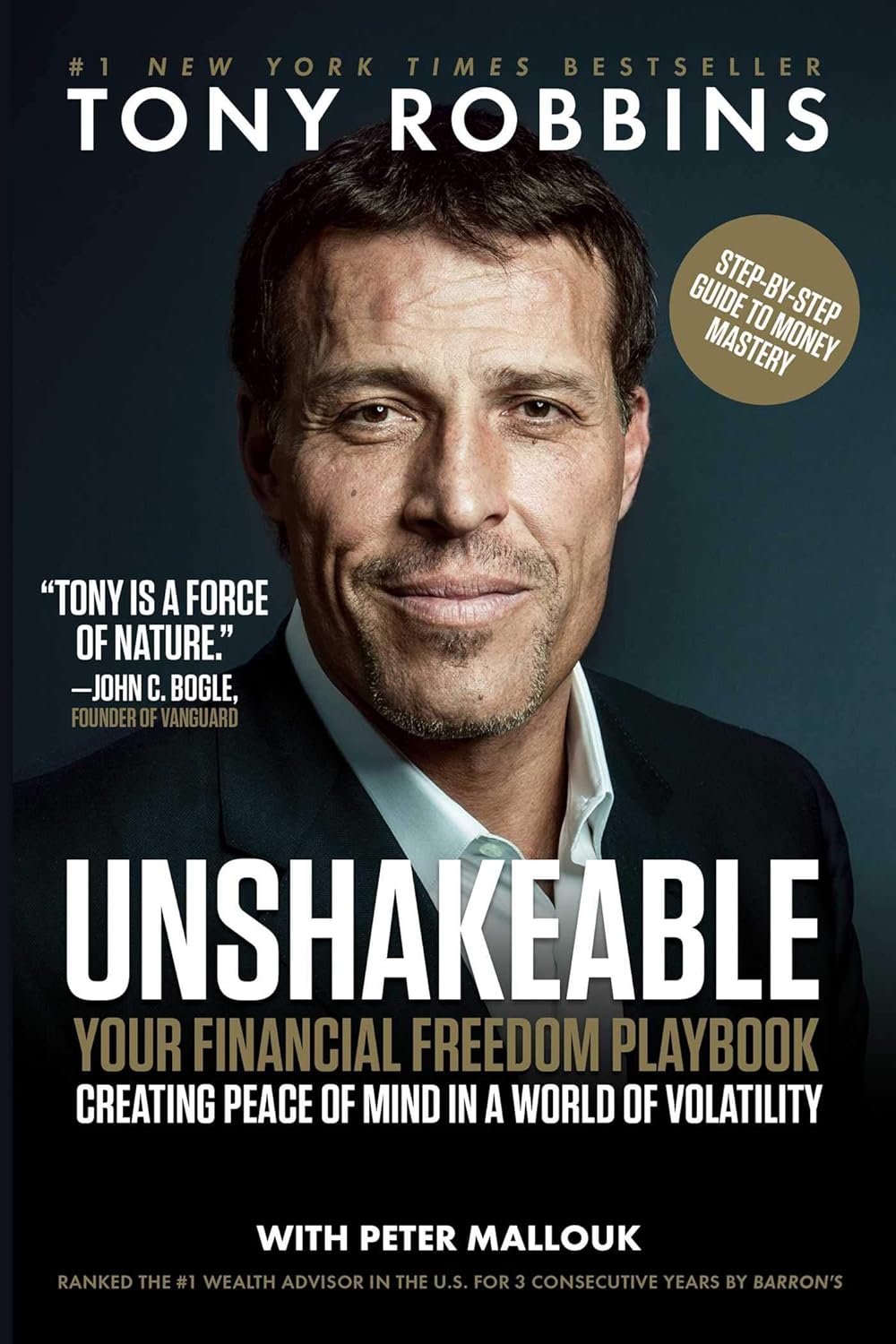
Unshakeable: Your Financial Freedom Playbook audiobook cover - Market crashes are inevitable, but panic is optional—this book turns volatility into a repeatable advantage by teaching low-fee, diversified investing, how to spot conflicted “advice,” and the simple behavioral rules that keep ordinary investors from sabotaging their future.

Unshakeable: Your Financial Freedom Playbook

Market crashes are inevitable, but panic is optional—this book turns volatility into a repeatable advantage by teaching low-fee, diversified investing, how to spot conflicted “advice,” and the simple behavioral rules that keep ordinary investors from sabotaging their future.

Tony Robbins (with Peter Mallouk)

4.7 / 5(3 ratings)
Start ListeningDownloadQR code that opens AudiobookHub on the App StoreTry free on iPhoneScan to start in 5 seconds

If You're Curious About These Questions...

You should listen to this audiobook

Listen to Unshakeable: Your Financial Freedom Playbook — Free Audiobook

Loading player...

Key Takeaways from Unshakeable: Your Financial Freedom Playbook

Learning Tools

Reinforce what you learned from Unshakeable: Your Financial Freedom Playbook

Mind Map

Unshakeable: Your Financial Freedom Playbook
The Unshakeable Mindset+
The Rule Book (Know the Game)+
The Playbook (Win the Game)+
The Psychology of Wealth (Master Yourself)+
Real Wealth & Action Plan+

Quiz — Test Your Understanding

Question 1 of 10
According to Tony Robbins, what is the definition of an "unshakeable" mindset for an investor?
  • A. The ability to predict market crashes before they happen.
  • B. A guarantee that your investment portfolio will never lose value.
  • C. The ability to remain calm and make good decisions when markets are volatile.
  • D. Achieving a level of wealth where market fluctuations no longer matter.
Question 2 of 10
What does the book identify as the single greatest danger to long-term investment returns?
  • A. Investing at the peak of a bull market.
  • B. Paying high taxes on investment gains.
  • C. Being out of the market and missing its best-performing days.
  • D. Experiencing a severe bear market (a drop of 20% or more).
Question 3 of 10
Why does the book describe investment fees as a "Silent Wealth Killer"?
  • A. Because they are illegal and must be hidden from investors.
  • B. Because even small, seemingly insignificant annual fees compound over time to consume a large portion of an investor's potential returns.
  • C. Because fees are only charged when an investor sells their assets, making the cost a surprise.
  • D. Because they only affect actively managed funds, not index funds.
Question 4 of 10
What is the primary "trap" within many 401(k) plans that the book warns against?
  • A. The risk that the employer will go bankrupt, causing the 401(k) to lose all its value.
  • B. The limited number of investment choices, which prevents proper diversification.
  • C. Layers of hidden administrative fees and expensive mutual fund options that erode savings.
  • D. Strict penalties for withdrawing money before the age of 59 ½.
Question 5 of 10
What is the crucial difference between a financial advisor who is a fiduciary (like an RIA) and one who is a broker?
  • A. Fiduciaries are paid a salary, while brokers work only on commission.
  • B. A fiduciary is legally required to act in the client's best interest, while a broker only has to recommend 'suitable' products.
  • C. Brokers are regulated by the government, while fiduciaries are self-regulated.
  • D. Fiduciaries specialize in retirement planning, while brokers handle stock trading.
Question 6 of 10
Which of the following is NOT one of the "Core Four" investment principles discussed in the book?
  • A. Maximize Short-Term Gains
  • B. Asymmetric Risk/Reward
  • C. Tax Efficiency
  • D. Diversification
Question 7 of 10
According to the book, what is the most important factor that determines the majority of a portfolio's investment outcomes?
  • A. Picking the right individual stocks.
  • B. Timing the market to buy low and sell high.
  • C. The asset allocation between different classes like stocks, bonds, and alternatives.
  • D. Finding a hedge fund with the best track record.
Question 8 of 10
The book describes "recency bias" as a common behavioral mistake. What is a typical action driven by this bias?
  • A. Investing heavily in your own country's stock market.
  • B. Seeking out news that supports your current investment thesis.
  • C. Believing you are better than the average investor at picking stocks.
  • D. Selling assets that have recently fallen in price and buying assets that have recently risen.
Question 9 of 10
How does the book recommend investors "slay the bear" (i.e., successfully navigate a bear market)?
  • A. By selling all assets and moving to cash until the market recovers.
  • B. By having a pre-determined asset allocation and rebalancing, allowing one to buy more when prices are low.
  • C. By using complex financial instruments to bet against the market.
  • D. By following the predictions of market gurus on financial news channels.
Question 10 of 10
In the final section, what does the book suggest is a crucial step for protecting your finances beyond investing?
  • A. Setting up a margin account to leverage your returns.
  • B. Creating a watchlist of speculative penny stocks.
  • C. Establishing legal documents like a will, powers of attorney, and a living trust.
  • D. Subscribing to an expensive stock-picking newsletter.

Unshakeable: Your Financial Freedom Playbook — Full Chapter Overview

Unshakeable: Your Financial Freedom Playbook Summary & Overview

Unshakeable is a practical guide for building financial security in a world where corrections, bear markets, and economic headlines can trigger costly fear. Tony Robbins—working with fiduciary advisor Peter Mallouk—argues that most investors lose not because markets are unbeatable, but because fees, conflicted incentives, and emotional mistakes quietly erode returns.

The book is organized as a rule book, a playbook, and a psychology manual. It explains why market drops are normal, why trying to time markets usually fails, how high fees can confiscate a large share of lifetime returns, how retirement plans often hide extra layers of costs, and how to identify trustworthy fiduciary guidance. It then lays out the “Core Four” decision principles—avoid losses, seek asymmetric risk/reward, prioritize tax efficiency, and diversify—followed by an asset-allocation approach designed to survive and capitalize on bear markets. Finally, it addresses behavioral biases that cause investors to buy high, sell low, and abandon long-term plans.

Who Should Listen to Unshakeable: Your Financial Freedom Playbook?

  • New and intermediate investors who want a simple, rules-based approach to long-term investing without trying to predict markets.
  • 401(k)/403(b) participants who suspect they’re paying hidden fees and want a checklist to evaluate plan costs and options.
  • Anyone who wants help choosing an advisor—especially learning the difference between brokers, fiduciaries, and “dually registered” advisors.

About the Author: Tony Robbins (with Peter Mallouk)

Tony Robbins is a bestselling author, entrepreneur, and philanthropist known for coaching in performance, business, and life strategy. Peter Mallouk is a Registered Investment Advisor and wealth manager who emphasizes fiduciary, comprehensive planning. The book also references insights drawn from interviews with prominent investors and financial leaders.

🎧
Listen in the AppOffline playback & background play
Get App