If You're Curious About These Questions...
You should listen to this audiobook
- Have you ever wondered how a tiny, blind insect manages to build complex, self-cooling "skyscrapers" that rival human engineering?
- What if the secret to a sustainable energy future is hidden inside the gut of one of the world’s most hated pests?
- What’s the secret behind the 250-million-year-old partnership between termites and a mysterious fungus that allows them to thrive against all odds?
Listen to Underbug — Cinematic Audio Edition
Loading player...
Key Takeaways from Underbug
- Learn how termites evolved from solitary cockroaches into highly social insects by sharing the essential gut microbes necessary for digesting wood.
- Understand the enormous global footprint of termites, a species that collectively outweighs humans ten to one and causes $40 billion in property damage annually.
- Discover why scientists historically projected human political structures onto social insects, using termite colonies to justify everything from monarchies to slavery.
- Explore the evolutionary conundrum of termite eusociality, where a single queen breeds while chemically suppressing the sexual maturity of her worker and soldier castes.
- Find out how studying the complex behavior of these resilient insects could unlock future human innovations, including sustainable biofuels, advanced robotics, and self-building architecture.
Learning Tools
Reinforce what you learned from Underbug
Mind Map
Underbug
Evolution & Biology+
Historical Perceptions+
The Evolutionary Conundrum+
Mounds as Living Organisms+
Symbiotic Agriculture+
Biofuel Potential+
Swarm Intelligence & Robotics+
Quiz — Test Your Understanding
Question 1 of 8
What evolutionary adaptation forced early solitary termite ancestors to become highly social creatures?
Question 2 of 8
Historically, how did early scientists and observers primarily interpret the behavior and structure of termite and ant colonies?
Question 3 of 8
How does William D. Hamilton's theory of 'inclusive fitness' explain the evolutionary success of non-breeding termite workers?
Question 4 of 8
What did physiologist J. Scott Turner discover about the function of termite mounds after pumping propane gas into them?
Question 5 of 8
How do African Macrotermes termites manage to digest complex plant materials like cellulose and lignin?
Question 6 of 8
Why have scientists struggled to commercially produce 'grassoline' (biofuel) using termite gut microbes, despite identifying the necessary genes?
Question 7 of 8
What principle, known as 'stigmergy,' allows termites to build complex structures without a central command or blueprints?
Question 8 of 8
How is the Wyss Institute's TERMES robot project directly inspired by termite behavior?
Underbug — Full Chapter Overview
- 1Recommendation
- 2Termites consume something humans prize very highly indeed – wood.
- 3Like other social insects, termites have long been viewed as mirrors of human society.
- 4The social lives of termites present an evolutionary conundrum.
- 5Termite mounds act like living bodies.
- 6African termites have evolved a sort of communal stomach.
- 7Termite guts might help us create biofuels.
- 8Individual termites are simple, yet together they’re clever – and that’s how future robots may well look, too.
Underbug Summary & Overview
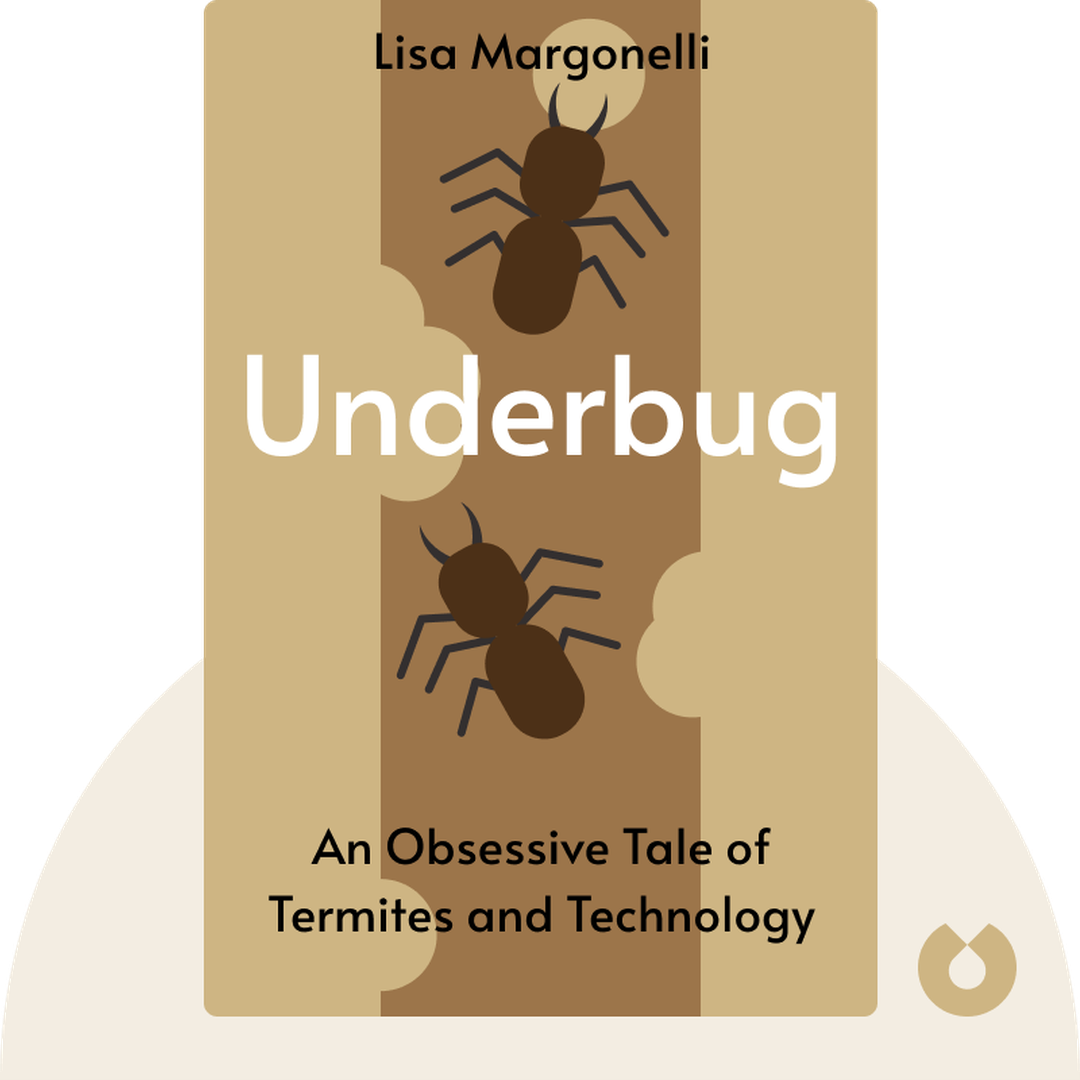
Underbug (2018) explores the fascinating world of a bug so unloved it might just beat cockroaches in an unpopularity contest – the termite. The result of years of research and interviews with biologists, entomologists, and geneticists, Lisa Margonelli’s study sets out to rescue the reputation of this underappreciated creature. Along the way she explores termites’ remarkable architectural powers, unpacks their strange relationship with a 250 million-year-old fungus, and shows how the microbes in their guts might just help us create a more sustainable future.
Who Should Listen to Underbug?
- Scientists
- Nature-lovers
- Amateur entomologists
Books Similar to Underbug
Readers who enjoyed this also liked these titles.